

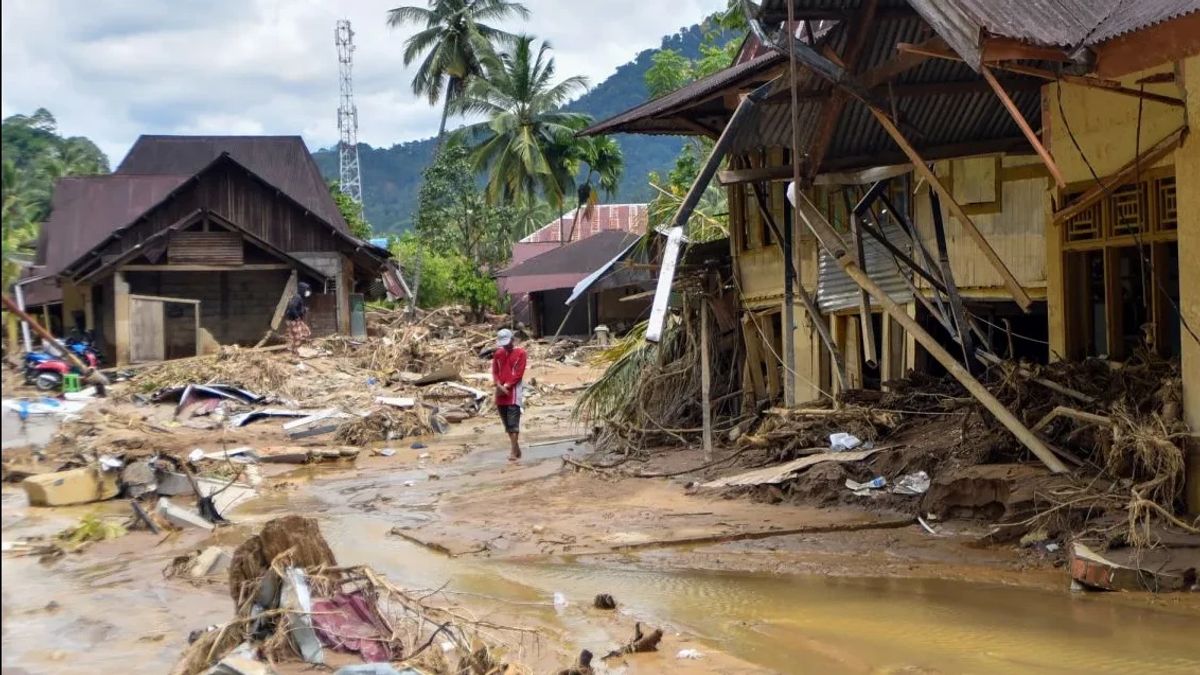


JAKARTA - The Head of the National Research and Innovation Agency (BRIN) Arif Satria said that his party had sent drinking water treatment equipment (arsenic) from mud water for victims affected by floods and landslides in Sumatra.
Arsinum car is the result of BRIN innovation developed to process water with poor quality into drinkable water according to the Ministry of Health's standards.
This technology is able to utilize various water sources, ranging from groundwater, PAM water, rainwater, seawater, to muddy and muddy water due to flooding.
Arif said that the arsenic that had been distributed was able to produce a large amount of drinking water every day to meet the needs of affected residents.
"We have sent arsenic, ready-to-drink water that can process flood water, mud water to become ready-to-drink water for 10 thousand liters per day," said Arif Satria after a ministerial-level meeting at the Ministry of Agriculture, Food and Forestry Office, Central Jakarta, Wednesday, December 17.
In the initial phase of distribution, BRIN sent three Arsinum cars to Sumatra. Two units were stationed in Aceh Tamiang, while the other unit was sent to the Central Tapanuli region.
In addition to the units that are already operating, BRIN is also preparing to develop the production capacity of clean water with a larger volume for the next phase. Arif targets that the device is able to process water into drinking water up to 100 thousand liters per day.
"Now we are preparing again for 20 thousand liters, then ready to process clean water up to 100 thousand liters. Hopefully this will be very useful for flood recovery," he said.
Then, BRIN also received a mandate from President Prabowo Subianto to provide satellite image data to support the process of handling disasters and decision-making in the field.
Currently, the analysis of the data is still being carried out through the BRIN control room, with a focus that has begun to be directed to the post-disaster reconstruction phase.
"Currently we are also continuing to analyze because we have a control room. Our next focus is how the basic data that we have that we analyze is needed for reconstruction," said Arif.
To support the process, BRIN has prepared the delivery of various monitoring devices, including drones with a wide range and underground detection technology.
"Now we will focus on reconstruction including sending drones, tools that can reach 100 km. Then also a ground penetration radar drone that can detect objects 100 meters below the ground that can detect the meaning of the victim's body and so on," explained Arif.
The English, Chinese, Japanese, Arabic, and French versions are automatically generated by the AI. So there may still be inaccuracies in translating, please always see Indonesian as our main language. (system supported by DigitalSiber.id)
Most Popular Tags
#Prabowo Subianto #donald trump #firearm #8791 #giias 2026Popular


