
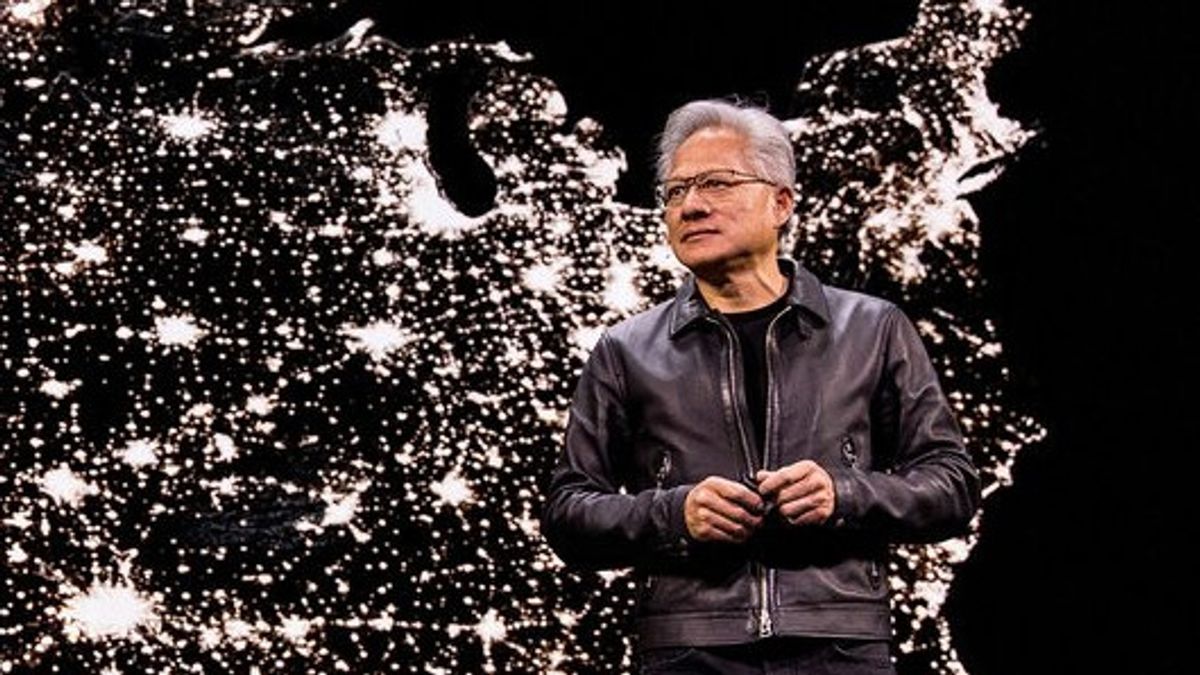


JAKARTA Nvidia officially announced the construction of seven artificial intelligence (AI) supercomputers for the United States Department of Energy (DOE), a major step that will strengthen US alternative nuclear research and energy. But behind this billion-dollar giant project, Nvidia CEO Jensen Huang also voiced his desire for the company to resume operations in China.
In a speech at the first Nvidia developer conference to be held in Washington, Huang balanced praise for President Donald Trump with statements alluding to China's policy. He praised Trump's America First agenda, which is considered to encourage large investments in manufacturing and AI research in the US, as well as regretting the attitude of the Chinese government to close market access for Nvidia.
"We want America to win the AI race, that's for sure," Huang said. But we also have to be present in China. The policy that makes America lose half the world's AI developers is actually detrimental to us.
SEE ALSO:
-
 | TEKNOLOGI
Studi HP: Lebih 90 Persen Pekerja di Indonesia Sudah Menggunakan AI
29 Oktober 2025, 14:05 -
 | TEKNOLOGI
BRIN Kembangkan Bilah Drone Khusus untuk Permudah Penyemprotan Bawang Merah
29 Oktober 2025, 13:35 -
 | TEKNOLOGI
AWS Akan Investasikan Rp83,1 Triliun di Korea Selatan untuk Bangun Pusat Data AI Baru
29 Oktober 2025, 13:05

Nvidia is now at the heart of the global race in AI development. The company is in the midst of a US 'China trade war' tug, which determines who will dominate the world's technology ecosystem. Huang's visit to Washington coincided with President Trump's Asia tour, which is scheduled to meet Chinese President Xi Jinping to discuss technological issues, including the use of Nvidia chips in China.
Huang confirmed that his company has not applied for a new generation of chip export permits to China due to a ban from Beijing. They have clearly stated that they don't want Nvidia to be there right now. I hope that situation can change," he said.
Nvidia's seven supercomputer projects for DOE will have two main functions: maintaining and developing US nuclear arsenal and accelerating alternative energy research such as nuclear fusion. One of the largest supercomputers, called Solstice, will be built with Oracle and containing about 100,000 Nvidia Blackwell chips.
OVER Group analyst Blake Anderson estimates the value of the chip for just one supercomputer could reach $3 to 4 billion, although actual prices are likely lower due to discounts for federal subscribers.
In addition to the DOE project, Huang also announced a number of major collaborations. Nvidia signed a partnership with Nokia to develop AI network technology, including an increase in power efficiency at base 6G stations. Nvidia also bought 2.9% of Nokia's $1 billion shares.
In the automotive sector, Nvidia launched a new autonomous car platform called Hyperion which will be used in robotics projects with Uber and Stellantis. Meanwhile, partnerships with Palantir Technologies will strengthen AI-based logistics systems for various industries.
These measures show Nvidia's ability to expand beyond the data center market, said Gil Luria, analyst at DA Davidson. Although its value is still small compared to Microsoft's massive spending, Amazon, Google, and Meta, this project could open up new markets for Nvidia.
In a separate interview, Huang confirmed that most of Nvidia chips are now being produced at TSMC facilities in Arizona, while servers and network devices are assembled in Texas and California. We are completely reproducing in America. President Trump himself was the first to encourage me to bring manufacturing home," he said.
Along with this announcement, Nvidia's shares closed up 5% at the 201.03 US dollar level on Tuesday (28/10). Huang added that TSMC will soon bring its most advanced chip packaging technology to the United States in the coming months to strengthen US ambitions to return to being the center of world semiconductor innovation.
Huang also emphasized one thing: in order for America to remain superior in AI, companies like Nvidia must be able to compete on the global stage, including in the world's second-largest market in China
The English, Chinese, Japanese, Arabic, and French versions are automatically generated by the AI. So there may still be inaccuracies in translating, please always see Indonesian as our main language. (system supported by DigitalSiber.id)


