


JAKARTA - Legal practitioner and musician, Deolipa Yumara, highlighted the issue of music royalties which are now polemics. The National Collective Management Institute (LMKN) is asked to be audited immediately for transparency.
According to him, LMKN, non-structural institutions under the Ministry of Law (Kemenkum) are considered an extension of the state's hand in managing royalties.
They are non-structural, but given institutional rights to collective, collective to royalties, music. Songs and music are given the right to collect. They are representatives of the state. Because it is regulated by law," Deolipa told reporters, Tuesday, August 19.
The royalty management system in its implementation has caused many problems. Deolipa assessed that many musicians and songwriters complained about receiving royalties in small amounts, even though withdrawals from various entertainment sectors were quite large.
Finally, there were shouts from songwriters who said they only received payments as small songwriters, only Rp. 700 thousand for a year, yes, some Rp. 200 thousand. Well, while this LMKN receives or collects from almost all entertainment businesses," he said.
"Bioscopes are billed, then malls are billed, hotels are billed, travel institutions that make music are billed, all are billed, even cafes are billed," continued Deolipa.
Deolipa gave an example of the Mie Gacoan case with LMKN whose bill was in one year of Rp2.4 billion. Later, it was questioned about the transparency of the management of the funds.
"The question is, where is the money? The public has the right to know. That's why I asked for this to be audited. Just like Ari Lasso also asked LMKN to be audited," he said.
Deolipa explained that the weak regulations, supervision, and practices in the field made the problem increasingly complicated regarding the distribution of music royalties in the country.
"The regulation has also become weak, then the supervision also seems to be collusion, then the practice is also weak, the billing is also weak. Only certain targets seem to be, right," said Deolipa.
"Or if we think that all the collection targets are going well, of course there will be big money which then becomes dark. Why? Because the royalty payment is for small songwriters, that's it. So that was it, that's why we considered it all weak," he said.
SEE ALSO:
-
 | BERITA
Trump: Putin Mungkin Tidak akan Capai Kesepakatan Damai dengan Ukraina
19 Agustus 2025, 21:07 -
 | BERITA
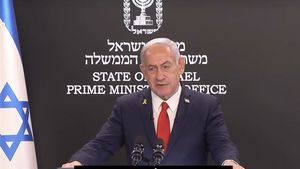
PM Netanyahu Hardik PM Australia: Politikus Lemah yang Mengkhianati Israel
19 Agustus 2025, 18:29


In addition, Deolipa analogizes LMKN as a ' Billing carpentry' that threatens the crime if business actors do not pay.
"So they are LMKN such as collectibles, collectors. If they don't pay, we will imprison them, right, that's it. Exceeds tax people," he said.
On the other hand, Deolipa also regrets the position of LMKN with non-structural status. According to him, this makes royalty management even more vague.
"This is because it is made non-structural and makes gray. So it's not firm, right? Because the gray was because it's non-structural. If it's structural, it's clear. If it's non-structural, it's gray. You can go here, here, to sono, right? So you can fly everywhere. Just leave it, right? "Deolipa said.
"So in the future this must be emphasized. Is LMKN a neat state institution, which is easily structured under state supervision, or is it left gray. Until now, his position is still gray," he said.
Therefore, as a long-term solution, Deolipa also encourages the government and the DPR to make new laws that are more detailed about royalty governance.
"So, this needs a new law. The concrete. Because the old law turns out, the current law, which is positive, can't cover anything that is in the interest of the parties, yes, in the world of song creation and in the world of royalties," said Deolipa.
The English, Chinese, Japanese, Arabic, and French versions are automatically generated by the AI. So there may still be inaccuracies in translating, please always see Indonesian as our main language. (system supported by DigitalSiber.id)
Most Popular Tags
#Prabowo Subianto #donald trump #2026 World Cup #Febrie Adriansyah #8791Popular


