

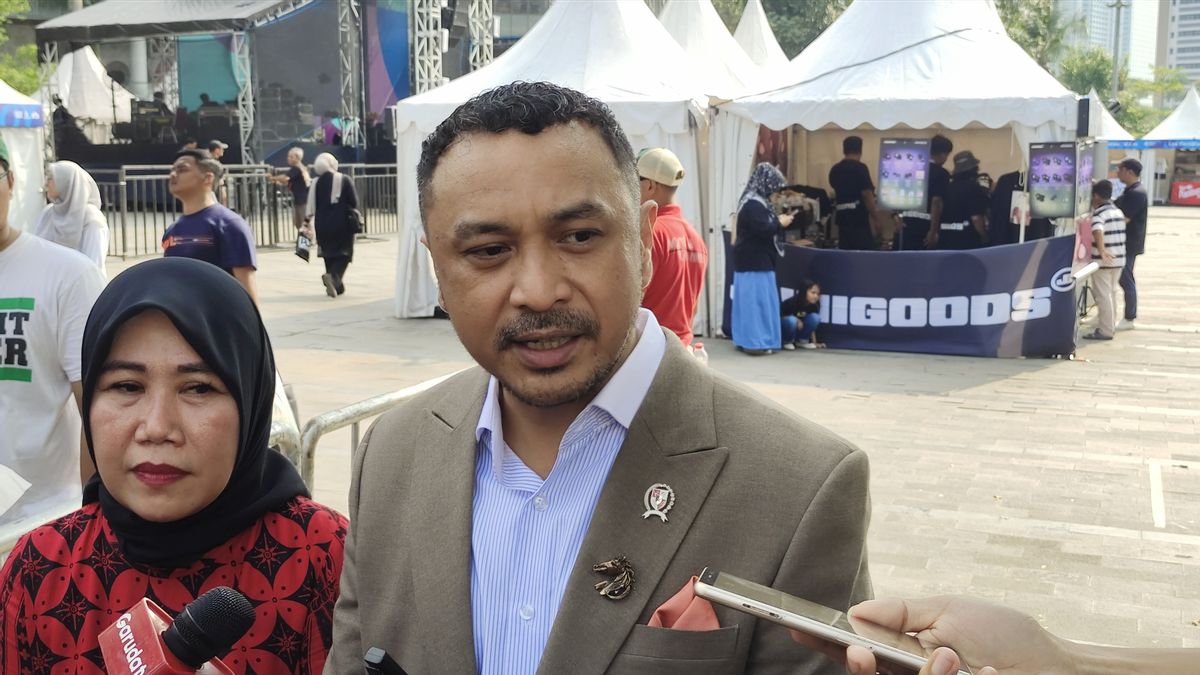


JAKARTA - The 2025 Indonesian Music Conference (KMI) which was held in Jakarta since Wednesday, October 8, officially ended. At the KMI 2025 Closing event, Deputy Minister of Culture (Wamenbud) Giring Ganesha conveyed the points resulting from various sessions that had been passed.
Giring said that thousands of KMI 2025 participants consisting of representatives of associations, institutions, musicians, and regulators agreed to form a team that works specifically in advancing the Indonesian music ecosystem.
"Based on the results of the proposal of all participants ... declaring the follow-up, among others: the formation of a joint working team consisting of the Ministry of Culture together with representatives of actors in the music ecosystem, musicians, industry players, academics, media, and regulators, under the name of the Joint Working Team for the Advancement of the Music Ecosystem in Indonesia," said Giring when closing KMI 2025 in Senayan, Central Jakarta, Saturday, October 11.
Later this work team will make an analysis and strategy to follow up on the many proposals produced from various sessions at KMI 2025.
SEE ALSO:
-
 | MUSIK
Keluhkan Biaya Perizinan Konser di Indonesia, Promotor: Bahkan Damkar Harus Dibayar
11 Oktober 2025, 07:35 -
 | MUSIK
Reuni One Direction Tanpa Liam Payne, Louis Tomlinson: Saya Tidak Yakin Itu Dibenarkan
10 Oktober 2025, 21:35



Proposal From The 2025 Indonesian Music Conference
Meanwhile, a series of discussion sessions at KMI 2025 presented various resource persons, ranging from industry players, academics, researchers, communities, to the government as regulators.
"The 2025 Indonesian Music Conference emphasizes the urgency of cross-stakeholder collaboration, musicians, the government, players in the music industry, digital platforms, academics, and the media in building a strong national music ecosystem," said Giring.
The weakening appreciation of local music began with elementary and secondary education, starting from the dominance of matter and western methods. For this reason, it is necessary to revise the music arts education curriculum that is in accordance with today's context at the elementary, medium and high levels," he continued.
The Deputy Minister of Culture also mentioned that there are proposals regarding infrastructure development in the form of an IT-based music database, as well as making religious music a strategic segment in the national music industry.
Furthermore, in the context of reforming the governance of music royalties, the government and regulators are asked to involve actors in the music ecosystem as a whole.
"The need for SKB to regulate regulations and licensing schemes related to the implementation of definite, clear, concise, and supported socialization and overall education by the government," said Giring.
"National policies are needed to strengthen recognition of rights, protection of labor, and provide social security for music industry players, including the implementation of tax incentives in the form of simplification of royalty tax, exemption of VAT and relief of VAT 21 for art workers earning less than 10 million," he added.
In addition, KMI 2025 proposed the construction of a performance venue that is representative of international standards in several cities. The government is also asked to facilitate event industry research.
Then, the music sector is expected to strengthen synergies with the tourism sector through developing musical identities in every regional tourist destination by involving local musicians in the creation of hot music and typical musical works that represent regional character.
Exchange of show artists with other countries is also expected to be carried out and facilitated. Both from Indonesia abroad and vice versa, by integrating aspects of cultural diplomacy to strengthen Indonesia's soft power," said Giring.
The presence of artificial intelligence (AI) also did not go unnoticed. KMI 2025 encourages the preparation of national guidelines and policies that regulate the use of artificial intelligence technology in the production and distribution of music, which includes aspects of copyright, royalties, and ethics.
Working Team
Another proposal was also submitted by Giring when closing KMI 2025. He said the success of this conference could be seen from the follow-up to be carried out.
"In fact, we are successful if later all the results from KMI can really become regulations or policies that can encourage the progress of Indonesian music," he said.
Although homework for the national music ecosystem is not easy, Giring ensures that the work team that has been declared will immediately try their best to realize these proposals.
Giring emphasized that KMI 2025 was only the beginning of a long struggle to create a better Indonesian music ecosystem. This conference is expected to be an annual agenda to find answers to the latest problems.
This is a long struggle. Because later 2026, KMI will discuss new problems. One of the new problems is artificial streamers. So, there are people who use AI to compose songs. Have made the lyrics using a prompt, make the song use a prompt, after that, it will be published immediately," said Deputy Minister of Culture Giring.
"This means that the Ministry of Culture together with fellow songwriters and fellow musicians must coordinate with the Ministry of Communication and Information and also the Police," he concluded.
The English, Chinese, Japanese, Arabic, and French versions are automatically generated by the AI. So there may still be inaccuracies in translating, please always see Indonesian as our main language. (system supported by DigitalSiber.id)
Most Popular Tags
#Prabowo Subianto #donald trump #Febrie Adriansyah #8791 #giias 2026Popular


