

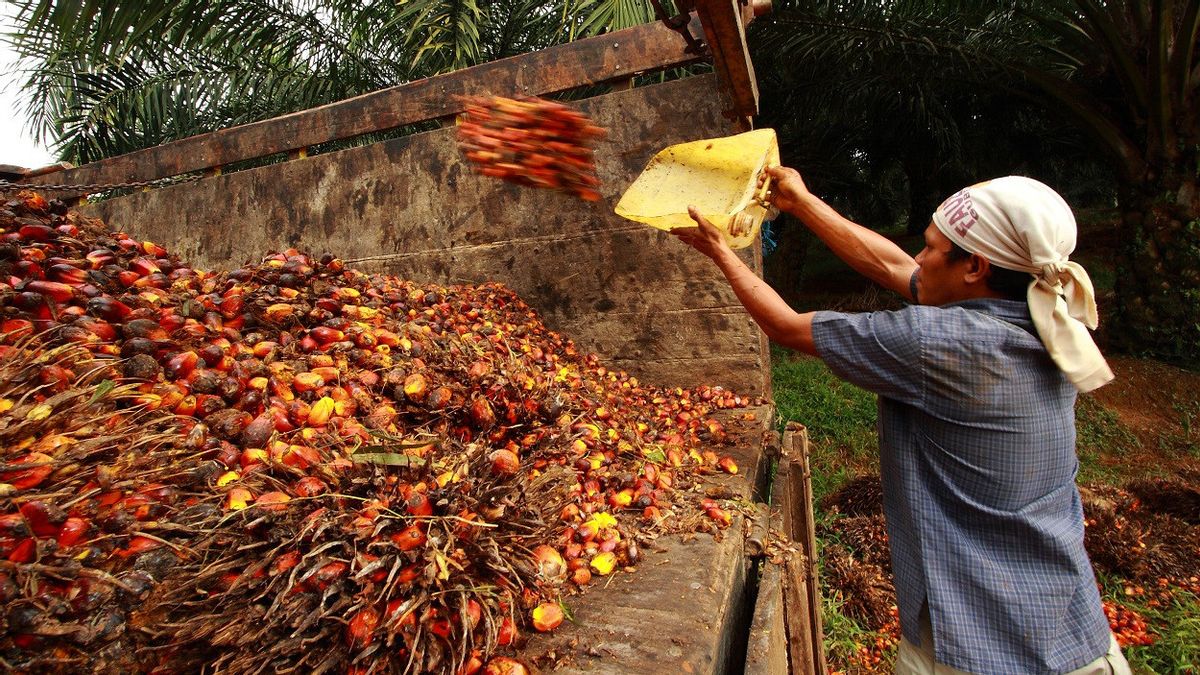


JAKARTA - The Palm Oil Farmers Association (SPKS) hopes that the Government will immediately evaluate the one-door palm oil export plan, by listening to and considering the complaints of millions of palm oil farmers in Indonesia.
The Government's plan to require palm oil exports through one door through Danantara Sumberdaya Indonesia (DSI) has begun to trigger panic among palm oil farmers.
In a written statement, Monday (25/5), the Palm Oil Farmers Association (SPKS) said that in recent days the price of fresh fruit bunches (FFB) of palm oil in a number of production centers has dropped sharply to touch the level of Rp. 1,500 per kilogram.
Palm oil farmers from various regions reported a sharp price drop in just the last two days. Yakobus Hariyanto, a palm oil farmer from Sintang, West Kalimantan, said the TBS price fell by around Rp1,000 to Rp1,500 per kilogram.
Meanwhile, Supriyadi, a farmer from Mamuju, West Sulawesi, said the price of TBS, which was previously in the range of Rp2,800 per kilogram, has now dropped to around Rp1,000 per kilogram.
A similar complaint was also made by Parlindungan Sitorus, an oil palm farmer from Labuhanbatu, North Sumatra, who said the price of TBS in his area had dropped to Rp1,500 per kilogram.
In addition to the price reduction, farmers also admitted that they were worried because a number of factories had started to reduce or even stop buying TBS. This condition makes farmers more anxious because palm oil is a commodity that must be sold immediately and cannot be stored for too long.
"Farmers are now panicking because the price of TBS has dropped very quickly in just a few days to Rp1,500 per kilogram. Many companies are also starting to wait and see, even stopping purchases temporarily. With the very large production of people's palm oil, farmers' losses can reach billions of rupiah every day," said Yakobus.
Meanwhile, the Chairman of the SPKS, Sabarudin, assessed that the rapid decline in prices was a negative market response to the export management plan for a single door, which was feared to give rise to a monopoly or single buyer.
"The situation worsened after a number of companies started to hold back purchases and temporarily stop sales," said Sabarudin.
SPKS asked the government to immediately intervene to respond to the price decline and stabilize the market.
"We have recorded losses for palm oil farmers of tens of billions of rupiah per day," said Sabarudin.
According to SPKS, the one-door export policy has the potential to impoverish palm oil farmers because it opens the space for the occurrence of monopsony which can suppress the price of TBS at the farmer level. The impact is assessed not only to erode farmers' income, but also threatens the sustainability of people's garden productivity.
SPKS said many farmers are now considering reducing or even stopping fertilization because they are worried that palm oil prices will continue to fall and production costs will no longer be covered.
In fact, around 40 percent of the national palm oil supply comes from people's gardens, which are highly dependent on price stability.
If this condition lasts for a long time, the productivity of people's palm oil is estimated to decrease and have an impact on the national palm oil supply.
"Farmers are traumatized by the 2015 incident when the TBS price fell below Rp. 1,000 per kilogram. At that time, many farmers even cut down oil palms and replaced their land with other commodities because they could not survive," said Sabarudin.
SPKS also assessed that the policy was not in line with the government's target in strengthening the B50 biodiesel program. If the productivity of people's gardens decreases due to lack of fertilization and many farmers leave oil palm, then the supply of national palm raw materials is feared to be disrupted.
In addition, SPKS reminded the government not to repeat the mistakes of commodity management as had happened with the Cengkeh Buffer and Marketing Agency (BPPC), which was considered to have destroyed the price of cloves at the farmer level in the past.
Therefore, SPKS asked the government to immediately evaluate the one-door export plan through DSI.
"We hope that the government will listen to the complaints of millions of farmers in Indonesia before the situation gets worse," said Sabarudin.
It is known that President Prabowo Subianto announced the issuance of a Government Regulation (PP) on the Management of the Export of Natural Resources Commodities (SDA) as a strategic step to strengthen the supervision and management of national commodity exports.
President Prabowo explained that the policy aims to ensure that all Indonesian natural resources export results can be managed more transparently and provide maximum benefits for the country and the people.
The government will require exports of palm oil, coal, and ferro-alloys to be carried out through SOEs designated as sole exporters.
The policy was conveyed by President Prabowo in a speech at the DPR, Wednesday (20/5). He said this rule was made to close foreign exchange leakage, under-invoicing, transfer pricing, and export earnings evasion.
"The main objective of this policy is to strengthen supervision and monitoring and eradicate the practice of underpayment, price transfer practices, and the escape of foreign exchange from exports," said President Prabowo.
According to Prabowo, Indonesia's three strategic commodities will generate large foreign exchange in 2025. Palm oil reaches US$23 billion, coal US$30 billion, and ferro-alloys US$16 billion. In total, it is more than US$65 billion or around Rp. 1,100 trillion per year.
The government through the Daya Anagata Nusantara Investment Management Agency (BPI) (Danantara) has just launched a mechanism to monitor natural resource export transactions (SDA). With this mechanism, the management of strategic SDA exports is carried out through SOEs as of June 1, 2026.
The appointed agency is a new company established by Danantara Indonesia named PT Danantara Sumberdaya Indonesia (DSI). In the initial phase, the managed commodities consist of crude palm oil (CPO), coal, and ferrous alloy.
Danantara Indonesia CEO Rosan Roeslani revealed that this policy is a follow-up to President Prabowo Subianto's direction to increase transaction transparency.
The English, Chinese, Japanese, Arabic, and French versions are automatically generated by the AI. So there may still be inaccuracies in translating, please always see Indonesian as our main language. (system supported by DigitalSiber.id)


