


The Minister of Finance of the Republic of Indonesia, Sri Mulyani Indrawati, stated that she was calculating the opportunity to narrow the deficit in the State Revenue and Expenditure Budget (APBN) to zero percent in 2027-2028, as aspired by President Prabowo Subianto.
Currently, the government is targeting the 2026 State Budget deficit to be at the level of 2.48 percent of Gross Domestic Product (GDP). According to Sri Mulyani, the calculation towards the budget balance will be carried out in stages while still paying attention to the national fiscal condition.
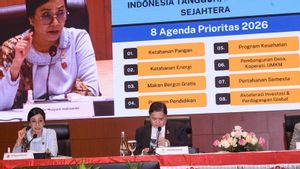
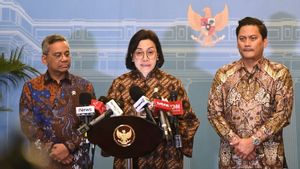
"For a 2-3 year balance budget, we will see first in 2026. Not yet starting 2026, I have been thinking about 2-3 years. But, I see a signal from the President, so later we will also prepare it as expected," he said at a press conference for the 2026 RAPBN and Financial Notes in Jakarta, Saturday, August 16.
SEE ALSO:
-
 | EKONOMI
Anggaran Transfer ke Daerah 2026 Turun, Dialihkan ke Belanja Pemerintah Pusat
16 Agustus 2025, 06:01 -
 | EKONOMI
Pemerintah Alokasikan Rp1.376 Triliun untuk Program Bantuan Langsung, Ini Rinciannya
16 Agustus 2025, 04:04 -
 | EKONOMI
Mendagri Tito Bantah Kenaikan PBB Daerah Disebabkan Efisiensi Anggaran Prabowo
15 Agustus 2025, 23:56


Sri Mulyani added that in the short term, she focused on overseeing the implementation of the 2025 State Budget which is still running for the next four months. In parallel, the Ministry of Finance is also preparing for the implementation of the 2026 State Budget, which has now entered the annual session stage for the discussion of the State Budget Bill.
"For the direction requested by the President, for one day the Indonesia balance budget, I think that is something that we must continue to calculate and will definitely be reported to the President," he said.
Previously, President Prabowo in his speech delivering the 2026 RAPBN and the Financial Note expressed his desire that the Indonesian State Budget no longer have a deficit in 2027 or 2028.
"My hope is, for one day, whether in 2027 or 2028, I want to stand in front of this assembly, on this podium, to convey that we have a state budget that has no deficit at all," said Prabowo.
In the 2026 RAPBN, the government stipulates state expenditures of IDR 3,786.5 trillion, state revenues of IDR 3,147.7 trillion, and deficits of IDR 638.8 trillion or 2.48 percent of GDP.
Prabowo also emphasized the importance of efficiency in budgeting so that the deficit can be reduced as small as possible, while still prioritizing prudent, innovative, and sustainable financing.
The English, Chinese, Japanese, Arabic, and French versions are automatically generated by the AI. So there may still be inaccuracies in translating, please always see Indonesian as our main language. (system supported by DigitalSiber.id)


