

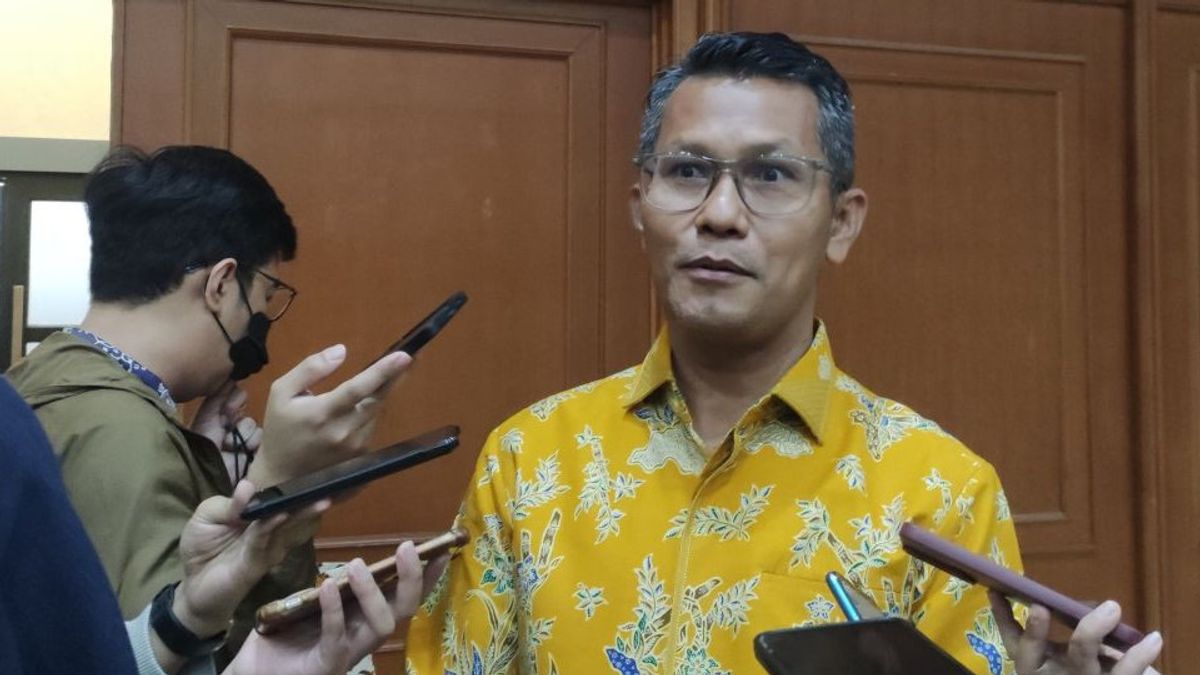


JAKARTA - The Ministry of Industry (Kemenperin) said that the policy of relaxing product imports has reduced the domestic demand for several industries.
Spokesperson for the Ministry of Industry Febri Hendri Antoni Arif said relaxation triggered a spike in imports of finished products and suppressed domestic industrial utilization.
This triggers industrial closure and increases threats to Termination of Work Relations (PHK). The Ministry of Industry noted that industrial groups that are prone to closure and layoffs are the footwear, electronics, cosmetics and finished clothing sectors.
Therefore, Febri said, his party supports and appreciates the government's deregulation policy for ease of doing business and controlling and limiting imports of finished products in textile sub-sectors and textile products (TPT).
Then finished clothing products and clothing accessories are as mitigation steps as well as efforts to maintain national industrial resilience.
"The revision of this Permendag considers the supply-demand data for the textile sector and finished clothing. With selective import restrictions, domestic product orders will increase. Therefore, after the policy is implemented, we are sure that the impact will be positive on order variables in IKI, especially on textile industry sub-sectors and finished clothes," said Febri in a written statement, quoted on Tuesday, July 1.
Febri said, in June 2025, orders for the textile industry, finished clothing products and clothing accessories have contracted.
This shows that the relaxation of imports has previously suppressed domestic demand.
"So, the revision of this policy is expected to restore demand and increase domestic industrial utilization," he said.
In the release of IKI June 2025, the Ministry of Industry also said that five sub-sectors experienced contractions, namely the skin, leather and footwear industry (KBLI 15), the computer industry, electronic and optical goods (KBLI 26), the electric equipment industry (KBLI 27), the YTDL machine and equipment industry (KBLI 28) as well as machine and equipment repair and installation (KBLI 33).
"So, this month there are five sub-sectors entering into contracting status, of which in the previous month there were only two sub-sectors," said Febri.
In macro terms, said Febri, the manufacturing industry in June 2025 experienced an increase in demand, but experienced a slight decline in production.
"Well, (related to) increasing demand but declining production is covered from stock of goods produced in the previous month," he explained.
When viewed from the perspectives on the market orientation of export and domestic manufacturing products, he continued, the value of export-oriented industrial companies slowed slightly by 0.14 points to 52.19.
"We suspect that this is because there is still an influence from the trade war and also an increase in the political escalation in the middle east," explained Febri.
SEE ALSO:


Not only that, the value of IKI for domestic-oriented industries also slowed down by 0.5 points to 51.32.
"Well, specifically for domestic market-oriented industries, the decline is due to declining production. So, the industry is still using existing stocks in warehouses to meet demand for industrial products in the domestic market," he said.
Indonesia's Industrial Trust Index (IKI) in June 2025 is still in an expansive phase with an achievement of 51.84. However, this figure is lower than in May 2025 which was 52.11 and in June last year, which was 52.50.
The English, Chinese, Japanese, Arabic, and French versions are automatically generated by the AI. So there may still be inaccuracies in translating, please always see Indonesian as our main language. (system supported by DigitalSiber.id)
Most Popular Tags
#Prabowo Subianto #donald trump #2026 World Cup #bgn #konflik timur tengahPopular


