

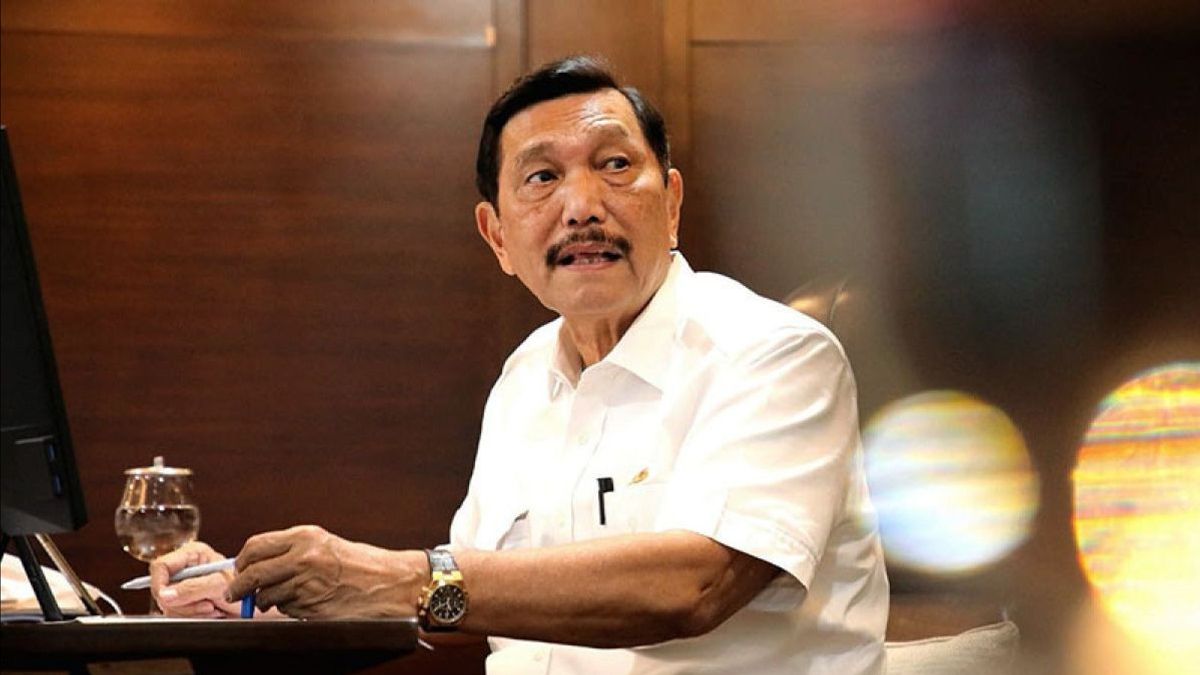


JAKARTA - Chairman of the National Economic Council (DEN) Luhut Binsar Pandjaitan revealed that Indonesia has created a Mineral and Coal Information System between Ministries/Institutions (Simbara) so that it can increase state revenues.
According to him, the system can monitor transparently and integrated all activities in the mineral and coal sector, including the amount of production, quality, export, and compliance with royalty and tax payments.
"Simbara sekarang semua mineral kita dimasukkan di sana. Itu sehingga orang tidak bisa misalnya tadi Pak Tommy punya KP Batubara, kita tahu jumlahnya, produksinya berapa, calorinya berapa, dia mau ekspor berapa, dia sudah bayar royalty belum? Sudah bayar pajak belum? Ada utang di pemerintah belum? Once itu terjadi, otomatis blocking," ujarnya dalam acara menavigasi ekonomi global, strategi untuk 2025, Rabu, 15 Januari.
Luhut conveyed that Simbara's implementation could increase state revenue by around 30 percent to 40 percent.
"It's running now and it increases state revenue, 30 percent-40 percent," he said.
Previously, the Government had strengthened the Mineral Information System and Coal ecosystem of Ministries/Institutions (SIMBARA) by adding nickel and tin commodities in it.
The Director General of Budget at the Ministry of Finance Isa Rachmatarwata said that the addition of nickel and tin commodities in SIMBARA was because it had great economic value for Indonesia, after coal.
"Today we are expanding for nickel and tin, whose role is increasingly strategic to support the domestic and global economy," he explained at the Launching and Socialization of the Implementation of Nickel and Timah Commodities through SIMBARA, Monday, July 22.
Isa said Indonesia is one of the largest nickel and lead producers in the world. Meanwhile, nickel reserves in Indonesia reach around 21 million tons or about 24 percent of the world's total reserves. While the second lead reserves are ranked second in the world with a total of 800 thousand tons or 23 percent of the world's total reserves.
SEE ALSO:
-
 | EKONOMI
Luhut Yakin Pertumbuhan Ekonomi Capai 8 Persen Menuju Indonesia Emas
15 Januari 2025, 11:23 -
 | BERITA
Pemerintah Kejar Penerimaan Pajak Sawit dengan Sistem Digital Simkasatu
11 Desember 2024, 08:55
Therefore, Isa conveyed through Simbara that it is hoped that nickel and lead governance will be stronger to provide services and commodity governance, starting from the side of preventing illegal mining, strengthening additional non-tax state revenue deposits (PNBP), to forcing companies to pay their receivables.
"In particular, this event aims to strengthen the commitment of government agencies to continue to synergize and coordinate in providing services for nickel and tin entrepreneurship in Indonesia," said Isa.
In addition, Isa said that it is hoped that it can increase the understanding and commitment of nickel and tin business actors to recognize and carry out new business, system, and governance processes that are more transparent, accountable, and fair.
The English, Chinese, Japanese, Arabic, and French versions are automatically generated by the AI. So there may still be inaccuracies in translating, please always see Indonesian as our main language. (system supported by DigitalSiber.id)
Most Popular Tags
#Prabowo Subianto #donald trump #Febrie Adriansyah #8791 #giias 2026Popular


