
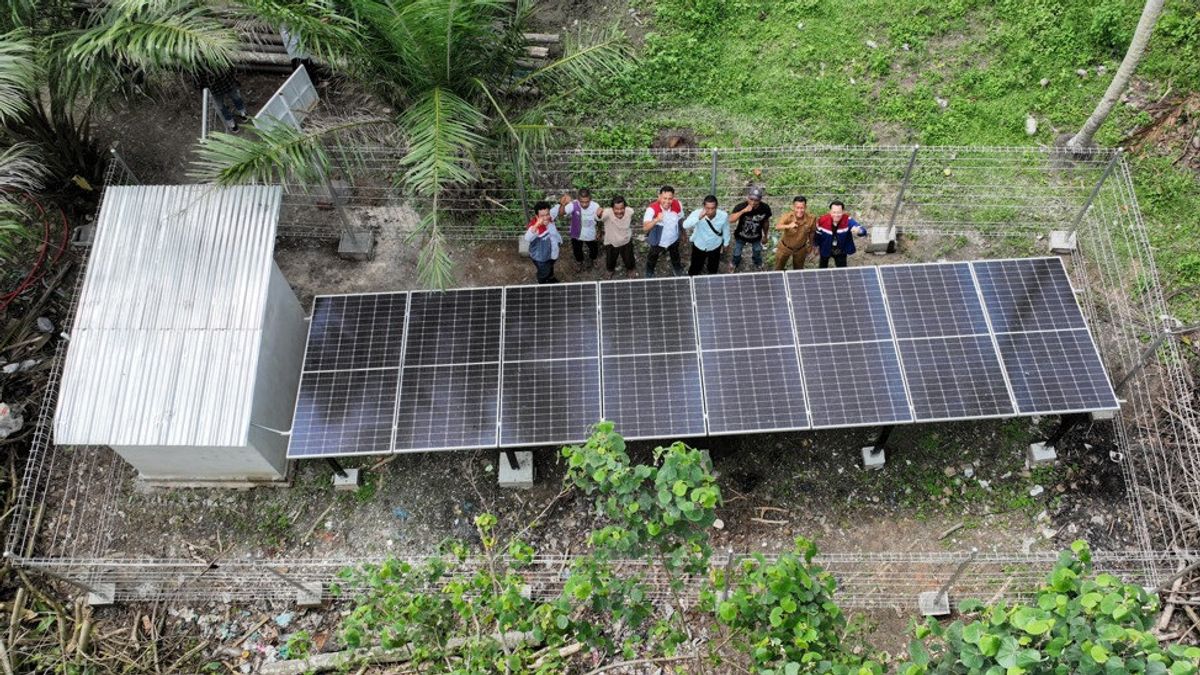


JAKARTA - Sometimes unfriendly natural conditions are often considered as conditions that must be accepted as they are. But it turns out that this is not an obstacle for the fostered partner group of PT Kilang Pertamina Internasional (KPI) Unit Dumai to think creatively and adapt to these conditions.
In the Dumai Refinery operating area, there are groups of fishermen who often face major challenges in catching fish at sea. The weather that often doesn't seem friendly limits their access to fishing, while fishery infrastructure is still minimal and the threat of abrasion in the area where they live, Mundam Village, Medang Kampai District, further complicates the situation.
"Looking at this condition, the Dumai Refinery took the initiative to introduce a fishery model with bioflok technology. We hope this technology will be an alternative to a more stable and sustainable economic source," said KPI Corporate Secretary Hermansyah Y Nasroen, in a written statement, Saturday, March 1.
Tilapia cultivation with a bioflok system is a promising opportunity for other fishing groups who are members of the Mundam Jaya Joint Business Group (KUB). This method is considered potential because it only needs tarpaulin ponds as a cultivation medium and has a relatively short maintenance time, about 4 6 months to harvest period, depending on the type of fish cultivated.
In addition to providing support for the infrastructure of bioflok ponds and fish cultivation skills for the Mundam Jaya Fishermen's Group, the Dumai Refinery also takes strategic steps to ensure the sustainability of the tilapia fish cultivation program by presenting renewable energy solutions.
"As a mitigation measure against potential obstacles and to support cultivation operations, the company has built an off-grid Solar Power Plant (PLTS) with a solar panel capacity of 4.4 kWp and a 5 kWh battery," added Hermansyah.
This PLTS is part of Pertamina's Energy-Residential Village (DEB) program, which not only helps meet electricity needs for the operation of dock lights and bioflok ponds, but also contributes to saving electricity costs of up to IDR 9.3 million per year. In addition, the use of this PLTS also supports efforts to reduce greenhouse gas (GHG) emissions, with an estimated decrease of 5.52 tons of CO2 per year.
SEE ALSO:
-
 | EKONOMI
Ini Penyebab Dolar Perkasa di Negara Berkembang tapi Lemah di Negara Maju
23 Juni 2023, 19:02 -
 | EKONOMI
Paris Summit 2023 Ungkap Belum Ada Investasi Ideal dalam Transisi Energi
23 Juni 2023, 17:19

Hermansyah emphasized that this initiative is not only aimed at supporting the sustainability of fishermen's bioflok pool operations, but also as an effort to encourage the public to be more aware of the use of clean energy in facing the challenges of climate change.
"This PLTS allows fishermen to no longer fully depend on conventional electricity. This is also part of Pertamina's commitment to developing new and renewable energy (EBT), as well as encouraging the transition to using more environmentally friendly energy," concluded Hermansyah.
The English, Chinese, Japanese, Arabic, and French versions are automatically generated by the AI. So there may still be inaccuracies in translating, please always see Indonesian as our main language. (system supported by DigitalSiber.id)


