


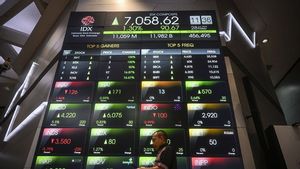
JAKARTA The movement of the Composite Stock Price Index (JCI) closed at the level of 6,300.14, down 2.86 percent in the trading session I, Friday, February 28 and experienced a significant decline of more than 7 percent in the past week.
President Director of the Indonesia Stock Exchange (IDX), Iman Rachman explained that the decline in the JCI in the last five days could be caused by various factors, both global, domestic, and corporate.
Iman said that from a global perspective there are several issues that affect, such as the tariff war between the US and its partners, and the Fed's policy regarding interest rates is one of the main factors that affects the flow of foreign funds to the Indonesian stock market.
"Trump 2.0 is not easy. Currently, about 70 percent of global funds continue to flow to high-quality assets in the US. In addition, trade tariff threats continue to emerge, as previously happened to Mexico and Canada, as well as the United Arab Emirates," he told media crews, Friday, February 28.
In addition to the tariff war policy, Iman conveyed another factor, namely policies related to value added tax (VAT) which are expected to decrease but are not in accordance with market expectations.
"There is hope that VAT will fall, but the reality will show a different trend. Meanwhile, the still high US interest rate makes investors prefer low-risk assets over stocks in emerging markets," he explained.
Iman said that the flow of foreign funds experienced a significant outflow since the beginning of the year where until February 27, 2025, foreign investors recorded a net sell of almost Rp19 trillion year to date (YtD), inversely proportional to last year which still recorded a net buy of Rp17 trillion.
"We see, from the fourth quarter of 2024 to early 2025, foreigners continue to carry out sales actions. Even though transactions in the market increase, the selling pressure from foreign investors remains high," he explained.
On the domestic side, Iman said the most influential factor was the decline in MSCI ratings and foreign ownership in the Indonesian stock market by around 40 percent so that changes in investor composition were also a challenge in itself.
SEE ALSO:
-
 | EKONOMI
IHSG Akhir Pekan Diproyeksi Melemah, Tiga Saham Ini Bisa Dicermati
28 Februari 2025, 07:07 -
 | EKONOMI
IHSG Kamis Diproyeksi Bergerak Positif, Simak Rekomendasi Sahamnya
27 Februari 2025, 07:07

"In the past, 70 percent of the market was controlled by domestic and retail investors, so when prices fell, they could absorb it. Now, with 40 percent of foreign ownership, when they leave, the market becomes more vulnerable," he said.
According to him, in the past domestic and retail investors supported each other, but now it is domestically those who are under pressure.
In addition, Iman said there were also effects from issuer financial reports that had been released although several issuers recorded an increase in profit, many of which results were still below consensus expectations, which exacerbated market conditions.
"Some issuers recorded growth, but it is still below the analyst consensus, which still triggers a sell-off," he said.
The English, Chinese, Japanese, Arabic, and French versions are automatically generated by the AI. So there may still be inaccuracies in translating, please always see Indonesian as our main language. (system supported by DigitalSiber.id)
Most Popular Tags
#Prabowo Subianto #donald trump #Febrie Adriansyah #8791 #giias 2026Popular


