
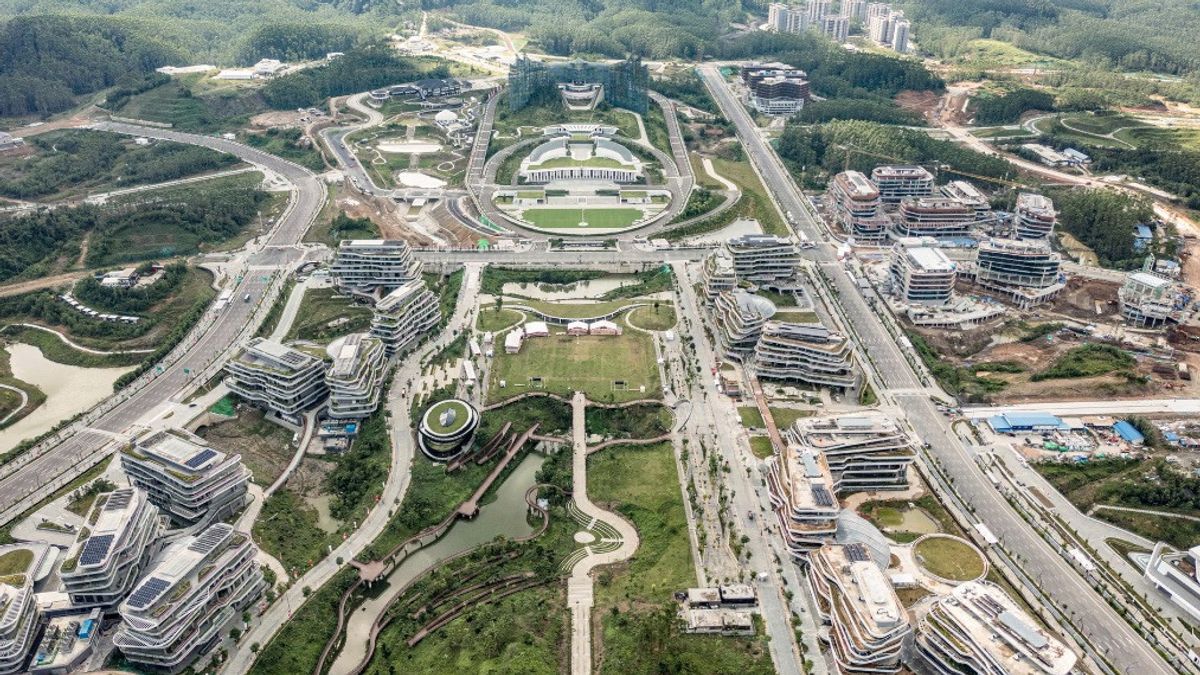


JAKARTA The Nusantara Capital City (IKN) development project has slowed down. British-based media, The Guardian, said the new capital city of Indonesia was in danger of becoming a ghost city.
Three years since the Seventh President of the Republic of Indonesia Joko Widodo (Jokowi) inaugurated an ambitious capital, some fear that the city will be threatened with becoming a dead city. Under the inauguration of President Prabowo Subianto, who has only served for a year, state funding for the IKN project has experienced a significant decline, even more than half of it.
Throughout 2024, government funds for the IKN project reached IDR 43.4 trillion. This value reached 97.3 percent of the total state budget (APBN) throughout the year, which was IDR 44.5 trillion. However, the funds used fell to IDR 15.3 trillion in 2025, and for next year, the government allocated IDR 6.5 trillion.
The Guardian wrote that at least 2,000 state civil servants (ASN) and 8,000 construction workers live in IKN. This figure is still far from the target of 1.2 million people by 2030.
Prabowo issued a decision regarding the continuation of the IKN project in Penajam Paser Utara, East Kalimantan to become the capital of politics. Confusion also arose, because there was no detailed explanation of the phrase political capital in the presidential regulation issued last September.
Prabowo Subianto, who still has not visited the archipelago with his status as president, lowered IKN's status to a political capital last May. However, the decision was only announced to the public in September.
Previously, in mid-2024, the Head of the IKN Authority Bambang Susantono and OIKN Deputy Dhony Rahajoe surprisingly announced their resignation. The news sparked questions among observers and the wider community about the future of IKN development.
The apartment complexes, ministerial complexes, hospitals, water systems and airports have been built, but most of the city construction is still in process.
Herdiansyah Hamzah, a constitutional law expert from Mulawarman University in East Kalimantan, said the IKN project is like a ghost city, and the phrase political capital has no meaning in the constitutional law in Indonesia.
"The new capital city is not a priority for Prabowo. Politically, it's like living, I don't want to die," he said.
Although IKN development is slowing down and the budget is decreasing, those involved in the project remain optimistic. In fact, a statement that states that IKN development is slowing down and the government has no desire to continue it is not true.
"President (Prabowo) told me my commitment was to continue and finish this faster," said Basuki Hadimuljono, head of OIKN.
"The funds are there, the political commitment is there. Why should we doubt that," he said, adding that government funds were not cut, but reallocated, "he continued.
Regarding IKN as the capital of politics, this phrase is sticking out in the attachment to Presidential Regulation Number 79 of 2025 concerning the Updating of Government Work Plans for 2025.
In the Presidential Decree, which was set for June 30, 2025, it was stated that regional planning and development, as well as relocation to the capital city of Nusantara, were carried out as an effort to support the realization of the capital city of the archipelago to become the capital of politics in 2028.
However, Herdiansyah Hamzah said that in Indonesian state administration, only the capital city of the country is known. He also then assessed that the use of the term political capital in the Presidential Regulation was solely to separate the function of the nation's capital as the center of government and economic center.
Jakarta is still the capital city of the state or the center of government as well as the center of the economy. The phrase of the political capital in the Presidential Decree, he said, shows that the government wants to separate two functions of a city.
SEE ALSO:
-
 | BERNAS
Presiden Prabowo Subianto Siap Tanggung Jawab Utang Whoosh, Dari Mana Duitnya?
07 November 2025, 19:00 -
 | BERNAS
Soeharto Pahlawan, Reformasi Gagal: Indonesia Masih Mengagungkan Pemerintahan Otoriter
07 November 2025, 12:00 -
 | BERNAS
Annus Horribilis, Kasus Pangeran Andrew adalah Malapetaka bagi Kerajaan Inggris
06 November 2025, 16:00 -
 | BERNAS
OTT Gubernur Riau: Biaya Politik Tingggi, Kepala Daerah Berulang Kali Terjerat Korupsi
04 November 2025, 19:30

This is what Malaysia is doing. Putrajaya is used as the center of government administration, while the economic center is in Kuala Lumpur. Likewise with Australia which places a center of government in Canberra.
As the nation's capital, all government administration offices that include executive, legislative, and judicial institutions must be there. Including embassy offices, in order to facilitate communication on political affairs.
But Herdiansyah Hamzah assessed that making IKN a political capital in 2028 is not that easy. Because the government means that it only has less than three years to form it. In such a short time, he doubts that all state institutions, both executive, judicial, and legislative institutions, will move to IKN.
Making IKN a political capital in 2028 is also referred to as a form of political elite frustration with the sustainability of IKN. It has become a common secret that IKN is one of the mega development projects in the Jokowi era. Initially, IKN was not only projected as a center of government, but also a new economic center.
"This can also be read as a political compromise (President Prabowo Subianto) so that it is called continuing Jokowi's legacy," he said.
The fact that IKN's program brought criticism was that its development was considered without careful planning and lack of public participation, Herdiansyah encouraged the government to be wiser in utilizing the state budget by based on good planning, side politics, and implemented for the benefit of many people.
"Even though there are still many financing posts that the public needs, especially for education, health, and others," he concluded.
The English, Chinese, Japanese, Arabic, and French versions are automatically generated by the AI. So there may still be inaccuracies in translating, please always see Indonesian as our main language. (system supported by DigitalSiber.id)
Most Popular Tags
#Prabowo Subianto #donald trump #Febrie Adriansyah #8791 #giias 2026Popular


