
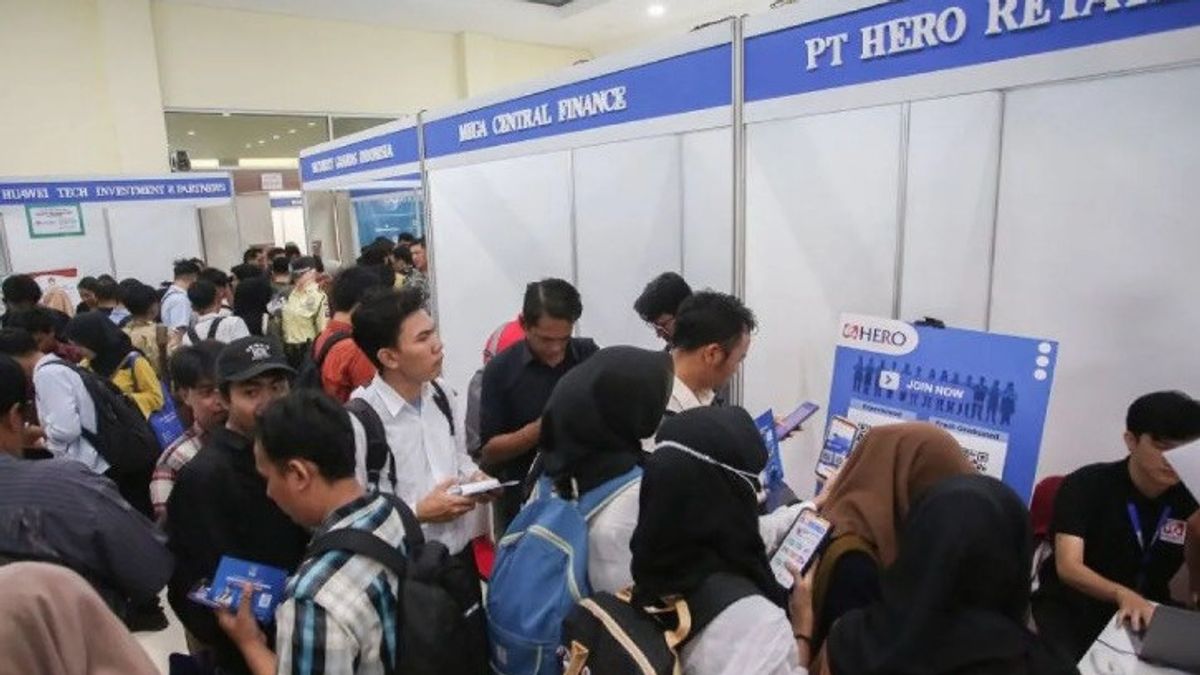


JAKARTA President Prabowo Subianto plans to abolish the outsourced or power transfer system in Indonesia. However, a number of observers asked the president to properly calculate the profit and loss of outsourced systems.
He plans to hold the plan in front of thousands of workers during the May Day or International Labor Day 2025 commemoration in Jakarta on May 1. Prabowo claims to form a National Labor Welfare Council and asks them to conduct a study on the demands for the elimination of outsourced.
"I will ask the National Welfare Council to learn how we can if we can, not immediately, but as soon as possible we want to remove outsourced," said Prabowo.
Economic observers say there are positive and negative sides to consider before removing outsourced. Nailul Huda from the Center of Economic and Law Studies (Celios) said outsourced systems should have long been removed, for harming workers.
However, another opinion states that the elimination of outsourcing system without proper calculations can actually increase the wave of layoffs or layoffs. In the midst of a wave of layoffs and a sluggish economy, the discourse of eliminating outsourcing can lead to other problems.
The Ministry of Manpower said the number of layoffs in 2022 reached more than 25,000 people. This figure has more than doubled to 64,855 in 2023, and has increased to 77,965 in 2024.
In Law Number 13 of 2003 concerning Manpower, outsourcing is a supporting service that is not directly related to the production process or outside the core business (core business) of a company. The sectors that are allowed to useoursourcing are cleaning services, catering, security/security officers, supporting services in mining and oil, driver.
After Prabowo's speech on May Day 2025, the Minister of Manpower Yassierli immediately prepared new rules regarding outsourcing to follow up on Prabowo's directives. The regulation will be included in the Minister of Manpower Regulation.
"The President's policy conveyed at the May Day 2025 celebration regarding outsourcing will certainly be the basic policy in the preparation of the Ministerial Regulation on Outsourcing which is currently being prepared," Yassierli said in an official statement.
Responding to the plan, the Economic Director of the Center of Economic and Law Studies (Celios) Nailul Huda tried to analyze the impact of President Prabowo's plan. This step, said Huda, could be used as an excuse for the company to make efficiency to termination of employment (PHK).
The outsourced system that has been applied so far allows companies to get labor that is paid daily, without providing social protection to workers.
SEE ALSO:



"So when the President says he will eliminate outsourcing systems, challenges will be obtained from the side of entrepreneurs who will oppose the removal of this outsourcing because they have been enjoying the benefits of outsourcing systems," said Huda when contacted by VOI.
Huda emphasized that the outsourcing scheme should have been removed for a long time because this system allows companies to provide low wages, workers are paid daily without providing social protection, getting wages for cheap workers. When removed, this can be an excuse for companies to make efficiency or layoffs.
If eliminated, the company will definitely reduce costs where the threat of dismissal ends. So it must be eliminated, but the challenges remain and have the potential to interfere with our economy," he said.
One way that can eliminate outsourced systems is to revise the Job Creation Law, especially the employment department. This is because the outsourced system in Indonesia is full of uncertainty related to the types of work that are allowed to protect its own outsource workers.
"I think the revision of the Job Creation Law is an entry point to eliminate this outsourced practice. At the same time, it provides incentives for purchasing power so that the business world also benefits," said Huda again.
Researcher from the Center of Reform on Economics (CORE) Indonesia Yusuf Rendy Manilet said the government must consider the positive and negative sides before removing outsourced.
Deleting outsourced can indeed strengthen workers' protection, but on the other hand, the world of work has many interests and variables involved. The outsourced system that has been present in Indonesia for a long time is considered a solution to the flexibility of the workforce for the company, especially since the 1998 economic crisis.
Companies experiencing time difficulties want to avoid long-term expenses such as large severance pay, national security obligations, and others. With this outsourced system, companies can "waive" workers without being directly attached.
Unfortunately, this practice is often abused. Outsourced workers often do not get decent wages, social security is minimal, and it is very easy to stop without severance pay.
To solve these problems, deleting outsourcing according to Rendy is not a solution. If the outsourcing system is removed, workers who are currently working through this method will lose their jobs. So, what must be addressed is how to work.
"If outsourcing is completely removed, there is indeed a potential for turmoil. The company will lose flexibility and may take shortcuts: mass layoffs or work process automation," he explained.
In other countries, outsourcing practices are successful because the government is not absent from conducting surveillance. In addition, the scope of work and the amount of wages are also strictly regulated.
"In many developed countries, this practice exists, especially in non-core sectors such as cleaning services, security, or logistics. But the difference is that strict supervision and protection of workers are guaranteed. In Indonesia, the weakness is in a wide gap in exploitation," he concluded.
The English, Chinese, Japanese, Arabic, and French versions are automatically generated by the AI. So there may still be inaccuracies in translating, please always see Indonesian as our main language. (system supported by DigitalSiber.id)
Most Popular Tags
#Prabowo Subianto #donald trump #firearm #8791 #giias 2026Popular


