
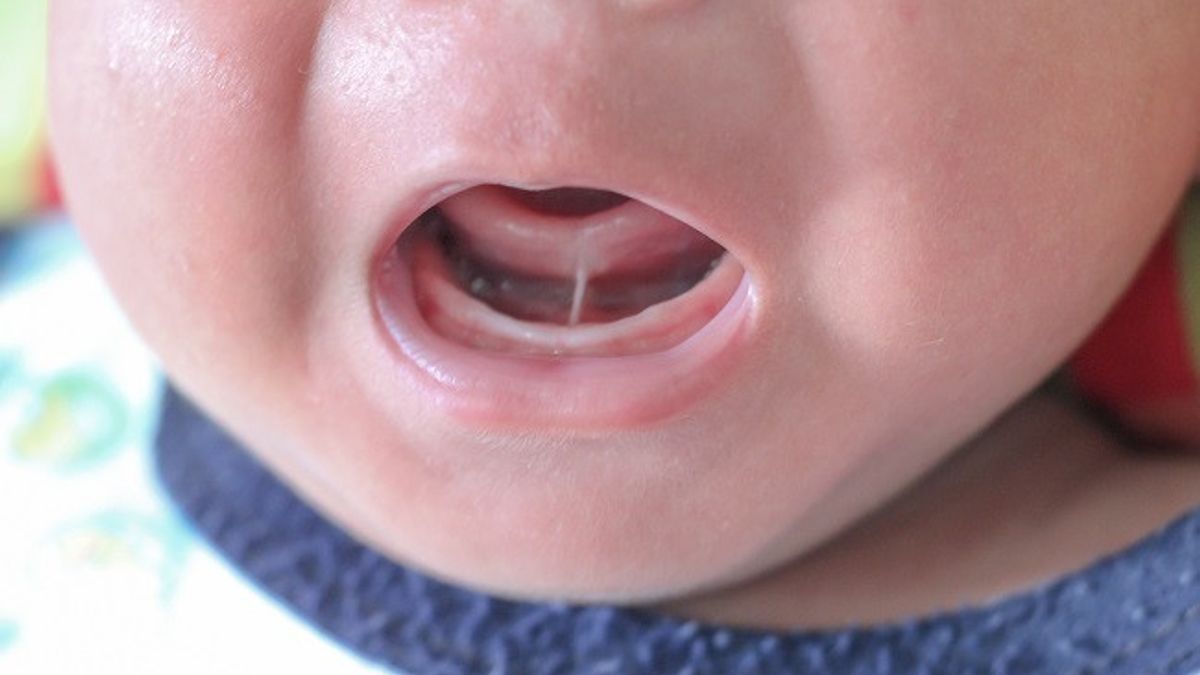


JAKARTA Tounge-tie is often considered the cause of children experiencing speed delays or being late in talking and having difficulty attaching breastfeeding when breast milk (ASI).
Recently, the term tounge-tie is quite often discussed in society, especially mothers. Generally they worry when a baby experiences tounge-tie will cause a number of problems.
Tounge-tieini is said to cause a number of problems in children, ranging from breastfeeding difficulties which result in lack of weight, to delays in talking to children.
However, the doctors agreed that there was no connection between the delay in talking and the tounge-tie, so there was no need to carry out an incision or cutting process.
"Will Tongue-tie affect speech delay? Of course not. Maybe it will affect the pronunciation of several letters such as T-D-S-L-R and others, but will improve with age. This problem will be solved but will not cause speech delay," said dr. Naomi in a webinar with the Indonesian Pediatrician Association (IDAI).
Tounge-tiekatauankyglossia is an abnormality in the baby's tongue phenulum so it measures too short. Usually children with tounge-tie have problems with the tongue's frenulum that connects the tongue to the mouth floor.
Tounge-tiem is a congenital disorder that is expected to occur in three to five percent of newborns. This condition is also more common in baby boys than baby girls.
Babies with tounge-tie will find it difficult to move their tongue up and cannot stick their tongue through their front teeth.
Until now, it is not known exactly what caused the tounge-tie. However, in some cases, the baby sufferers have parents with a history of the same condition. Therefore, there are allegations of tounge-tie related to genetic factors.
VOIR éGALEMENT:
-
 | BERNAS
Alih-alih Belanja, Banyak Orang Memilih Menabung THR di Tengah Ekonomi yang Lesu
20 Maret 2025, 09:00




But lately, the tounge-tie conditions are often referred to as causing the baby to have difficulty attaching breastfeeding. Babies with tounge-tie will also have difficulty moving their tongue up and cannot stick their tongue through their front teeth.
Not to mention the belief about the speed delay or the delay in speaking which he said was caused by the tounge-tie. However, the assumption that the tounge-tie will cause a delay in speaking was denied by the Head of the IDAI Breastfeeding Task Force Dr.dr.Naomi Esthernita F. Dewanto, Sp.A, Subsp.Neo (K).
"Will tongue-tie affect the speed delay? Of course not," said dr. Naomi.
"Maybe it will affect the pronunciation of several letters such as T-D-S-L-R and others, but will improve with age. This problem will be resolved but not cause a speed delay," he added.
This was also emphasized by dr. Arifianto, Sp.A (K). He emphasized that there is no connection between the tounge-tie and the delay in speaking. If you link between the tounge-tie and the speech disorder, especially the disturbance of articulation such as the pronunciation of certain words or riots, it could be.
Even though there are many scientific publications, it is not always children with tounge-tie who will definitely experience speech disorders, such as cadels or the like. If you talk too late, obviously it has nothing to do with it, "explained the man who is familiarly called dr. Apin.
Apart from the speed delay, tounge-tie is also said to be able to give birth to problems with attachment in breastfeeding. Some babies with tounge-tie can indeed cause breastfeeding difficulties. This usually makes the mother worried that the baby will not get enough nutrition.
But in fact, not all babies with tounge-tie conditions must be handled with incision actions, as long as there is no problem breastfeeding or eating.
This problem can be found in babies where the linguistic frenulum is short or thick but no incision always has to be done. Incisions are medical actions involving cutting or incisions on the body's tissue.
"So the message is that breastfeeding difficulties are often found to have a postpartum period, but not all breastfeeding difficulties are caused by atongue-tie, and not all tontongue-tie must be acquired," explained dr. Naomi.
Doctor Arifianto agrees with this. Even though it turns out to be categorized as a tounge-tie, the majority do not need to be acquired, because it does not interfere with the process of breastfeeding babies or will cause disturbances in the future," he concluded.
The English, Chinese, Japanese, Arabic, and French versions are automatically generated by the AI. So there may still be inaccuracies in translating, please always see Indonesian as our main language. (system supported by DigitalSiber.id)
Most Popular Tags
#Prabowo Subianto #donald trump #Febrie Adriansyah #8791 #giias 2026Popular


