
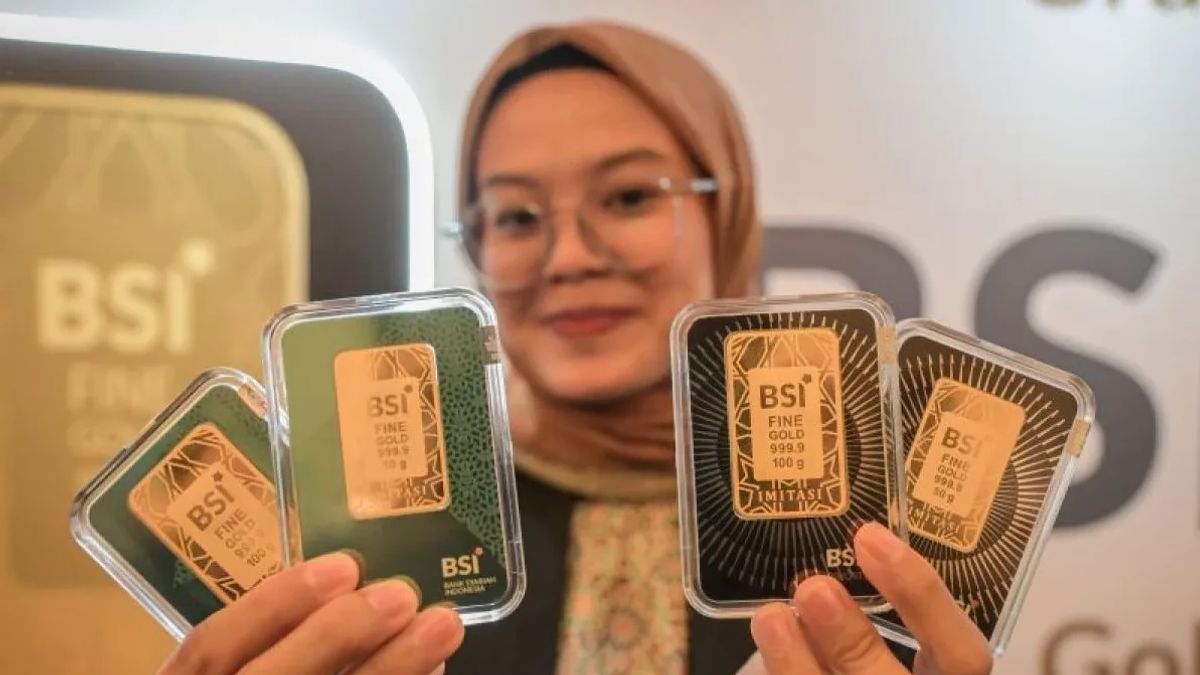


JAKARTA President Prabowo Subianto announced the plan to establish the first gold bank in Indonesia, which will be inaugurated on February 26, 2025. The announcement was made at a press conference regarding the Foreign Exchange of Natural Resources Export Results at the State Palace, Jakarta on February 17.
The main reason for forming a gold bank, according to Prabowo, is because the gold mined and produced in Indonesia flows more and is stored abroad.
"We will form a gold bank. So so far we don't have a gold bank for us. Nothing in Indonesia. So our gold is mined a lot and flows abroad. We want to now have a special bank for gold in Indonesia. God willing, we will inaugurate it on February 26. I think this is the first time in our Republic, "said Prabowo.
What exactly is a gold bank and its profits if Indonesia sets it up?
In recent years, the concept of a gold bank has begun to attract attention in various countries as an alternative to a sustainable and real asset-based financial system.
The concept of a gold bank is based on an institution that can serve banking business activities with precious metal instruments. With the gold bank, the gold ecosystem will be integrated from upstream to downstream for gold-based needs, ranging from deposits, deposits, financing, investment, to trade and other activities.
This model has been successfully implemented in countries such as Turkey and Malaysia, where public confidence in gold as an investment instrument and a hedge has been very strong.
However, when talking about its potential in Indonesia, various opportunities and challenges need to be carefully analyzed.
In Turkey, gold banks have grown rapidly as part of a financial system diversification strategy. The banks there allow people to store gold in physical form converted into digital gold accounts.
In that country, banks such as Kuveit T\"urk and T\"urkiye Badminton provide services such as gold accounts, electronic gold transfers, and gold deposits supported by safely stored physical gold.
In addition, Takasbank Gold Transfer System allows electronic gold transfer between banks, providing convenience for customers to make transactions without the need to bring physical gold. This model was successful because of the Turkish people's trust in gold as stable and value-protecting assets.
Meanwhile, in Malaysia, the gold bank also received a warm welcome from the high demand for gold in the country. Malaysia ranks eighth in the world with the highest gold demand in 2020. The figure jumped 25 percent to 18.5 tons compared to 14.9 tons in 2021.
According to reports from Forex Suggest, Malaysia is behind Turkey, Russia, Singapore, the United Arab Emirates (UAE), Vietnam, Iran, and Egypt on relevant charts.
Services such as gold investment accounts are offered by major banks in Malaysia, including Maybank, CIMB, and Public Bank, with features that make it easier for customers to buy and sell gold digitally.
In this neighboring country, the concept of a gold bank is applied with government support through clear regulations and massive socialization.
The gold bank there is also integrated with sharia platforms, thus attracting a wider market segment, especially Muslims.
The potential of gold banks in Indonesia is actually no less big. As one of the countries with the largest Muslim population in the world, gold has a strong cultural and religious appeal.
Gold is often considered a safe asset, especially among the lower middle class who do not believe in conventional financial system stability.
Research conducted by Khairul Arifin Lubis and Donny Abdul Chalid from the Faculty of Economics and Business, University of Indonesia in 2020 found that gold investment was proven to be a means of hedging against the risk of inflation and exchange rates in analysis using the VECM method.
Data shows that gold consumption in Indonesia continues to increase, both for jewelry and investment, making Indonesia a potential market for gold banks.
In addition, in the context of Islamic finance, gold banks can become a new instrument in line with Islamic economic principles that emphasize justice and ownership of real assets.
Center of Sharia Economic Development (CSED) Institute for Development of Economics and Finance (Indef) adviser Abdul Hakam Naja assessed that the existence of a gold bank (Billion bank) could be a driving force for the growth of Islamic banking.
Several companies that have carried out their functions as billionaire banks are PT Pegadaian (Persero), PT Bank Rakyat Indonesia (BRI Persero) Tbk, and PT Bank Syariah Indonesia (BSI Persero) Tbk. However, when it was inaugurated later, the government only appointed PT Pegadaian and PT Bank Syariah Indonesia as the first store and provider of gold bank services.
"This bullion bank is not a compulsory (obligatory), its role is like banking too," said Coordinating Minister for the Economy, Airlangga Hartarto after attending the 2025 Indonesia Economic Summit (IES) in Jakarta, Tuesday. (18/2).
Even so, so far, Indonesian gold has more cost of industrial processing (cost of manufacturing) because the gold bank, aka bullion bank, is in Singapore.
However, through the latest regulations, Indonesia will soon have a gold bank after the Financial Services Authority Regulation (OJK) Number 17 of 2024 concerning the Implementation of Business Activities for Bullion is issued.
So far, despite its huge potential in Indonesia, many challenges have been faced. One of the main obstacles is regulation. Indonesia to present a gold bank needs to design a legal framework that specifically regulates the operation of a gold bank.
This is so as not to cause doubt for business actors and prospective customers. In addition, Indonesian financial literacy, especially related to gold investment, must also be increased.
Because until now many still keep gold in physical form at home because of a lack of understanding about the benefits of keeping it in financial institutions.
The next challenge is infrastructure. Unlike other countries that have long implemented, such as Turkey which has a wide network of gold banks, financial infrastructure in Indonesia is still concentrated in big cities.
Gold banks need high-tech support to ensure security and transparency, such as a blockchain system for gold tracking or standardized gold storage sites.
Currently, only a handful of financial institutions in Indonesia are able to provide such services.
No less important, there are challenges of trust. The cases of gold investment fraud that are rampant in Indonesia have made some people skeptical of the gold-based scheme.
If not managed properly, the gold bank risks losing people's trust before it actually develops.
To answer these challenges, several solutions can be proposed. The government must immediately design regulations that support the operations of gold banks, including ensuring that their activities are in accordance with sharia principles. These regulations must include good standards of security, transparency, and governance to protect customers.
Then, the importance of public education is key. Banks that want to enter this sector must actively provide financial literacy to the public, especially regarding the benefits and security of storing gold in banks compared physically.
This educational campaign must be carried out widely, by involving local communities, media, and religious leaders to increase public trust.
Furthermore, collaboration with fintech can be a solution to overcome infrastructure problems. With digital technology, gold banks can be accessed by people in remote areas without having to open physical branches.
For example, mobile applications can be used to monitor gold balances, make transactions, or even disburse gold into cash.
SEE ALSO:
-
 | BERNAS
Tak Ada Guna Bikin Partai Super Tbk Kalau Masih Berharap Kucuran Duit Negara
18 Februari 2025, 08:00 -
 | BERNAS
Percuma Presidential Threshold 20 Persen Dihapus jika Kita Setuju Koalisi Permanen
17 Februari 2025, 22:00 -
 | BERNAS
Kebijakan Berbasis Viral di Era Presiden Prabowo, Kesalahan yang Seolah-olah Benar
17 Februari 2025, 07:00 -
 | BERNAS
Pantauan Netray: Sentimen Negatif Warnai Kebijakan Efisiensi Anggaran
16 Februari 2025, 17:00

In terms of profits, gold banks can provide great benefits for Indonesia. At the micro level, gold banks help people protect their assets from inflation.
At the macro level, gold banks can support economic diversification and strengthen the Islamic financial sector in Indonesia. In addition, gold banks can also attract foreign investors who see great potential in the financial sector based on real assets.
However, there are also risks that need to be considered. One of them is the volatility of gold prices in the global market. If the price of gold falls significantly, customers who have kept their assets in gold may lose money.
In addition, high operational costs for gold storage and management can be a challenge for banks, especially in the early stages of implementation.
The gold bank is not an instant solution to strengthen Indonesia's financial system, but with careful planning, great potential in this sector can be optimized.
In the end, the success of gold banks in Indonesia will depend heavily on collaboration between the government, financial institutions, and the community.
With the right approach, the gold bank can be one of the innovative instruments that not only support financial inclusion, but also strengthen Indonesia's economic sovereignty.
*) Adapted from ANTARA
The English, Chinese, Japanese, Arabic, and French versions are automatically generated by the AI. So there may still be inaccuracies in translating, please always see Indonesian as our main language. (system supported by DigitalSiber.id)
Most Popular Tags
#Prabowo Subianto #donald trump #Febrie Adriansyah #8791 #giias 2026Popular


