
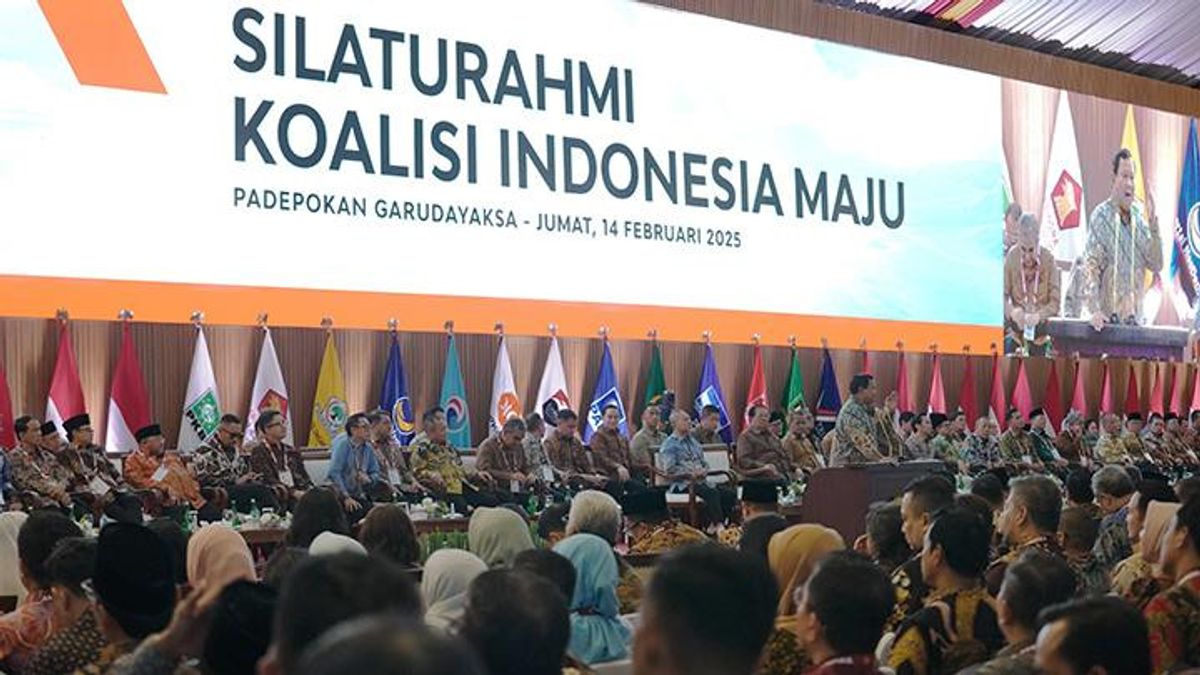


JAKARTA President Prabowo Subianto conveyed the discourse on permanent coalition' to his colleagues from the Advanced Indonesia Coalition (KIM) Plus, during a gathering at the Garudayaksa Padepokan, Hambalang, Bogor Regency on Friday (14/2/2025). The reason used as the basis for forming a permanent coalition is to maintain political stability and oversee government programs and policies until 2029.
The idea of a permanent coalition was echoed again at the Gerindra Party Anniversary event at Sentul International Convention Center, Sentul City, Bogor Regency, Saturday (15/2). The discourse was even strengthened by the Gerindra Party's declaration to bring Prabowo back as a candidate for President of the Republic of Indonesia in the 2029 presidential election.
KIM Plus is a political party supporting Prabowo in the 2024 presidential election. They are the Greater Indonesia Movement Party (Gerindra), the Golkar Party (Golkar), the Democratic Party, the National Mandate Party (PAN), the Indonesian Solidarity Party (PSI), the Indonesian People's Wave Party (Gelora), the Crescent Star Party (PBB), the Indonesian Change Guard Party (Garuda), the People's Fair and Prosperous Party (Prima), and the Justice and Unity Party (PKP).
Meanwhile, plus are parties that do not support Prabowo, namely the National Awakening Party (PKB), the Prosperous Justice Party (PKS), and the National Democratic Party (Nasdem), the United Development Party (PPP), the Indonesian Unity Party (Perindo), the Ummat Party, and the Labor Party. Only the Indonesian Democratic Party of Struggle (PDIP) is outside the grand coalition.
The coalition of parties supporting President Prabowo in the 2024 presidential election has actually raised ideas about the permanent coalition in the 2024 Simultaneous Pilkada, last November. However, this idea is not easily realized, considering that the political dynamics at the regional level are very different from the national level.
According to the Deputy Chairman of the Gerindra Party who is also the Minister of Foreign Affairs of the Republic of Indonesia, Sugiono, the reason Prabowo made the idea of a permanent coalition was for the sake of a cool atmosphere and harmony in political life in Indonesia. Sugiono denied that the idea of a permanent coalition emerged in anticipation of the elimination of the 20 percent presidential threshold rule, or the presidential nomination threshold, by the Constitutional Court (MK) on January 2.
The decision of the Constitutional Court regarding the abolition of the presidential threshold is an important moment for the sustainability of democracy in Indonesia. After 32 times being filed and rejected, the Constitutional Court has just granted the 33rd lawsuit.
The last lawsuit was filed by four students of the State Islamic University (UIN) Sunan Kalijaga, Yogyakarta, namely: Enika Maya Oktavia, Rizki Maulana Syafei, Faisal Nasirul Haq, and Tsalis Khoirul Fatna, by submitting the argument that Article 222 of Law Number 7 of 2017 concerning Elections limits the rights of voters and small parties.
"The Court understands that this threshold benefits big political parties, or at least contestants who have seats in the DPR," said Saldi Isra, Judge of the Constitutional Court when delivering the verdict.
Saldi also added that in previous elections, major political parties dominated nominations. This condition limits the right of voters to nominate alternative candidates.
You can imagine if the permanent coalition is approved and only Prabowo Subianto is proposed as a presidential candidate in 2029. So what are the efforts to eliminate articles regarding the threshold for presidential candidacy to be carried out? Even up to 33 times it has only been successful.
When of the dozens of political parties that exist today, no one has a capable candidate to be nominated as President of the Republic of Indonesia?
Political activist who is also a constitutional law expert from the Jentera Indonesian Law College, Bvitri Susanti, once reminded that the abolition of the presidential threshold has a positive and negative side. One of the positive sides is that the dominance of major political parties and political cartels can be dismantled. In addition, voters will have more choices.
However, there is also a negative side to the Constitutional Court's decision, namely the emergence of problematic candidates in the presidential election. People who have problems but have assets like the sultan, can influence, co-opt, and buy political parties so that they can be nominated as president.
"However, there will definitely be loopholes that are sought by political parties in Indonesia whose orientation is power and capital, until now. That is a negative impact that we must anticipate. But in my opinion, the Constitutional Court's decision is good to dismantle the political cartel first," said Bivitri asserted.
It is not impossible for the idea of a permanent coalition to become the forerunner of a new political cartel, after the presidential nomination threshold is gone. If this is the case, the Constitutional Court's decision will be in vain. Even though the Constitutional Court's decision should be a 'luxury' for political parties in Indonesia, and if used optimally, it will bring significant changes in the life of democracy in this country.
The formation of a major coalition in the politics of a country is actually not natural, because each political party must have its own DNA, idealism, and foundation. In fact, this kind of coalition tends to be a structural compromise to avoid partisan conflicts, as well as share policy resources at the institutional level.
British Social Anthropology Expert Frederick George Bailey, in his book published by Presses Universitares de France in 1971 under the title Les Regles du jeu Politique said that compromises had to be made, because competing parties were not confident in their abilities.
There is also a moderate situation that occurs more frequently in political competitions than in sports. Competing parties withdraw from the brink, because they are not sure they will win. Or in general, peace will provide more benefits than struggle," Bailey wrote in his book.
According to political observer Adi Prayitno, the idea of a permanent coalition departed from President Prabowo's concern about political maneuvers from his supporting parties ahead of the 2029 election. It is feared that the maneuver will have an impact on the smooth running of priority programs in his government.
"Indeed, there is a tendency for the coalition to be a bit noisy, a bit excited when it comes to the election. Of course Prabowo is worried that ahead of the elections in 2029, for example, his supporting parties at KIM Plus will start maneuvering, breaking up partnerships and starting to show an uncompact attitude. Of course it is not conducive and dangerous for the pro-people strategic program launched by Prabowo," said Adi.
According to Adi, the permanent coalition is Prabowo's strategy to lock up political party support for him, when he returns to running for the upcoming five-year presidential election competition.
SEE ALSO:
-
 | BERNAS
Kebijakan Berbasis Viral di Era Presiden Prabowo, Kesalahan yang Seolah-olah Benar
17 Februari 2025, 07:00 -
 | BERNAS
Pantauan Netray: Sentimen Negatif Warnai Kebijakan Efisiensi Anggaran
16 Februari 2025, 17:00
The journey to 2029 is still long. Changes are very likely to occur in the middle of the road, because of the political dynamics of Indonesia which is impossible to be in a vacuum. There is always a paradox in every developing situation, and it is not impossible that Prabowo will relax the lock.
Learning from experience, no one thought that the Jokowi and PDIP coalitions would end up falling apart at the end after 10 years of looking solid. According to political communication expert Gun Gun Heryanto, the permanent coalition is only a diction that will be difficult to realize.
The English, Chinese, Japanese, Arabic, and French versions are automatically generated by the AI. So there may still be inaccuracies in translating, please always see Indonesian as our main language. (system supported by DigitalSiber.id)
Most Popular Tags
#Prabowo Subianto #donald trump #earthquake #independence day #8791 #hut riPopular


