
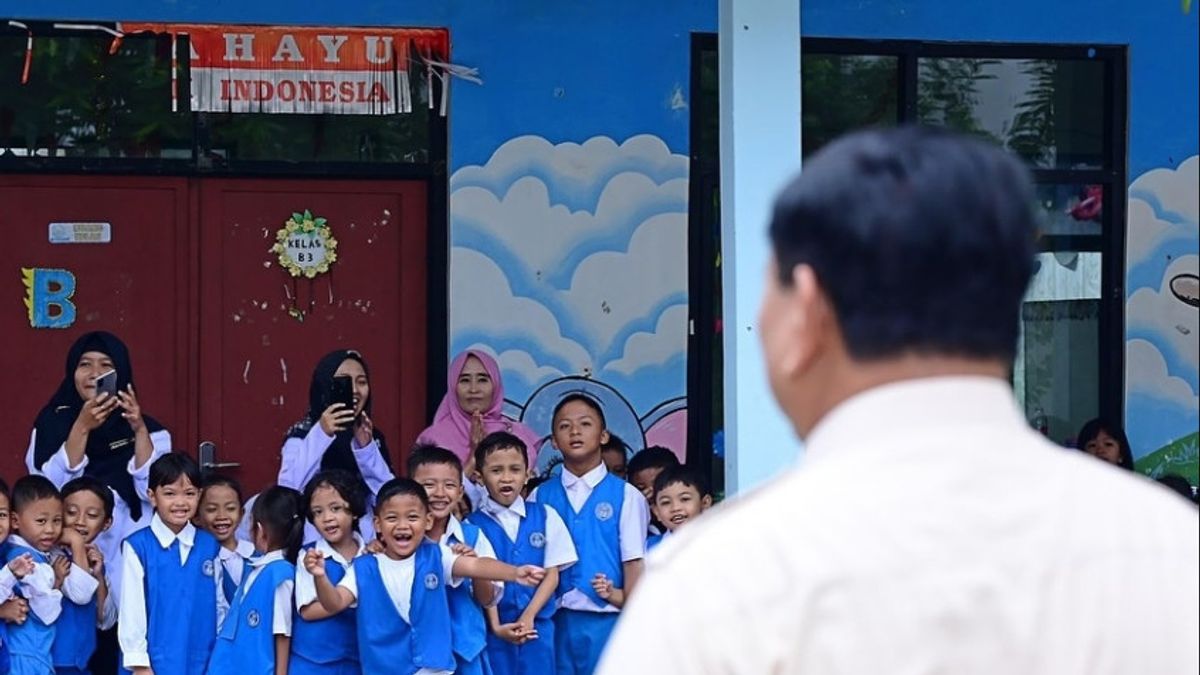


JAKARTA When there was confusion about the distribution of 3 kg LPG gas sticking out on various social media platforms, President Prabowo suddenly corrected the policy previously implemented. 3 kg LPG gas, which is often called tube gas melon', is circulating again through retailers after previously being only able to be purchased in official distributors. No matter how many weeks, melon gas cylinders are resold in stalls. People are happy.
Likewise with the policy of increasing VAT 12 percent. The people shouted, noisy, crowded with all concerns about the increase in the prices of necessities of life. And then the government gercep corrected, mentioning that VAT 12 percent was only intended for luxury goods. The atmosphere is cool again.
The viral condition of the based policy or viral-based policy does create a positive narrative, as if the government is responsive to all problems in society. However, this condition actually shows the weakness of coordination between institutions in the government. Synergy in the government, which many years ago echoed the results of zero.
Policy makers show doubt over all the decisions he makes. If this kind of thing continues and becomes a tradition, policy instability has the potential to erode investor confidence and create unnecessary market uncertainty.
If it is pulled wider into a problem that is currently also viral, budget efficiency, the implementation of this viral-based policy is very likely to cause misperceptions in society. In fact, it is not impossible to trigger greater anger.
This year, it began with unpleasant news, namely the massive policy of cutting fiscal spending. The cuts were large, reaching Rp306 trillion. This amount is equivalent to more than eight percent of the 2025 State Budget. President Prabowo emphasized the budget efficiency policy through Presidential Instruction Number 1 of 2025.
The budget efficiency policy is based on the need for funds to meet President Prabowo's flagship program, Free Nutrition Food (MBG). In addition, the budget cuts are also said to be used to fix dilapidated schools throughout Indonesia.
Budget efficiency may indeed be needed in the midst of a sluggish world economy. However, the planning to implement the Red and White Cabinet still leaves many questions, as well as controversy. This condition is proof that the policy was badly designed, and did not have a clear purpose.
It is proven by the decision to lay off honorary employees in various government institutions. The two that surfaced were on TVRI and RRI. As usual, this problem went viral after several honorary employees on TVRI and RRI conveyed the problems they faced through social media.
Not long after the issue of layoffs became a hot topic of conversation on social media, the government again issued a viral-based policy. Minister of Finance Sri Mulyani in front of members of the Indonesian Parliament said that there were no layoffs of honorary staff due to budget efficiency in ministries and institutions.
"There are no layoffs of honorary staff within ministries and institutions. We ensure that the efficiency measures or in this case the reconstruction of the ministry/institutional budgets have no impact on honorary staff," said Sri Mulyani, at a press conference at the Parliamentary Complex. RI, Senayan, Jakarta (14/2).
Sri Mulyani added that the Ministry of Finance she leads will conduct further research on the direction of efficiency from President Prabowo, as outlined in Presidential Instruction Number 1 of 2025. Prabowo signed the Presidential Instruction on January 22, 2025.
It is difficult to confirm, actually Presidential Instruction Number 1 of 2025 decides on efficiency or savings. Actually there is a different meaning between efficiency and savings. Design about efficiency, budget cuts, savings or whatever the name is, looks problematic.
In Sri Mulyani's version, Prabowo's move means that the focus is on increasing the efficiency of budget allocation without affecting the fiscal posture. If that is what is meant, then the total government spending budget in 2025 will not decrease. Only the allocation is changed, so that it is in line with the agenda of the new government and has a significant impact on the community.
But no one guarantees that this is pure efficiency, which does not affect the total budget. In reality, there are budget cuts here and there, but the budget reallocation plan is clear, official, and transparent. So it's only natural that a viral-based policy appears, which has become a trend in Indonesia in recent years.
Viral-based policies are not the right way to determine policy directions for the government. Viral-based policies are often made in a hurry. One important thing is that this viral-based policy is not included in the category of stages of making public policies. In fact, the application of viral based policies has the potential to create noise in society.
Pressure from the public through social media and mainstream media requires policymakers to immediately reduce negative issues. One way to reduce this negative issue is to make new policies in the shortest possible time.
Therefore, the principle of openness is very necessary in every public policy making. Every preparation of public policy involves the active participation of the community. It is possible that the government has referred to the existing data when drafting policies. However, there are often less applicative data when applied in the field.
The process of making public policies in Indonesia should follow a linear process that is cycled, rational, and gradual. Starting from the determination of the agenda, making academic reports to explore the urgency of problems that require intervention, and ending the evaluation.
SEE ALSO:
-
 | BERNAS
Pantauan Netray: Sentimen Negatif Warnai Kebijakan Efisiensi Anggaran
16 Februari 2025, 17:00


However, the sequence of these processes is often passed. Amanda Tan's research, a doctorate candidate in the field of Public Policy at Monash University, Melbourne, Australia on June 14, 2024, found this shortcoming. Even the determination of the agenda is often placed in the middle of the process, not at the beginning.
The process of making public policies in Indonesia is often carried out by jumping, not linear. The linear stages that should be carried out in every public policy making have never been carried out by the central and regional governments in Indonesia.
This condition is exacerbated by the emergence of brokery practices. They become intermediaries that become a bridge between evidence and policy. These brokers connect various stakeholders to get a perspective that a problem is categorized as urgent.
Virality then becomes meaningful to straighten out a problem that is really needed by the community, not on the basis of the interests of each person. This viral method is clearly not ideal, but still has a meaning for the public.
The government of President Prabowo, or whoever is the future leader of Indonesia, should capture this condition as a lesson. Public involvement should be widely applied in every policy-making process. The cycle of policy-making linearly should be obeyed.
Viral-based policies can damage the credibility of the government, if every public policy maker does not go through a linear process properly. The analytical capacity that is lost in the policy-making process in Indonesia, makes virality a habit.
State actors must really understand and feel the existing problems. Then make solutions through the right policies, so there is no need to go viral so that it becomes right.
The English, Chinese, Japanese, Arabic, and French versions are automatically generated by the AI. So there may still be inaccuracies in translating, please always see Indonesian as our main language. (system supported by DigitalSiber.id)
Most Popular Tags
#Prabowo Subianto #donald trump #firearm #8791 #giias 2026Popular


