

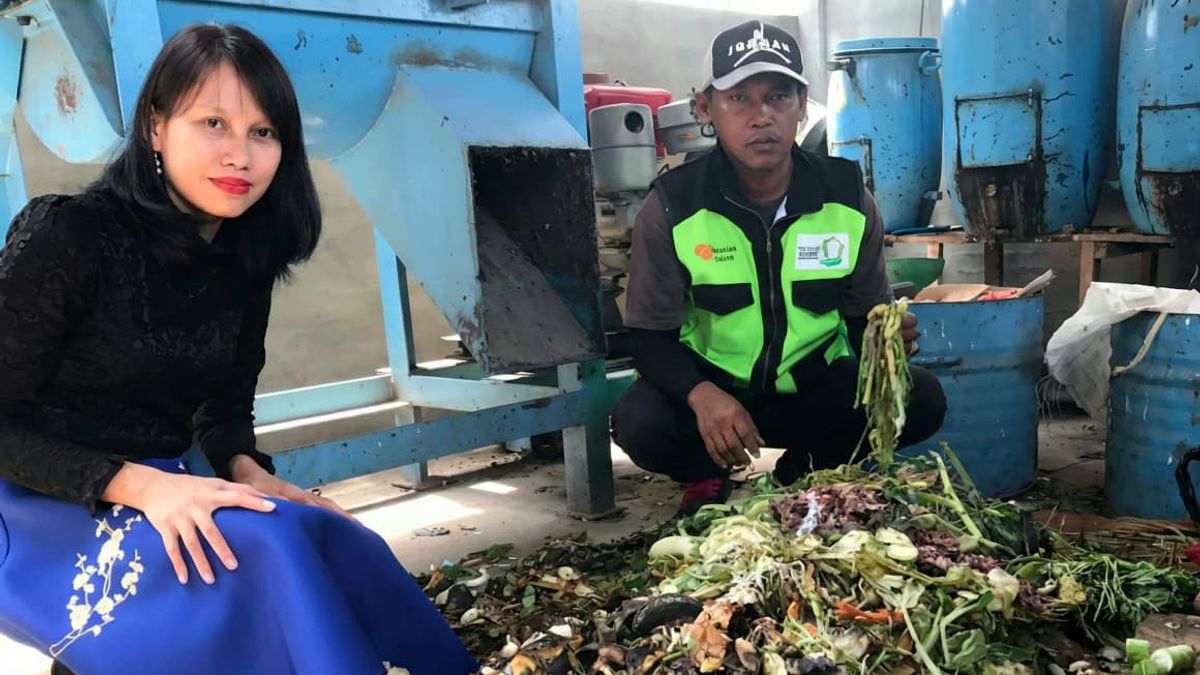


JAKARTA - The Association of Indonesian Waste Banks (ASOBSI) is a national forum that collects and strengthens the movement of waste banks in various regions. Led by Wilda Yanti as General Chair, ASOBSI plays a strategic role in encouraging waste management from its sources, namely households and communities.
ASOBSI's main focus is to ensure that waste is sorted from upstream, managed sustainably, and provides environmental, social and economic benefits for the community. In the context of an increasingly complex waste crisis, the existence of ASOBSI is an important node linking national policy and real practice at the site level.
Wilda Yanti emphasized that waste banks are not just voluntary environmental programs, but are part of the national waste management system that cannot be ignored.
Waste banks play a direct role in suppressing the emergence of waste to TPA, reducing pollution, and building public awareness about the responsibility of waste management.
Hulu is the key. If sorting does not work in the community, then no matter how good the technology downstream will always be overwhelmed," he said.
In relation to the Waste Processing policy into Electricity Energy (PSEL), ASOBSI expressed support for the government's efforts to find long-term solutions to urban waste problems. However, Wilda Yanti reminded that PSEL should not be positioned as a single solution.
Without strengthening the waste bank and TPS 3R (Reduce, Reuse, Recycle), PSEL risks simply moving the problem from one point to another. Mixed, wet, and inseparable waste will reduce technology efficiency and increase operational costs.
According to ASOBSI, waste banks and 3R TPS have a strategic function as providers of more controlled raw materials for the PSEL system. sorting in the source is able to reduce contamination, improve the quality of residuals entering processing facilities, and ensure the process of converting running energy is more optimal.
SEE ALSO:
-
 | BERITA
Kedua Kalinya Prabowo ke Aceh, Cek Penanganan Bencana dan Lokasi Terdampak
07 Desember 2025, 09:42 -
 | BERITA
Keluarga Ungkap, Ayah Tiri Alvaro Tewas Bunuh Diri di Polres Jaksel
24 November 2025, 14:50 -
 | BERITA
Bivitri Susanti Anggap Pemerintah Tergesa-gesa Mengesahan KUHAP Baru
20 November 2025, 09:39 -
 | BERITA
Ribka Tjiptaning Dilaporkan ke Bareskrim Usai Menyebut Soeharto "Pembunuh Jutaan Rakyat"
12 November 2025, 16:14 -
 | BERITA
Polisi Ungkap Kronologi Siswi SD Ditemukan Tewas Usai Diperkosa Tetangganya
14 Oktober 2025, 16:38

In addition, upstream strengthening also creates additional benefits in the form of local employment opportunities, circular economies, and reducing environmental burdens in the area around the TPA.
Wilda Yanti emphasized the importance of policy alignment. Support for PSEL must go hand in hand with strengthening regulations, funding, and assistance for waste banks and 3R polling stations. "If the government is serious about PSEL, then it is also serious about strengthening actors upstream. Waste banks and 3R TPS should not only be seen as a complement, but as a foundation of the system," he said.
ASOBSI encourages local governments to make waste banks an official partner in an integrated waste management system. Incentive schemes, data integration, capacity building, and simple technology support are considered important so that this movement is sustainable. That way, the PSEL policy does not stand on a fragile system, but is supported by an active and empowered community network.
Strong waste management always starts from upstream. When the community is involved, the waste bank is strengthened, and the 3R TPS functions optimally, then PSEL will run more efficiently and fairly. That's where the policy direction should move," concluded Wilda Yanti.
The English, Chinese, Japanese, Arabic, and French versions are automatically generated by the AI. So there may still be inaccuracies in translating, please always see Indonesian as our main language. (system supported by DigitalSiber.id)
Most Popular Tags
#Prabowo Subianto #donald trump #Febrie Adriansyah #8791 #giias 2026Popular


