
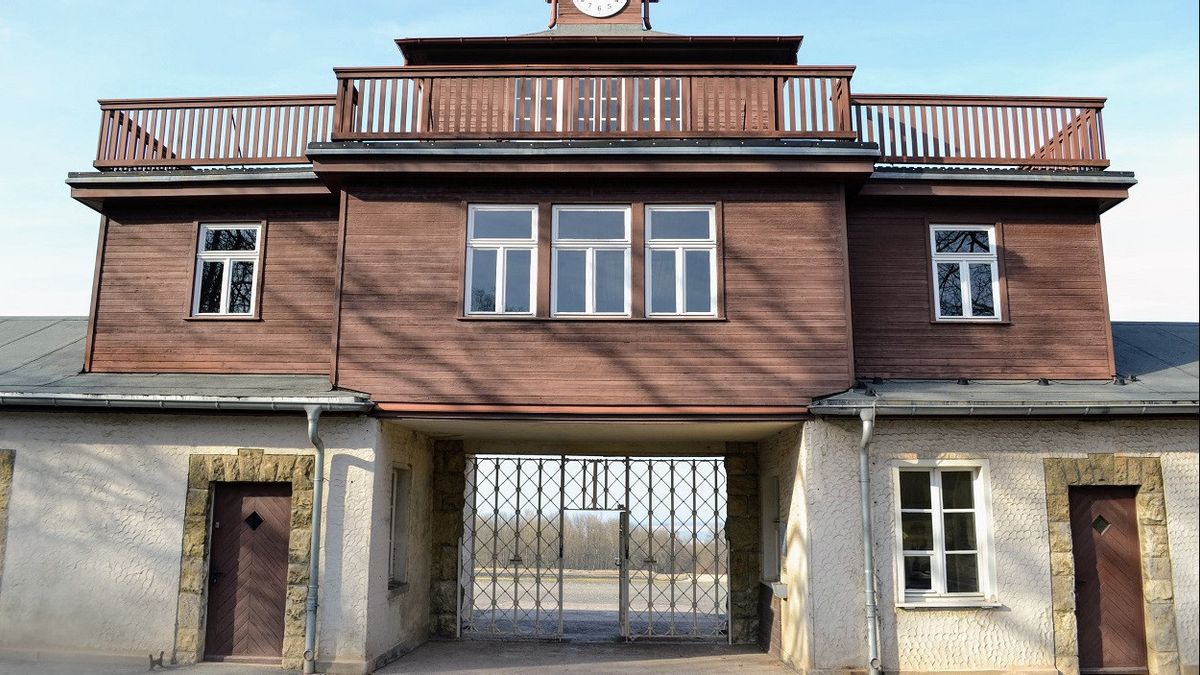


JAKARTA - The German court ruled that the Nazi concentration camp monument has the right to refuse entry for those wearing Palestinian keffiyeh.
The court rejected a woman's request against Israel's current policy of being allowed into the Buchenwald concentration camp monument while wearing a keffiyeh.
The woman was rejected while trying to attend the 80th anniversary of the camp's release last April while wearing the scarf, as confirmed by the monument.
The monument told the Die Welt newspaper its decision was related to the context in which the scarf was worn.
He then submitted a request to the top-level administrative court in eastern Thuringia state to be allowed to return to the site for another memorial service this week, again while wearing keffiyeh.
The court ruled that the monument had the right to reject the woman's entry, referring to the woman's declared purpose of "sending a political message against what she considers a unilateral support for the Israeli government's policy".
"There is no doubt that this will threaten the sense of security of many Jews, especially at this location," the court said, launching The National August 21.
The woman's right to freedom of expression was defeated by the interests of the monument to "maintain the institution's goals," he added.
Germany, which is still trying to make up for the killings of six million Jews in the Holocaust, has long been one of Israel's strongest allies.
However, in recent months, Germany has sharpened its criticism of Israel's actions in Gaza, with Chancellor Friedrich Merz announcing this month that there will be no more permits granted for arms exports that can be used to attack Gaza.
The Buchenwald monument received criticism last month after internal documents were leaked, describing keffiyeh as "deeply linked to attempts to destroy the Israeli state".
The director of the monument, Jens-Christian Wagner, has since said the document contains a "mistake" and must be revised.
Regarding keffiyeh, he told NDR television station last month the symbol was not automatically "forbidden" at the monument.
SEE ALSO:
-
 | BERITA
Israel Undang Ratusan Delegasi Asing di Tengah Kritik Terhadap Situasi Jalur Gaza
21 Agustus 2025, 18:45 -
 | BERITA
PBB Sebut Sanksi AS Terhadap Hakim dan Jaksa ICC Merusak Pondasi Keadilan Internasional
21 Agustus 2025, 14:00

"However, when used with other symbols, to reduce Nazi crimes, we will ask people to remove these symbols," he explained.
About 340,000 prisoners, including Jews, Rome and the Soviet Union survived Buchenwald and its branches Mittelbau-Dora, both near the German city of Weimar.
About 56,000 people died in Buchenwald some were executed, others were starving or dying from forced labor and another 20,000 people were killed in Mittelbau-Dora, where prisoners worked to build V1 and V2 Nazi rockets.
The English, Chinese, Japanese, Arabic, and French versions are automatically generated by the AI. So there may still be inaccuracies in translating, please always see Indonesian as our main language. (system supported by DigitalSiber.id)
Most Popular Tags
#Prabowo Subianto #donald trump #2026 World Cup #Febrie Adriansyah #8791Popular


