


JAKARTA - The United Nations said no aid had yet been distributed in the Gaza Strip, a day after Israel allowed limited humanitarian aid deliveries to resume after an 11-week blockade in the Palestinian enclave, where experts warn hunger is now threatening.
UN spokesman Stephane Dujarric said four baby food trucks were unloaded on the Palestinian side of the border on Monday, while several dozen flour trucks, medicines, nutritional supplies, and other staples entered Gaza on Tuesday.
"Israeli authorities required us to lower supplies on the Palestinian side of the Kerem SALom crossing and load it back separately after they secured access to our team from within the Gaza Strip," Dujarric told reporters.
"Today, one of our teams waited a few hours until the Israeli green light to access the Kerem SALom area and pick up the nutritional supplies. Unfortunately, they were unable to bring the supplies to our warehouse," he said.
Earlier on Tuesday, a spokesman for the United Nations humanitarian office in Geneva said Israel had granted permission for about 100 aid trucks to enter Gaza.
On Monday, UN aid chief Tom Fletcher said the initial amount of aid approved by Israel was "dropping water in the ocean".
Last week, Israel said it plans to intensify military operations against Hamas and to control the entire Gaza, which has been destroyed by Israeli air and land warfare since a cross-border Hamas attack on the Israeli community in October 2023.
Israel claims its blockade was aimed partially at preventing Palestinian militants from diverting and seizing aid supplies. Hamas denies doing so.
Separately, a US-backed group plans to start working in the Gaza Strip in late May, overseeing a new model of distribution of aid in the Palestinian enclave. However, the United Nations says the plan is impartial or neutral, and will not be involved.
SEE ALSO:

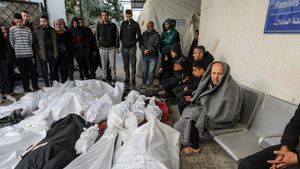



A health official at the UNN Palestinian refugee agency UNRWA in Geneva on Tuesday said the level of malnutrition in the densely populated region had increased during the Israeli blockade and could worsen if food shortages continued.
"I have data until the end of April and the data shows malnutrition continues to increase," said UNRWA Health Director Akihiro Seita.
"The concern is that if the current food shortage continues, it will increase exponentially, and then be beyond our control," he added.
The English, Chinese, Japanese, Arabic, and French versions are automatically generated by the AI. So there may still be inaccuracies in translating, please always see Indonesian as our main language. (system supported by DigitalSiber.id)


