


JAKARTA - Although it is increasingly being discussed, in fact the circular economy is not simple to realize, especially for plastic packaging. An extensive network is needed with various parties, as well as an open mind and the spirit of multi-sector collaboration. Starting from manufacturers responsible for reprocessing used packaging from consumers, people responsible for disposing and sorting waste, waste banks that collect and sorting waste according to their use value, to recycling that reprocesses plastic packaging so that they can be reused and have new selling value.
The number of parties who need to be involved can be one of their own challenges, especially when they don't know each other and understand each other's roles.
Based on data from the KLHK National Waste Management Information System (SIPSN), around 64 percent of waste is managed from more than 33 million tons of waste collected from 308 districts/cities in Indonesia in 2023. To achieve the 100 percent waste management target, active roles and collaborations of various parties are needed.
Some of the problems that are often encountered in the community-based waste management ecosystem include a lack of information and education about types of waste, as well as access and relationships with recyclers (offtakers) who will buy waste that has been collected and managed by waste Bank activists. For this reason, a unique and different solution is needed to support more effective and sustainable community-based waste management.
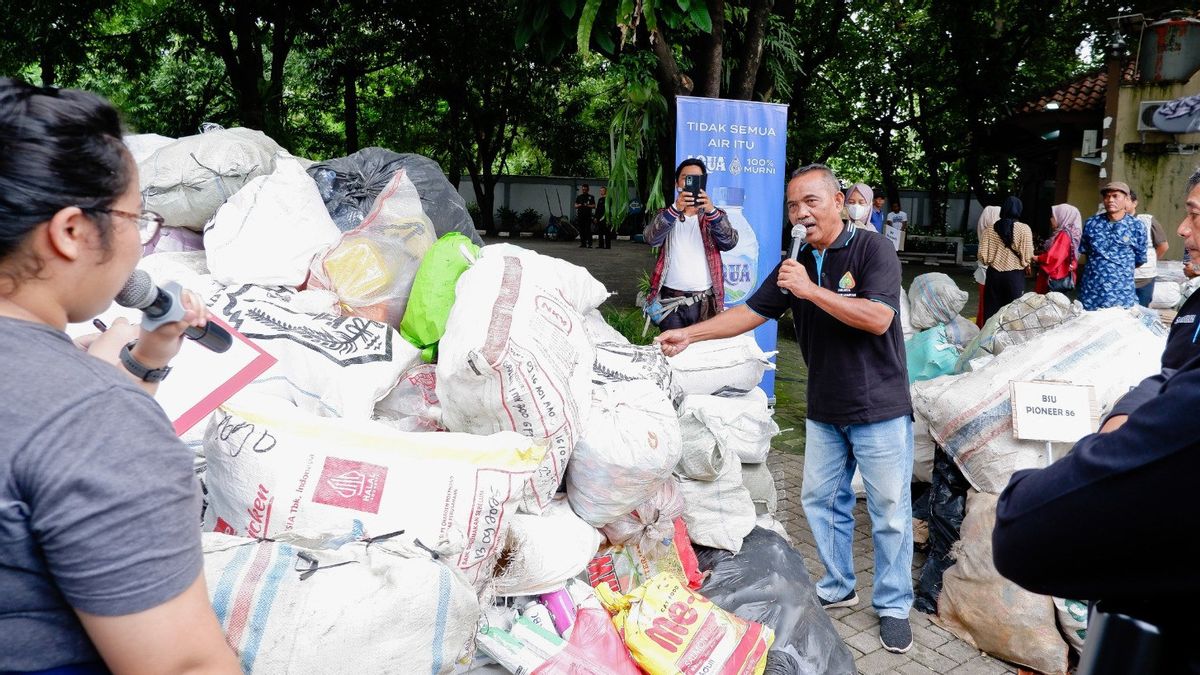
One of them is the Garbage Auction activity, an initiative that was first carried out in Indonesia. This Waste Auction activity is also part of a series of commemorations of the 2025 National Waste Care Day (HPSN).
Like an auction of art, which is common, this auction activity is carried out to make the waste that has been sorted and collected at the Unit Waste Bank (BSU) a commodity worth selling. This garbage auction is also a forum that brings together BSU with offtakers who will take and recycle the waste.
This is important in order to increase waste management capacity, both in terms of quality and quantity. Not only that, but Waste Auction also acts as a means of education and relaxation, as well as introducing quality standards for sorting waste with high economic value to BSU.
Garbage auctions are one of the collective actions under an innovative program titled #EcoResolution 2025 initiated by AQUA in collaboration with the Ministry of Environment (KLH) and partners in order to welcome National Waste Care Day. This program is a follow-up to the "Disposal Bank Management Training" which has been organized by AQUA in collaboration with the DKI Jakarta Environmental Agency (DLH), and the Divers Clean Action (DCA). This waste auction initiative and innovation is expected to increase public awareness in community-based waste management.
The waste auction activities that were held for the first time today were also attended by representatives of multi-sectors, including Drs. Ade Palguna Rutika, Deputy for Waste Management, Waste, and Hazardous and Toxic Materials (KLH/BPLH), Agus Rusli, Director of Waste and Economy Reduction of Circulars, Novrizal Tahar, Director of Waste Management, Asep Kuswanto, Head of the DKI Jakarta Provincial Environment Agency, Dr. Ir. Tri Liayanti, ST, M.S. Director of Chemical Industry Downstream & Pharmacy Ministry of Industry, Astri Wahyuni, Public Affair and Sustainability Director of Danone Indonesia, and Ahmad Nuzuluddin as Chairman of Indonesia Plastic Recyclers (IPR), as well as Swietenia Puspa Lestari from Divers Clean Action (DCA).
Drs. Ade Palguna Rutika, Deputy for Waste Management, Waste, and Hazardous Toxic Materials (PSLB3) of the Ministry of Environment/Environmental Control Agency who was also present at the event said this was a good step and I appreciate AQUA for its commitment.
"As a pioneer, I hope that AQUA can be an inspiring example for other companies. However, keep in mind that companies that produce plastic packaging cannot only take cover behind the initiatives of either that AQUA has done. Real collaboration in plastic waste management must involve all parties, both from the government and industry. In the future, we plan to carry out this activity regularly and invite more parties to join, including the Waste Bank, Buyer/Offtaker, and other plastic packaging companies, together to create bigger and more sustainable solutions," he explained.
Meanwhile, Astri Wahyuni, Public Affairs and Sustainability Director of Danone Indonesia, said that AQUA, has been present in Indonesia for 70 years, rooted, and became a pioneer in various sustainability and environmentally friendly initiatives. This Waste Auction activity, especially as a momentum to bring together Waste Bank activists with offtakers, so that the waste that has been collected becomes a commodity and has a selling value. S
"For example, the plastic packaging of former PET that has been collected by the Waste Bank, was bought by offtakers who are also AQUA partners such as Veolia or Namasindo, to then recycle it into RPET packaging. Since 2018, AQUA has been the pioneer of environmentally friendly initiatives, one of which is through packaging gallons to repeat and the #BijakBerplastic movement, inviting the public to be wiser in using and managing plastic waste," he explained.
As a manifestation of the commitment to developing waste collection infrastructure, AQUA also contributes to building a Recycling Business Unit (RIBU) as a social model for recycling business to reprocess plastic bottle waste into plastic waste to be used as a raw material for recycling products.
To date, AQUA has involved more than 10,000 scavengers through 11 Recycling Business Units (RIBU), 2 TPST, 12 TPS3R, 13 collection centers, and 60 waste banks. In an effort to educate consumers and the public, the waste management-related education program carried out by AQUA and its partners has reached 19 million people.
In an effort to innovate packaging, AQUA has ambitions to make 100% packaging reusable, recycled or used as compost. For various efforts that have been made by AQUA and its partners, the company has managed to collect more than 22,000 tons of plastic waste per year.
SEE ALSO:
-
 | EKONOMI
Ini Penyebab Dolar Perkasa di Negara Berkembang tapi Lemah di Negara Maju
23 Juni 2023, 19:02 -
 | EKONOMI
Paris Summit 2023 Ungkap Belum Ada Investasi Ideal dalam Transisi Energi
23 Juni 2023, 17:19

Ahmad Nuzuluddin, Chairman of the Indonesian Plastics Recyclers (IPR) said that his party in the recycling industry needs 2 million tons of plastic waste per year, and even though they never refuse goods sent by the Waste Bank, grouping and more thorough sorting are still needed so that the value of waste entering the industry does not decrease.
"Currently, the industry is still short of 1 million tons of waste, thus opening up great opportunities for Waste Banks to play a more active role. The key is collaboration between sectors to meet this need, but incoming waste must meet certain criteria so that it can be accepted by the industry. That way, if all the recycling components move together, we can not only reduce the waste that enters the TPA, but also drive the economy more effectively," he said.
AQUA realizes that the key to dealing with waste is collaboration. With active communication and understanding between Waste Banks and offtakers from activities like this, the public will increasingly be aware of the value of waste as a commodity, and will further raise public awareness to collect, sort, and recycle waste, while increasing public awareness and encouraging the circular economy.
"Therefore, we do not stand alone, but work together with the DKI Jakarta Environmental Agency, the Divers Clean Action, and the ladies and gentlemen of the waste bank. This collaboration has also yielded significant results. By 2024, AQUA has partnered with 500 waste banks throughout Indonesia, including in Jakarta, where there are 4 Main Waste Banks (BSI) and 35 Unit Waste Banks (BSU) which collect around 15 tons of bottle PET waste every month. We hope that this step can inspire more parties to participate. Sustainability is a shared responsibility, and with the support of the government, partners, as well as the community, we believe that the more parties involved in this program will accelerate the achievement of circular economic targets," concluded Astri.
The English, Chinese, Japanese, Arabic, and French versions are automatically generated by the AI. So there may still be inaccuracies in translating, please always see Indonesian as our main language. (system supported by DigitalSiber.id)
Most Popular Tags
#Prabowo Subianto #donald trump #firearm #8791 #giias 2026Popular


