
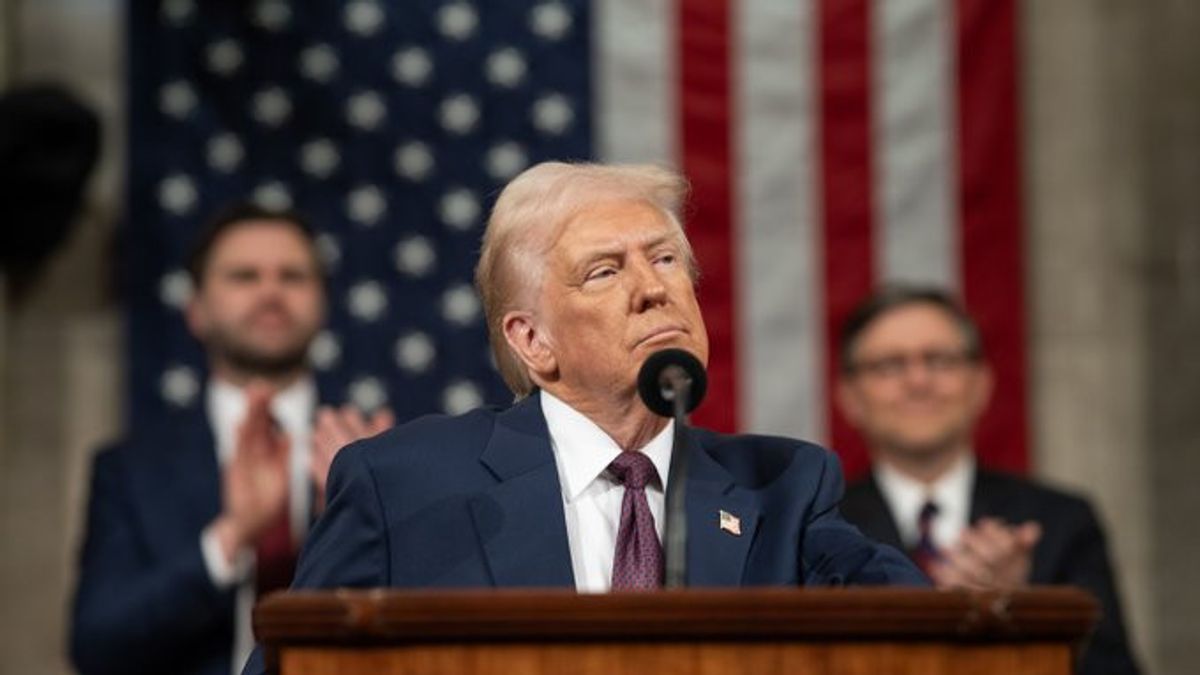


JAKARTA President Donald Trump called for the 2022 bipartisan law to provide subsidies of US$52.7 billion (Rp860 trillion) for semiconductor chip manufacturing and production to be removed. Trump stressed that the funds would be better used to pay off national debt.
"The CHIPS law is a terrible thing. We gave hundreds of billions of dollars and that means nothing. They took our money and didn't use it properly," Trump said in a speech at Congress on Tuesday 4 March. "You have to remove the CHIPS Act, and whatever's left, use it to reduce debt."
The CHIPS and Science Law signed by President Joe Biden in August 2022 includes a US$39 billion subsidy for semiconductor manufacturing in the US as well as government loan authorities worth US$75 billion.
Trump Strong Criticism Of Semiconductor Subsidy
Trump's comments have been his strongest criticism of the CHIPS Act so far. He argues that semiconductor companies do not need to be given subsidies to build factories in the US, but simply by avoiding high import rates.
The current US Commerce Secretary, Howard Lutnick, has previously praised the program, but also stated that he wants to review the grants that have been approved in the Biden era.
Under the leadership of the Minister of Trade, Gina Raimondo, in the Biden era, five leading global semiconductor companies agreed to build a US plant with the help of government grants as part of efforts to reduce national security risks due to dependence on imported chips.
In recent weeks of the Biden administration, the US Department of Commerce has approved more than $33 billion in grants, including US$4.745 billion for Samsung Electronics from South Korea, to US$7.86 billion for Intel, US$6.6 billion for Taiwan Semiconductor Manufacturing Co (TSMC), and US$6.1 billion for Micron.
Concerns Over Cancellation Of Grant Contracts
Officials voiced concerns that Trump could cancel the grant agreement already approved in the Biden administration.
New York Governor, Kathy Hochul, insists that the CHIPS Act is the main reason for Micron to invest $100 billion and create 50,000 jobs in Central New York. "Trump has just said that he wants to remove it," Hochul said.
On the other hand, TSMC recently announced an additional $100 billion investment plan in the US, which includes the construction of five chip manufacturing facilities in the next few years.
Trade Minister Lutnick mentioned at the event at the White House on Monday 3 March that TSMC had received a grant of US$6.6 billion, but confirmed that the US government would not provide additional subsidies to the Taiwanese company. Even so, TSMC remains eligible for a 25% manufacturing investment tax credit. The company also revealed that it had received a grant of US$1.5 billion last month.
SEE ALSO:
-
 | TEKNOLOGI
Video CEO YouTube Digunakan Penjahat Siber untuk Tipu Kreator Konten
05 Maret 2025, 19:05 -
 | TEKNOLOGI
Tony Hawk's Pro Skater 3+4 Akan Diluncurkan pada 11 Juli di Konsol dan PC
05 Maret 2025, 17:10 -
 | TEKNOLOGI
Tips Aman Berbelanja Online Saat Ramadan: Lindungi Data Pribadi Anda!
05 Maret 2025, 16:35


Impact On US Semiconductor Industry
Trump's remarks drew criticism from various parties, including representatives from Arizona, Greg Stanton, who called the comments a "direct attack on the Arizona semiconductor industry and tens of thousands of workers there." Stanton stressed that TSMC's $100 billion investment would not have occurred without the CIPS Act.
Meanwhile, the new Trump administration has started a major review of projects funded under the program. Reuters reports that about a third of staff at the US Commerce Department's office in charge of the US$39 billion subsidy distribution for chipmakers have been laid off this week.
With this review and budget cuts step, the future of the US semiconductor subsidy policy is under uncertainty, amid increasingly fierce global competition in the high-tech industry.
The English, Chinese, Japanese, Arabic, and French versions are automatically generated by the AI. So there may still be inaccuracies in translating, please always see Indonesian as our main language. (system supported by DigitalSiber.id)


