
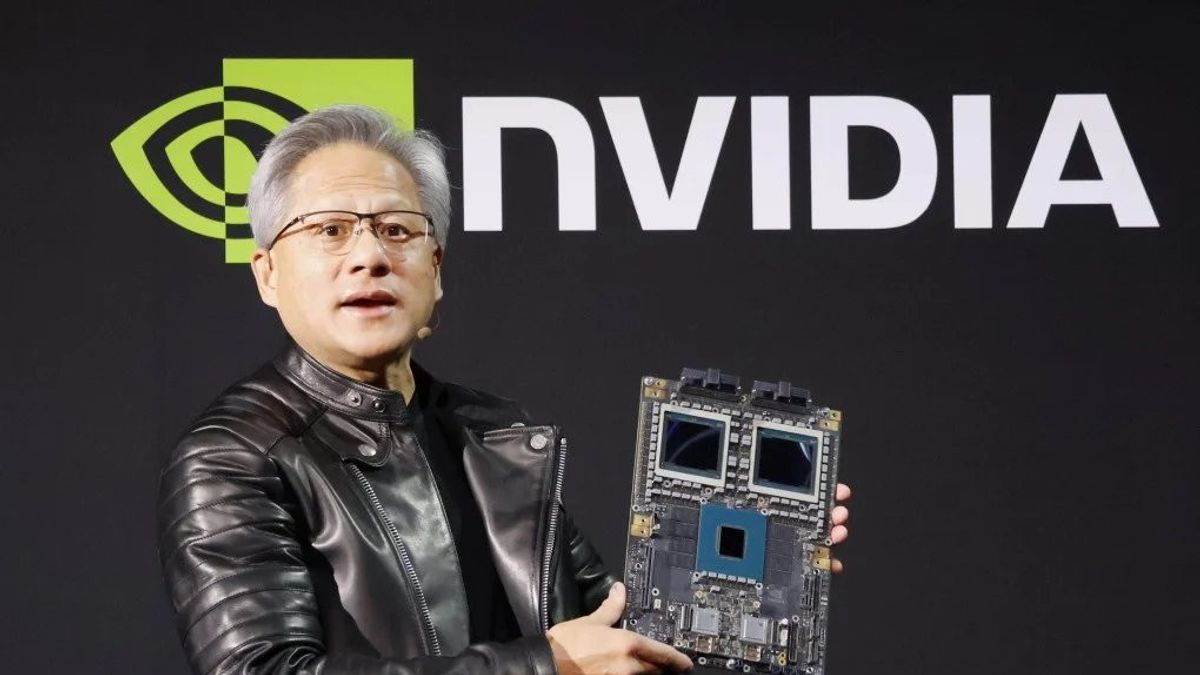


JAKARTA - The Chinese government has reportedly given official permission to its three largest technology giants - ByteDance, Alibaba, and Tencent - to acquire Nvidia's latest artificial intelligence (AI) chip, H200. This move marks Beijing's strategic shift in balancing national AI ambitions with domestic technological independence.
Based on a Reuters report on Wednesday, January 28, four sources familiar with the situation said that the three companies have been approved to purchase a total of more than 400,000 H200 chip units. Currently, a number of other technology companies are rumored to be queuing up to get similar approval in the next wave.
This decision comes amid a prolonged technology tension between the United States and China. Although the US has granted export permits for H200 chips to China earlier this month, the main obstacle comes from China itself. Beijing was hesitant to allow imports in order to spur the adoption of local products.
However, the magnitude of the performance gap seems to force Beijing to soften. The H200 chip is recorded to have six times the performance of the H20 chip - Nvidia's previous version of the product was deliberately cut to fit US export regulations.
A source said the approval came in conjunction with Nvidia CEO Jensen Huang's visit to Shanghai and Beijing this week.
"The Chinese government only gave approval with certain conditions, and details regarding these conditions are still in the finalization stage," said an anonymous source quoted by VOI from Reuters.
"Bundling" Domestic ChipsEven though the green light has been given, Beijing is not letting go of control. The Chinese government is reportedly discussing a domestic chip quota scheme. In the proposal, every purchase of an Nvidia H200 unit is likely to be accompanied by the purchase of domestically produced chips (such as those made by Huawei) with a certain ratio.
This "Balancing Act" strategy is carried out so that China's major internet companies can still compete with global rivals such as OpenAI, while ensuring that the local semiconductor industry continues to grow.
However, this transition is not without obstacles. The fifth source stated that until now, customers have not completely converted the approval into purchase orders because the rules are considered too restrictive.
"The license granted at this time is considered too restrictive, so customers are still weighing it before actually executing the order," added the source.
Chinese tech companies' enthusiasm for the H200 is massive. Last month, Reuters reported that orders from Chinese companies had exceeded two million units, a figure far exceeding Nvidia's current inventory capacity.
Until this news was released, the Ministry of Industry and Trade of China, Nvidia, as well as ByteDance, Alibaba, and Tencent have not given an official response regarding the details of the quota and import requirements.
The English, Chinese, Japanese, Arabic, and French versions are automatically generated by the AI. So there may still be inaccuracies in translating, please always see Indonesian as our main language. (system supported by DigitalSiber.id)


