
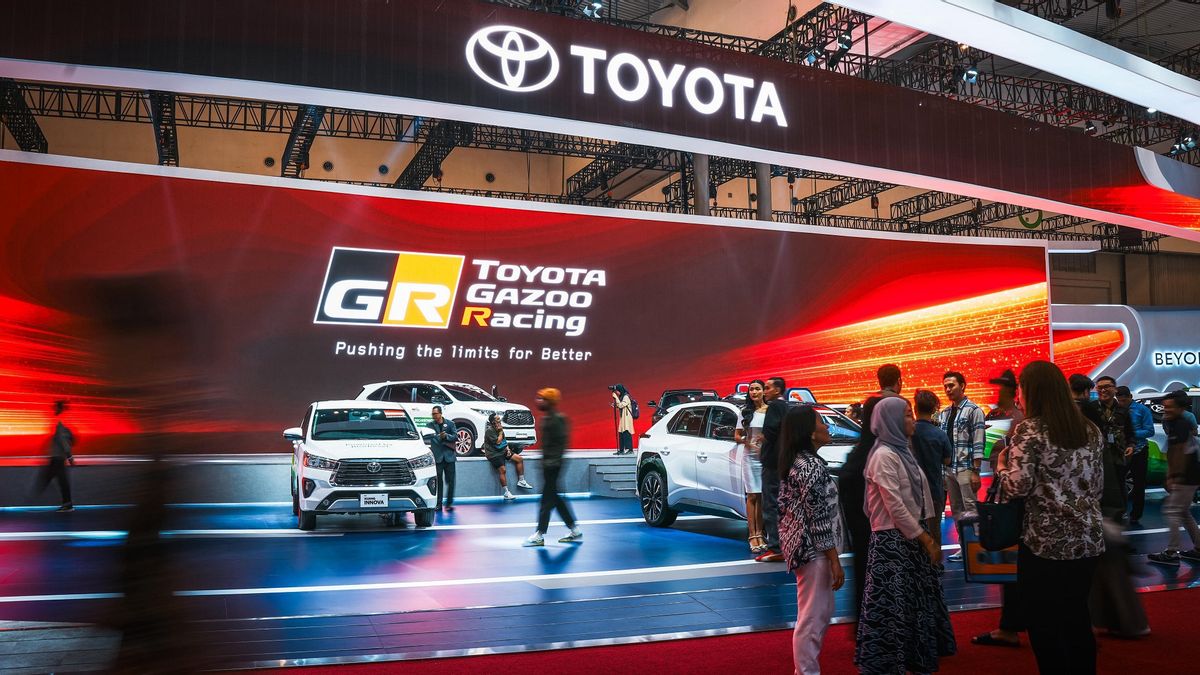


Toyota has managed to maintain its position as Indonesia's automotive market leader for the last two decades, with an average market share of more than 30 percent.
Based on data from the Association of Indonesian Automotive Industries (Gaikindo), total car sales in Indonesia will reach 865,723 units in 2024.
The Toyota and Lexus groups dominate the market with total sales reaching 291,566 units (market share 33.7 percent), followed by its subsidiary, Daihatsu, which occupies a second sales position of 163,032 units.
We are very grateful for the trust of the Indonesian people so far in the mobility solutions we offer. This is our long-term loyalty in assisting Indonesia's growth, not only as an automotive producer, but as a strategic partner in building the future of mobility, the environment and society," said Vice President Director of PT Toyota-Astra Motor (TAM), Henry Tanoto at the 2025 Gaikindo Indonesia International Auto Show (GIIAS), ICE BSD City, Tangerang, as reported by ANTARA.
In addition, Toyota also dominates a hybrid market in the country, by controlling a hybrid market share of 59 percent.
This achievement, according to the President Director of PT TAM Hiroyuki Ueda, was achieved thanks to Toyota's multi-pathway strategy, Beyond Zero's initiative, including by presenting electrification vehicles such as hybrid.
The multipathway strategy is Toyota's approach in presenting various electrification and mobility solutions, not only fixated on one type of technology, to achieve carbon neutrality targets.
The form of solutions in the Japanese manufacturer's Multi-Pathway Strategy is to provide a wide selection of electrification technologies such as electric vehicle (HEV), plug-in hybrid electric vehicle (PHEV), battery electric vehicle (BEV), and fuel cell electric vehicle (FCEV).
Some current Toyota hybrid vehicles such as the Corolla Cross Hybrid, Yaris Cross Hybrid, Kijang Innova Zenix Hybrid, Alphard Hybrid, and others, while Toyota Mirai is one example of Toyota's current FCEV vehicle, as well as bZ4X and Urban Cruiser as Toyota's BEV.
SEE ALSO:
-
 | MOBIL
Subaru Luncurkan All-New Forester di GIIAS 2025, Perdana di Asia Tenggara
24 Juli 2025, 17:13

While Beyond Zero is Toyota's global vision that reflects the company's commitment to not only achieving zero carbon emissions (zero emissions), but also surpassing it by providing additional benefits to humans, society and the environment.
Through a multi-path strategy, Toyota presents various solutions to environmentally friendly mobility, one of which is the Toyota Hybrid model which gets positive acceptance by the community so that it manages to dominate 59 percent of the national Hybrid market," said Hiroyuki.
This success, according to Hiroyuki, is also the fruit of the development of a comprehensive mobility ecosystem, reflecting Toyota's efforts to provide products and services relevant to the needs of the Indonesian people.
Through various local partnerships, Toyota has consistently strengthened its strategic role in developing the national automotive industry.
In an effort to strengthen the industry from upstream to downstream, Toyota maximizes the involvement of domestic resources through research and development, production, increasing the use of local components, and developing human resources.
"We will also actively pass the rate of five manufacturing factories in Indonesia to strengthen the industrial national foundation. All of these activities are supported by more than 350,000 local workers, including the value chain and supply chain," said Hiroyuki.
Toyota has also made Indonesia the main production and export base in the Global South region, with a cumulative total of nearly three million units of vehicles to various countries.
The English, Chinese, Japanese, Arabic, and French versions are automatically generated by the AI. So there may still be inaccuracies in translating, please always see Indonesian as our main language. (system supported by DigitalSiber.id)
Most Popular Tags
#Prabowo Subianto #donald trump #2026 World Cup #venezuela #konflik timur tengahPopular


