
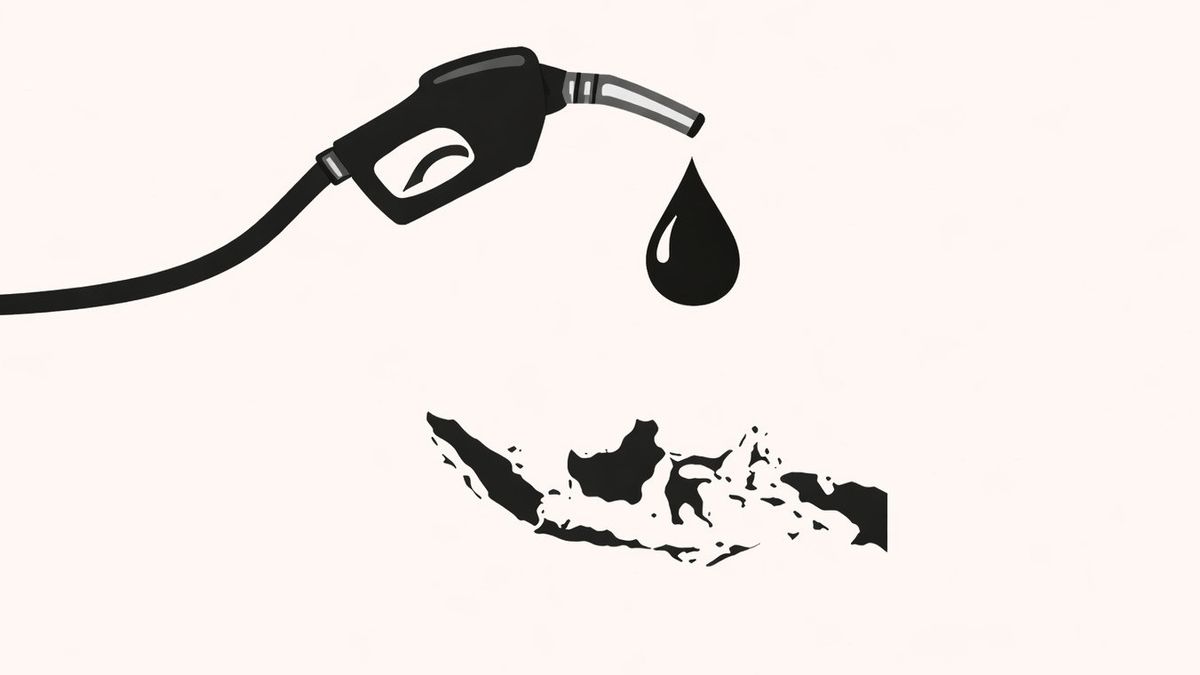


Donald Trump may have looked relaxed, even watching the UFC, when the negotiations between the United States and Iran ended without results. But the market does not work with political gestures. Markets count risks. And for Indonesia, what matters is not the spectacle, but the consequences that may come afterwards.
The deadlock in negotiations shows that global energy uncertainty has not really subsided. When negotiations are stalled, old concerns soon reappear. Energy supplies can be disrupted, oil prices can easily fluctuate, transportation costs are pushed up, and the pressure spreads to importing countries. Indonesia is included in it.
This concern occurs because the Strait of Hormuz remains one of the most sensitive energy routes in the world. A number of international data show that the flow of oil crossing the route remains very large, as does global LNG trade passing through it. Therefore, any tension around Iran is almost always read by the market as a signal of risk for world energy supply. The market's response to the tension has been seen from the rise in crude oil prices, while a number of countries have begun to adjust domestic fuel prices. "
Here Indonesia must count calmly. Indonesia did not sit at the negotiating table. However, Indonesia can still accept the impact. When the world energy price rises or moves wildly, the pressure does not stop in the international market. It can enter the country through import costs, distribution costs, daily commodity prices, and the burden on the state budget.
The government has so far chosen to hold back the direct impact. The price of subsidized fuel was decided not to rise until the end of 2026. Finance Minister Purbaya Yudhi Sadewa said the state budget was still enough to take care of it. President Prabowo Subianto also emphasized that subsidies were maintained to protect the little people. Efficiency measures are also one of the government's efforts to close subsidies.
This policy is important, especially to maintain the purchasing power of the lower group so that they are not immediately hit by global turmoil. In the short term, this step gives people breathing room and helps maintain stability.
"But holding prices does not necessarily eliminate the burden. The pressure is shifted to the fiscal, because the state must provide a larger budget so that the energy turmoil does not immediately turn into a social shock."
Therefore, the main question is not merely whether the fuel price will rise today or tomorrow. The question is until when the state budget can withstand the pressure if the energy turmoil lasts longer than expected?
Other problems are also not completely resolved. For non-subsidized fuel, the government is still observing the development of world oil prices before deciding whether or not to adjust. This means that there is cushioning, but not all pressures can continue to be absorbed by the country without limit. The public needs to see this situation clearly. Prices that seem stable on the surface do not necessarily mean that the burden has disappeared.
The Minister of Energy and Mineral Resources, Bahlil Lahadalia, himself stated that Indonesia had passed the critical period of fuel supply even though the turmoil in the Middle East had caused oil prices to rise. According to Bahlil, the national energy supply remains safe because Indonesia does not import fuel from the region, while the need for crude imports can be diverted from countries such as Angola, Nigeria, Australia, and the United States.
But considering the deadlock between the United States and Iran as a distant event that has nothing to do with daily life in Indonesia is also wrong. In an interconnected economy, a failure of diplomacy in one region can turn into a rise in the cost of living elsewhere.
Therefore, this issue cannot be seen as a mere foreign political drama. The essence is much closer than that. If tensions continue to persist, Indonesia will face an easy choice. Keeping prices low with a heavier fiscal burden, or adjusting prices with the risk of hitting people's purchasing power.
In the end, what is being tested is not only the result of negotiations between the United States and Iran. What is being tested is also the durability of Indonesia's own policies. How long can prices be held, how strong is the budget to bear the burden.
In that case, the deadlock between the United States and Iran is not news far away. It could turn into something very close. The cost of living, the country's shopping space, and the economic resilience of Indonesian households. If that's the case, food and energy self-sufficiency is absolute.
The English, Chinese, Japanese, Arabic, and French versions are automatically generated by the AI. So there may still be inaccuracies in translating, please always see Indonesian as our main language. (system supported by DigitalSiber.id)
Most Popular Tags
#Prabowo Subianto #donald trump #firearm #8791 #giias 2026Popular


