
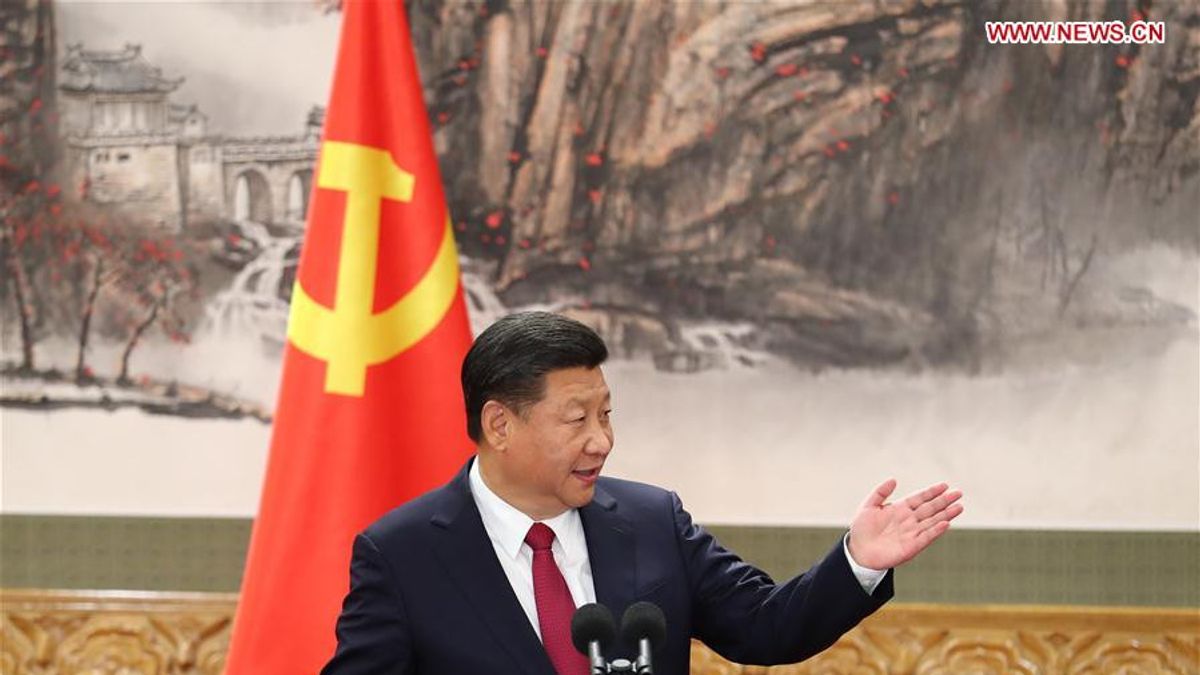


JAKARTA - President Xi Jinping on Tuesday promised China would play a "constructive role" in promoting peace talks in the Middle East, while urging respect for the autonomy of countries in the war-torn region, state media reported.
That was conveyed by President Xi when meeting with the Crown Prince of Abu Dhabi Sheikh Khaled bin Mohamed bin Zayed Al Nahyan in Beijing, outlining proposals to maintain peace in the Middle East and Gulf.
"Xi Jinping stressed China's principled stance in promoting peace and urging negotiations, and reiterated that China will continue to play a constructive role in this regard," the state-run Xinhua news agency said, as reported by Al Arabiya and AFP (14/4).
It is known that the first round of discussions between Iran and the United States held in Pakistan at the weekend was deadlocked and failed to produce an agreement.
Vice President JD Vance, who led the US delegation, said the ball was now in Iran's court to end the war.
President XI's comments were part of four proposals he put forward as a way to promote peace in the Middle East, according to state broadcaster CCTV.
"The autonomy, security, and territorial integrity of the Gulf countries in the Middle East must be sincerely respected," said President Xi.
"Maintaining the authority of international law cannot mean 'used when it is profitable, lost when it is not profitable'," he added.
Although he did not elaborate, President Xi also stressed the need to maintain a UN-based world order, and coordinate on security and development issues.
Tensions broke out in the Middle East on February 28, following a US and Israeli attack on Iran, which has so far killed more than 1,340 people, including the late Supreme Leader Ayatollah Ali Khamenei as well as a number of senior officials and military leaders.
The State of the Mullahs retaliated by targeting Israeli territory and facilities related to the United States in a number of countries in the Middle East region. Israel also strictly restricts the Strait of Hormuz, through which one-fifth or about 20 percent of the world's oil and LNG traffic passes every day.
Tehran and Washington last week announced a two-week ceasefire, followed by talks over the weekend in Islamabad, Pakistan.
However, the negotiations, which also discussed Iran's nuclear program and the Strait of Hormuz, were deadlocked and failed to reach an agreement.
The English, Chinese, Japanese, Arabic, and French versions are automatically generated by the AI. So there may still be inaccuracies in translating, please always see Indonesian as our main language. (system supported by DigitalSiber.id)
Most Popular Tags
#Prabowo Subianto #donald trump #Febrie Adriansyah #8791 #giias 2026Popular


