

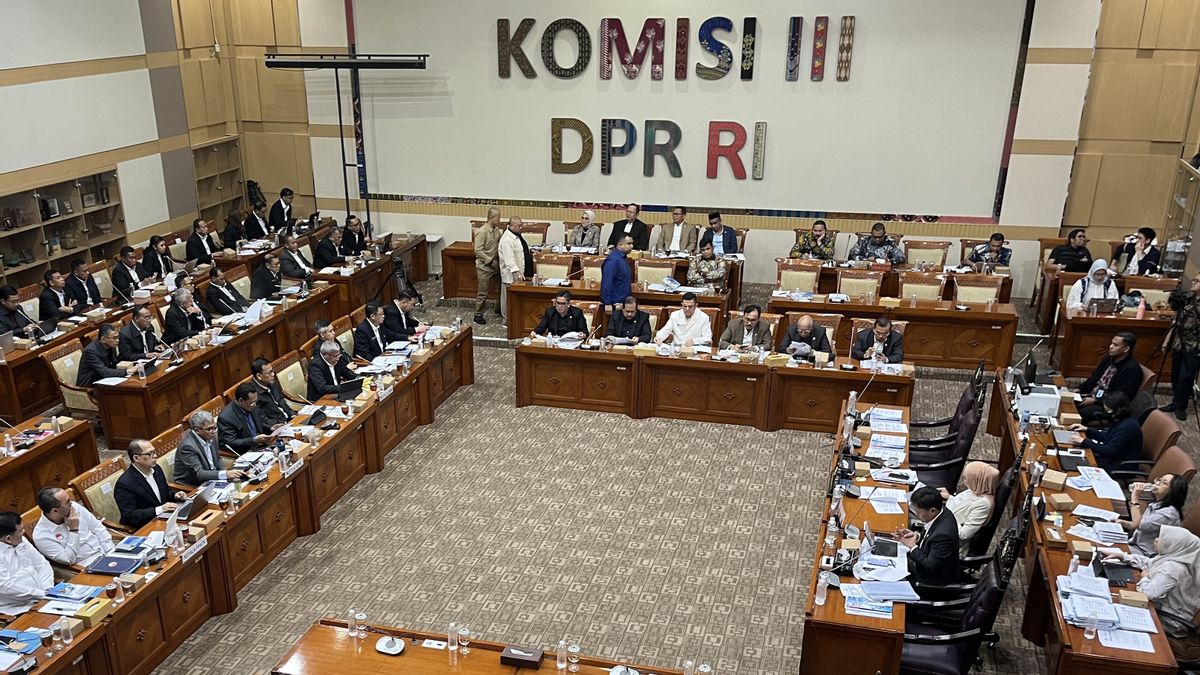


JAKARTA - Chairman of Commission III of the Indonesian House of Representatives, Habiburokhman, said that his party would synchronize Qanun or the applicable legal rules in Aceh by revising the Criminal Procedure Code (RKUHAP) to prevent two sentences against the same person for the same legal incident.
He conveyed this to respond to the aspirations conveyed by the Archipelago Student Alliance (Aman) regarding the phenomenon of Acehnese being still convicted after serving the sentence from Qanun. Habiburokhman also said that this was interesting to observe.
"Later, the norm of the article can be formulated which in detail regulates how to synchronize Qanun with the upcoming RKUHAP," said Habiburokhman at the parliament complex, Jakarta, Wednesday, October 15.
In principle, he said, there was the principle of Ne Bis In Idem which stated that the same problem could not be tried twice, either by Qanun with the specificity of Aceh or with national law.
He assessed that the concept of resolving 18 minor crimes practices in Aceh through Qanun had preceded the new restorative justice concept which would be implemented in the RKUHAP.
So, he said, Qanun and the Criminal Procedure Code only need to synergize.
He also considered that restorative justice actually did not only come from outside values, but also the Indonesian people had practiced in everyday life since the past.
"If we remember from ancient times we were used to solving problems in a family manner, especially problems that did not have fatal consequences, did not result in death," he said.
Meanwhile, representatives from the Nusantara Student Alliance Muhammad Fadli said that in Aceh there were 18 minor criminal cases that could be resolved by traditional court institutions at the village or village level.
However, he said, there were several cases in Aceh, for example, there were parties involved in the problem and had been resolved at the customary judiciary.
SEE ALSO:
-
 | BERITA
Serapan Anggaran MBG Jadi Fokus Pemerintah Prabowo Jelang Akhir Tahun
15 Oktober 2025, 09:06 -
 | TEKNOLOGI
Selamat Tinggal V2, SpaceX Masuki Era Baru dengan Roket Starship V3
15 Oktober 2025, 05:05 -
 | LIFESTYLE
Putuskan Keluar dari Rumah, Andre Taulany Kini Tinggal di Apartemen
15 Oktober 2025, 00:10
However, he said, there were parties who were not committed and reported the matter to law enforcement officials.
"Here the concept is that law enforcement officers cannot refuse reports, but on the one hand the customary judiciary has decided, so there is legal uncertainty," said Fadli.
The English, Chinese, Japanese, Arabic, and French versions are automatically generated by the AI. So there may still be inaccuracies in translating, please always see Indonesian as our main language. (system supported by DigitalSiber.id)
Most Popular Tags
#Prabowo Subianto #donald trump #2026 World Cup #Febrie Adriansyah #8791Popular


