

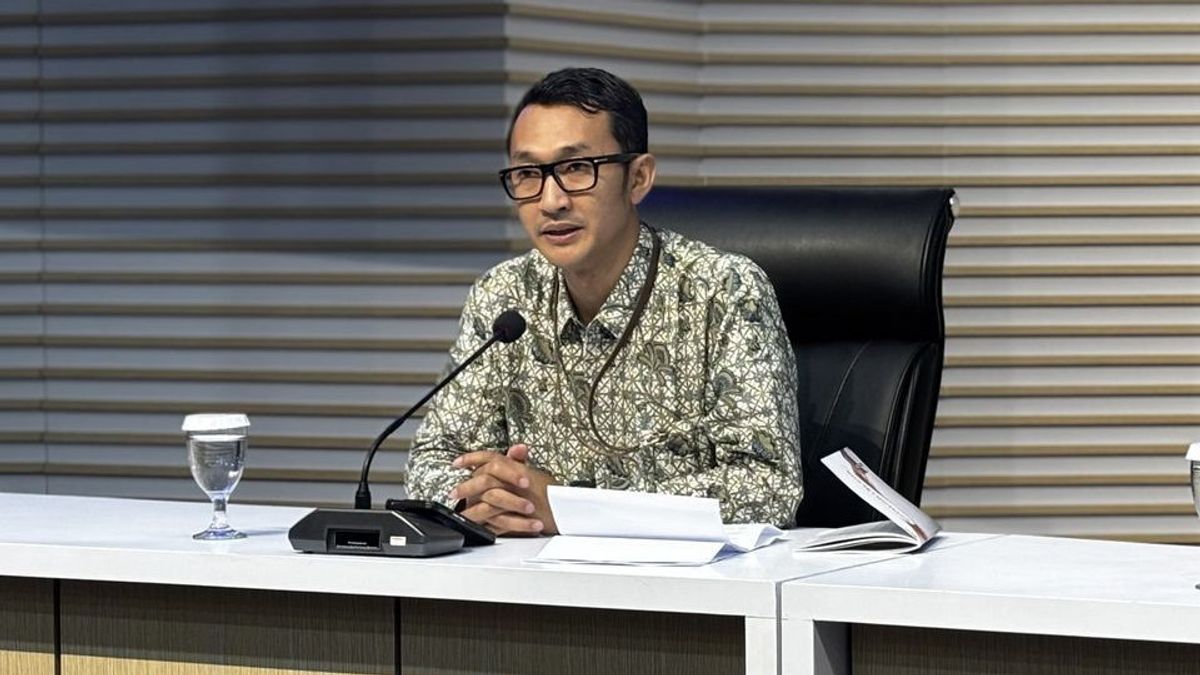


The Corruption Eradication Commission (KPK) revealed that the sale and purchase of special hajj quotas occurred because the distribution of 20,000 additional rations from the Saudi Arabian government did not comply with the regulations.
KPK spokesman Budi Prasetyo said that the allocation should be divided by 92 percent for the regular hajj quota and 8 percent for special Hajj. However, the Ministry of Religion (Kemenag) has recently divided the rations equally.
"With the distribution of additional quotas into the regular hajj quota and special hajj quotas, which are not in accordance with the provisions of the legislation, it will result in a decrease in the number of quotas managed by the Ministry of Religion in the form of regular hajj quotas," Budi told reporters in a written statement quoted on Thursday, October 9.
"On the other hand, the special hajj quota managed by PIHK or travel bureaus has increased significantly from what it should be," he continued.
Budi then said that the distribution certainly did not match the initial objective, namely cutting the queue of prospective pilgrims. Then, the anti-corruption commission also found the practice of buying and selling quotas accompanied by a flow of money to the Ministry of Religion (Kemenag) from a travel agent or travel agent for special Hajj organizers.
"This means that the special hajj quotas that are traded by PIHK stem from the discretion of the distribution of the quota," he said.
This money is said to be given to the Ministry of Religion with various modes. In fact, prospective pilgrims departing from the PIHK who deposited money ended up not queuing or cutting the queue period.
"Like acceleration money and others because with this special hajj quota prospective pilgrims then immediately left that year without having to queue," said Budi.
Previously reported, the KPK is investigating allegations of corruption related to quotas and the implementation of Hajj in 2023-2024 at the Ministry of Religion (Kemenag). No suspects have been named for using a general investigation warrant (sprindik).
The generalized sprindik uses Article 2 Paragraph 1 and/or Article 3 of Law Number 31 of 1999 concerning the Eradication of Criminal Acts of Corruption as amended by Law Number 20 of 2021 in conjunction with Article 55 paragraph 1 of the Criminal Code. This means that there are state losses that occur due to this corrupt practice.
State losses in the corruption case of quota and Hajj for the period 2023-2024 are said to have reached more than IDR 1 trillion. This number is still increasing because it is only the initial calculation of the KPK which continues to coordinate with the Supreme Audit Agency (BPK).
This case stems from the provision of 20,000 additional Hajj quotas from the Saudi Arabian government for Indonesia to reduce queues for pilgrims. However, the distribution turned out to be problematic because it was divided equally, namely 50 percent for regular Hajj and 50 percent for special Hajj based on the Decree (SK) of the Minister of Religion signed by Yaqut Cholil Qoumas.
In fact, based on the law, the distribution should be 92 percent for regular Hajj and 8 percent for special Hajj.
SEE ALSO:
-
 | BERITA
Istana Ungkap Alasan Prabowo Tambah Wakil Menteri di Kemendagri dan Kemenkes
09 Oktober 2025, 06:06 -
 | OLAHRAGA
Hasil Indonesia vs Arab Saudi: Kartu Merah dan Tiga Penalti, Garuda Takluk 2-3
09 Oktober 2025, 02:24 -
 | EKONOMI
Bos Danantara soal Utang Kereta Cepat: Negosiasi dengan China Sedang Berjalan
08 Oktober 2025, 23:36
Later, the distribution of problems was allegedly due to money from the Hajj and Umrah travel parties as well as the associations that oversee the Ministry of Religion. After getting the allotment, they sold the additional quota to prospective pilgrims.
During the investigation process, a number of parties have been questioned, including Yaqut Cholil Qoumas. Investigators have also searched his house and found documents and electronic evidence that are suspected to be related.
The English, Chinese, Japanese, Arabic, and French versions are automatically generated by the AI. So there may still be inaccuracies in translating, please always see Indonesian as our main language. (system supported by DigitalSiber.id)
Most Popular Tags
#Prabowo Subianto #donald trump #Febrie Adriansyah #8791 #giias 2026Popular


