

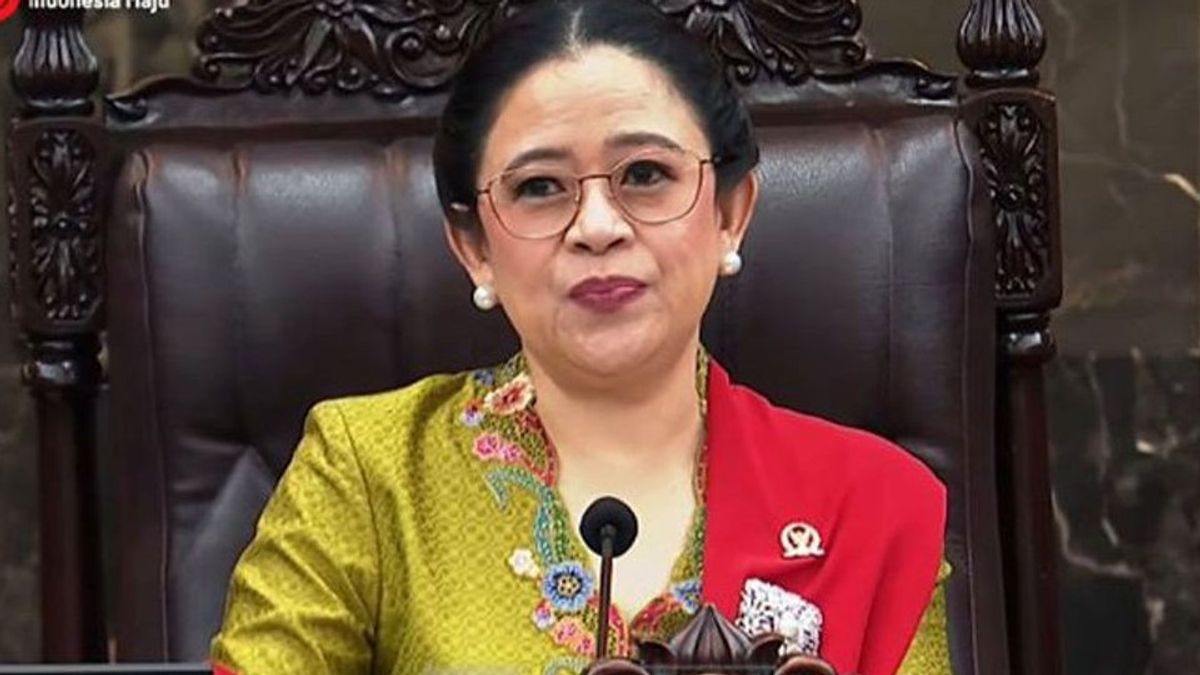


JAKARTA - Chairman of the Indonesian House of Representatives, Puan Maharani, emphasized that the DPR continues to carry out its functions actively, both in terms of the establishment of laws (UU) and supervision of the running of the government. During the first year, Puan said that the DPR RI together with the Government had completed the discussion of 14 Draft Laws (RUU) into Law.
This was said by Puan when she opened the First Session Period of the 2025 '2026 Session Year by submitting a report on the DPR's performance during the first year of the 2024'2029 term.
"In carrying out the legislative function, the DPR RI together with the Government have a common responsibility in forming laws to meet the needs of national legislation," said Puan at the Nusantara Building, Parliament Complex, Senayan, Friday, August 15.
The details of these achievements, continued Puan, include one Law from Commission I, ten Laws from Commission II, one Law from Commission VI, and two Laws from the Legislation Body (Baleg). Meanwhile, other commissions are still in the stage of forming and discussing the bill which is part of the national legislation agenda.
Entering this trial period, Puan said that the DPR RI focused on 11 bills that had entered the stage of Level I Talks. Puan emphasized that although quantities are important, the DPR RI prioritizes the quality of the resulting legislative products.
"The DPR RI will always prioritize the formation of quality laws; so that it is more pursuing quality performance than quantity," said the PDIP legislator from the Central Java electoral district.
Puan also explained the complexity of drafting legislation so far. Because, according to her, the DPR and the Government are often in the middle position between various parties who have different interests.
This situation, said Puan, demands balance in hearing and formulating every legal norm. "The DPR RI and the Government are often in positions in the midst of various legal subjects who have different interests such as between employers and workers, employers and consumers, apparatus and the people, service providers and users, as well as various other social relations," he explained.
"Like being a referee in the middle of a sporting match: all parties feel that they are right, and if there is a whistle sounded, there will also be many protests; not to mention observers who provide pros and cons comments. But that's how democracy is: it's crowded, aspirationful, and must be patient to hear before hitting the hammer," added Puan.
SEE ALSO:
-
 | BERITA
KPK Akan Panggil Eks Menag Yaqut Usai Geledah Sejumlah Tempat Terkait Korupsi Kuota Haji
15 Agustus 2025, 15:01 -
 | BERITA
Warga Yunani Geruduk Kapal Pesiar Berpenumpang Tentara Israel Sedang Liburan
14 Agustus 2025, 19:44


In the midst of this dynamic, Puan emphasized that the DPR must continue to uphold the principles of justice and wisdom in drafting legal rules.
"The main responsibility for legislators is to be fair and wise in formulating the legal norms governing these relations. The constitution wants the law to be an instrument of justice for all citizens," he said.
In drafting the law, Puan ensured that the DPR would also open up wide space for public participation. According to him, community involvement is an important part of substantive democracy.
"For this reason, in every process of forming a law, meaningful community participation (meaningful participation) is a very important requirement. This participation is a form of people's sovereignty," he concluded.
The English, Chinese, Japanese, Arabic, and French versions are automatically generated by the AI. So there may still be inaccuracies in translating, please always see Indonesian as our main language. (system supported by DigitalSiber.id)
Most Popular Tags
#Prabowo Subianto #donald trump #Febrie Adriansyah #8791 #giias 2026Popular


