

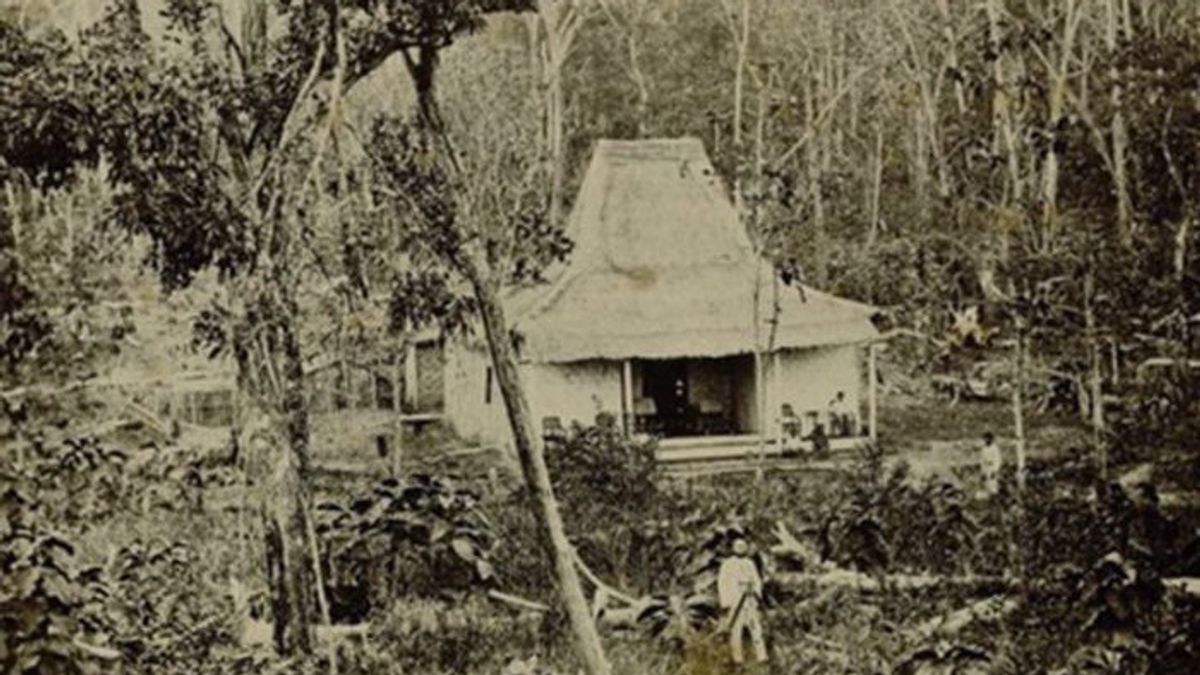


JAKARTA - Herman Willem Daendels is widely known as a leader with iron arms. The Governor-General of the Dutch East Indies in the 1808-1811 era was very firm in presenting bureaucratic reform. The problem-causing process in the archipelago is fixed one by one.
Take for example when the forests on the island of Java are badly damaged. Daendels dared to issue a ban on illegal logging. Anyone who steals wood will be punished. The forest is fully managed by the government responsibly to avoid ecological disasters.
The presence of the Dutch trading conspiracy, the VOC in the archipelago, brought disaster. The Company only thinks about profit, while the fate of the bumiputras is ignored. The forests that are planted are irresponsible.
The owner of his power uses the forest to take wood as a material for building ships to houses. Sometimes it is also a burning wood trial for sugar factories. This condition raises new problems.
The felling of trees is carried out carelessly. This condition is because the Company does not control it. Wood from the forest is then used as a profitable business by Chinese and local entrepreneurs for raw materials for houses and ships.
Problems arise. Forests on the island of Java are damaged and barren. The Company again doesn't really care. In fact, the ecological disasters that come and go from floods and landslides are not taken seriously. Everything changed when the VOC went bankrupt 1799.
Herman Willem Daendels was sent to fix the chaos of the Company in 1808. The man nicknamed Mas Galak moved to reform the bureaucracy. He cut all corrupt officials who were in the government body.
He formed an efficient government. Daendels does not want officials under his control to commit corruption. The archipelago, which was once controlled by a trading partnership, was brought by Daendels to become a modern country: the Dutch East Indies.
SEE ALSO:
-
 | MEMORI
Rumah Orang Tua Mahfud MD Kena Geruduk Massa dalam Sejarah Hari Ini, 1 Desember 2020
01 Desember 2025, 14:45 -
 | MEMORI
Kontroversi Siti Nurbaya Bakar: Menteri LHK yang Dituduh Dukung Kerusakan Hutan
29 November 2025, 16:12 -
 | MEMORI
Asal Bukan Gus Dur: Kala Guru Bangsa Ingin Digusur dari Jabatan Ketua PBNU
27 November 2025, 08:00
He started tidying up everything, especially around the management of forest products. He was assigned to repair forests on the island of Java so that forest products can be managed optimally and forests are not damaged.
Daendels did not play games in carrying out his policies. He revealed that there is no longer any room for illegal logging. Daendels will move to give punishment. Even though Daendels had to accept the risk of not being liked by many people.
Daendels wants an efficient government, and therefore it is necessary to create a standard government apparatus format. He divided Java into 9frefectures which are fully responsible for the regional government concerned.
The system he introduced aims to tighten administrative supervision of local entrepreneurs. He also focused (centralization) on power in the government in Batavia," said historian Mona Lohanda in the book History of the Regulation of Batavia (2007).
The prohibition on illegal logging is not just an empty message. Daendels emphasized that forest areas are the responsibility of the state. No one can take or do logging carelessly.
Daendels also built Forestry Services (Diens van het Boschwezen). An institution that is tasked with returning forests to the initial ecosystem. In particular, the jawatan also mapped the forest to be cut down and replanted, especially teak trees.
The government also rotates the planting and slashing forests. If later logging is carried out. Daendels already has an assessment. He marked all teak wood that was cut down with a regional code such as Surabaya with the S1 or Semarang code with the S5 code.
If the teak wood found does not have a wiliyah code, it will be confiscated by the state, the perpetrators are arrested. Whoever is caught stealing, will certainly be punished. The impact of Daendels' policy was immediately felt by those who took advantage of illegal timber.
No one dared to mess with Daendels' policy. As a result, during Daendels' tenure as Governor General of the Dutch East Indies from 1808-1811, many loggers were transferred by the colonial government to other areas. The policy for a moment succeeded in restoring forests in Java.
Daendels' policy was also criticized by many local entrepreneurs. The policy is accused of making the domestic economy not develop much. The livelihoods of the residents are lost. This narrative made the construction of ships and houses made of teak wood decrease. In particular, Daendels did not care until his power ended in 1811.
In 1808, the administration of Marshal Daendels began to be stopped, and the families of loggers were moved to other districts and given land and land to be worked on under the supervision of local and European rulers.
"This change restores the government's monopoly power and restores the condition of the forest, but at the same time destroys the domestic economy and livelihoods of the population because teak wood can only be purchased from the government at a certain price, also in small amounts. The number of ships and boats made decreased drastically and the cost of building a village that used to take just a few rupees, has now increased to 10 times, "said Thomas Stamford Raffles in the book The History of Java (2008).
The English, Chinese, Japanese, Arabic, and French versions are automatically generated by the AI. So there may still be inaccuracies in translating, please always see Indonesian as our main language. (system supported by DigitalSiber.id)
Most Popular Tags
#Prabowo Subianto #donald trump #Febrie Adriansyah #8791 #giias 2026Popular


