

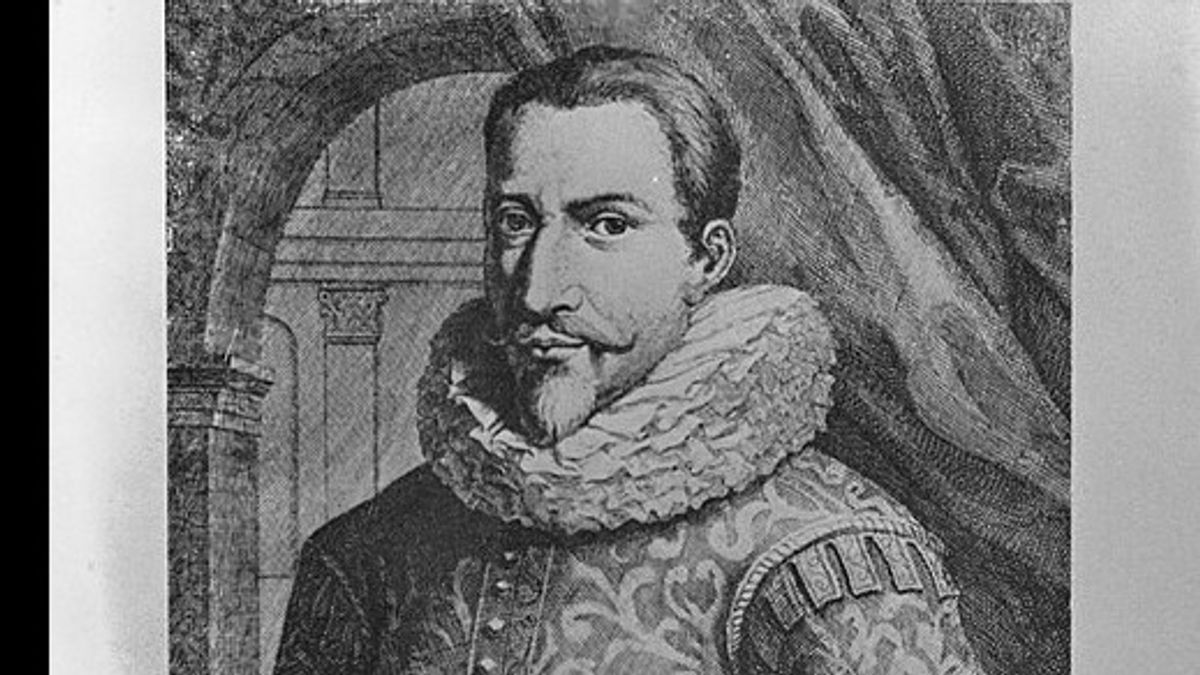


JAKARTA - The views of the Indonesian people and the Dutch regarding Jan Pieterszoon Coen are never the same. The Indonesian people consider it part of the colonialism and colonialism that is cursed. The Netherlands is the opposite. The Governor General of the VOC was appointed a national hero.
Coen was able to make the Dutch a profit from the colonial era. This condition made Coen, who had committed the crime of the Banda genocide, respected. His name was immortalized through monuments and became the name of a street in various Dutch regions.
No one doubts Coen's role as the founder of Dutch colonialism in the archipelago. The man who was born in Hoorn, January 8, 1587, came as an economist with brilliant thoughts. The Governor-General of the VOC twice, 1619-1623 and 1627-1629 presented the plan to monopolize spices that were structured in the archipelago.
Coen echoed the plan with the assessment of conquests in various regions in the archipelago: Ambon, Jayakarta, to Maluku. He also wants to establish a Dutch settlement. An thing that is considered an accurate solution so that the monopoly effort runs effectively and favorably.
Coen moved to conquer Jayakarta and turn it into Batavia City (now: Jakarta) in 1619. Coen also began to look at the potential for spices on Banda Island. However, local residents are less creative and refuse to cooperate with the Company.
As a result, Coen angry. Coen led the resistance to the Banda Islands on March 11, 1621. He carried a large military force of 13 large ships, 40 jung (small ships), 1,600 thousand VOC soldiers, 300 Javanese prisoners, and 100 Japanese samurai.
More than two thousand Banda people were killed. This condition made the islands inhabited by 14 thousand people so that only 480 people remained. The massacre of the people of Banda cannot be forgotten in historical memory. However, the Netherlands views Coen as a great person who brought the golden age of the Company.
As a result, the kingdoms in the archipelago were afraid. Many support Coen's monopoly agenda. The Company is a profit to be hoarded. Recently, the role of the VOC was taken over by the colonial government of the Dutch East Indies. The power of power continues to take advantage of the traces of colonialism that Coen opened like a gold mine that can be stolen.
SEE ALSO:
-
 | MEMORI
Susi Pudjiastuti dan Gelar Honoris Causa dari ITS dalam Memori Hari Ini, 10 November 2017
10 November 2025, 10:15 -
 | MEMORI
Dokter R. Soeharto Resmi Jadi Pahlawan Nasional dalam Memori Hari Ini, 7 November 2022
07 November 2025, 16:00



It is clear that Coen's plans are not limited to the Indonesian archipelago. He intends to build a large commercial scheme in Asia with his capital Batavia, the city he founded. He is not at all interested in political developments in the interior of the Indonesian archipelago. The most important thing for him is to maintain some of the Dutch positions he wants to build, and total control over the sea.
"Obviously he is a statesman with a grand vision and imagination and a far-forward view that is the main feature of a true human leader. Even the narrowness of his mind in other matters, as well as his cruelty, helps him achieve his great goals, all his thoughts center on his large commercial intolerance," concluded Bernard HM Vlekke in the book Nusantara (2018).
Coen may have passed away since September 21, 1629. However, his services to the Dutch were not forgotten. This condition made King Willem III approve the construction of a 4.10 meter high statue in the Lion Field, Batavia (now: Banteng Field) in 1869 now dead.
As a result, the statue was inaugurated in Batavia's 250th birthday celebration on May 29, 1869. The inauguration was also celebrated with anGER for three days. The entire Batavia party welcomed Coen as a hero. The Dutch proudly idolize the statue of Coen standing imitating the pose of the King of Sweden, Gustav Adolf.
The Dutch government itself did not forget Coen's services in his hometown. The owner of power appointed Coen as a national hero by accompanying Coen's statue by stakeblower Ferdinand Leenhoff in the hometown of a man who is often called the Bumiputra Murjankung in Roode Steen, Hoorn on May 30, 1893.
The statue was built 3.25 meters high on a sturdy stone base. Coen is depicted in an authoritative pose, with one hand rested on the hips and the other hand on the sword. Something that symbolizes his military greatness.
Coen's name was also immortalized in the form of a street name on the streets of the Dutch city. Take for example in Amsterdam. The owner of power wants to show that Coen has great service. Even though historical records make Coen's position no more than a cursed colonialist.
As a result, Colonialism can never be looked at one side. This condition is because colonialism often presents two different parties. Those who benefit and those who are harmed. The Dutch views Coen as a hero. Indonesia sees the invaders cursed.
The statue was placed there in 1893, as part of a larger program meant to strengthen the Dutch national identity with respect to national heroes with monuments. Coen was selected for the program because of his role in determining the monopoly of global spice trade during the early 17th century.
"However, his heroic status has always been controversial: he built a spice monopoly by killing the residents of the Banda archipelago, where the main plantations for nutmeg and cloves are located. Then, the islands were re-inhabited by people who werenetted from the Dutch colony, who were told to work in spice plantations," Gerlov van Engelenhoven said in the bookPostcolonial Memory in the Netherlands (2022).
The English, Chinese, Japanese, Arabic, and French versions are automatically generated by the AI. So there may still be inaccuracies in translating, please always see Indonesian as our main language. (system supported by DigitalSiber.id)
Most Popular Tags
#Prabowo Subianto #donald trump #Febrie Adriansyah #8791 #giias 2026Popular


