



JAKARTA - Indonesia has experienced a decline in the welfare rate in the New Order era (Orba). The narrative is supported by many families who rawly swallow views: many children have a lot of sustenance. Even though many children mean that the funds spent are not small.
Many children mean more and more burdens. Life is getting more and more difficult because it is overshadowed by poverty. Suharto and New Order took a stand. They inflamed the Family Planning (KB) program. The exhaustomi for men is trying to be echoed.
Narratives of many children have been popular in Indonesia. The Old Order Government often echoes it. The owner of power considers population growth to be able to make Indonesia a great nation.
The government expects indeed a democratic bonus. A thing that is beneficial for economic development because of the large number of productive workforces. However, the narrative was no longer relevant when Suharto and the New Order took power.
They no longer want to promote the same narrative since the 1960s. Suharto actually saw a decline in welfare from families with many children, especially women. Women become the most miserable people.
The maternal mortality rate after giving birth is high. Not to mention the business of raising children who need large funds. Whoever is in the family economy when they have many children is a big problem. They become witnesses of poverty growing.
Suharto took a stand. He began to fully support the KB program. This seriousness was attracted by Suharto's courage to establish a National Family Planning Institution (LKBN), then changed its name to the National Family Planning Coordinating Board (BKKBN) in 1970.
Large funds were disbursed to support the change of the narrative that many children were providing a lot of sustenance to two children. The activity received criticism. However, the New Order continues so that the existing families can live a prosperous life.
In the 1970/1971 physical year, the Indonesian government provided assistance of 1.3 million US dollars for the national KB program, offset with the help of foreign donors of more than three million US dollars. This assistance increased in the following years. In 1976/1977 the cost assistance used for the KB program was 28.5 million US dollars and in 1977/1978 it rose again to 34.3 million US dollars.
"Indeed, I argue that we need to continue to control the birth through increasing and expanding the implementation of the national KB program. Meanwhile, the death rate, especially the death rate of anyi and children, is expected to decrease rapidly thanks to the improving level of well-being as a result of progress in development and health services and counseling which will also expand," said Suharto as written by G. Dwipayana and Ramadhan KH in the book Suharto: Mind, Speech, and Action I (1989).
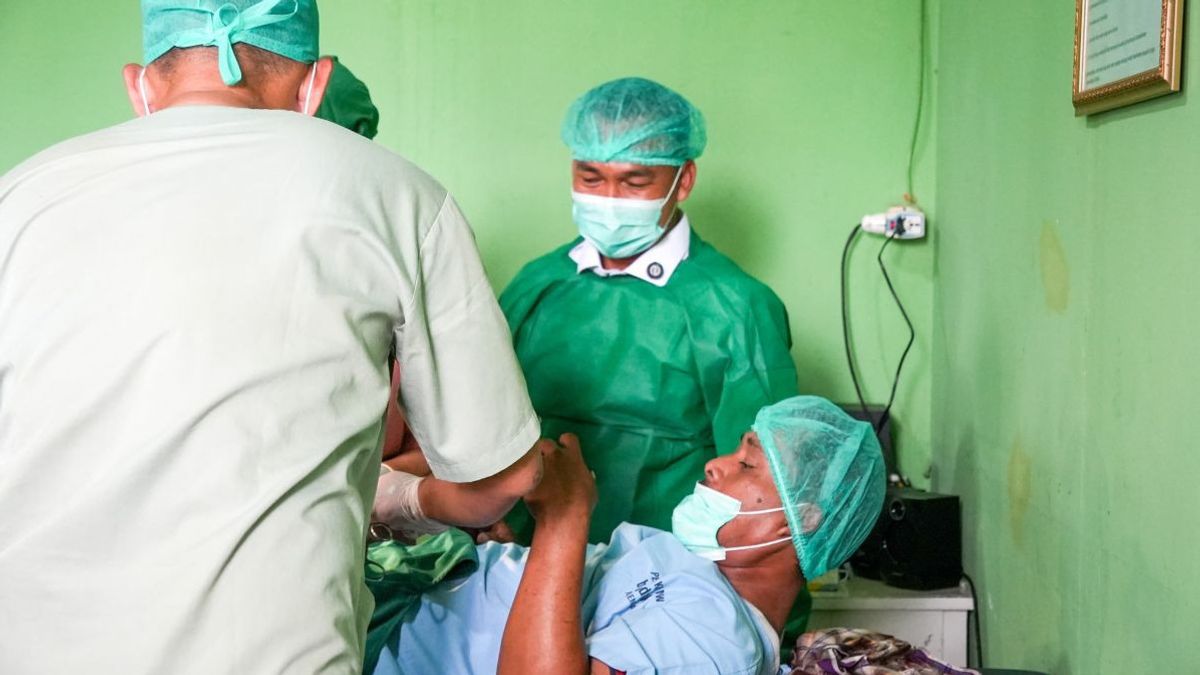
Suharto's KB program does not only target women. Suharto also targeted men. The family planning of men who are often called vasectomi is also favored. All because of the fast and effective process.
The government considers the vasectomi process to be well developed. The operating technique is no longer conventional. This condition makes the vasectomi can be done with various techniques. Take for example surgery without a knife or better known as a knifeless vasexomi (VTP).
Vasektomi also became safe, simple, fast, not sick, and not scary. The family planning program of vasectomi men began to be implemented first among the ABRI military, then to the general public. ABRI was also involved when the KB safari entered and out of the village supported the vasektomy.
The presence of male family planning began to be loved a lot. In fact, many people come independently to health facilities to carry out independent vaccinations. They no longer wait for a family planning safari from the government first.
SEE ALSO:




In every family safari in the sub-districts or villages can be resolved around 100 to 150 vascular acceptors. According to further developments, the situation is very encouraging again, apart from the increasing number of acceptors, also in areas where acceptors come from, the wider.
"During 1979 and 1983, male family planning services through safaris, both initiated by ABRI and government agencies, community and private organizations, increased. Areas receiving services include Tangerang, Bogor, Purwakarta, Subang, Cirebon, Majalengka, and Cianjur," Sunandar said in his report in Dharmasena magazine entitled Great Contraception for Men (1991).
Recently, the KB women and men program - received opposition from religious scholars. The Indonesian Ulema Council (MUI) is one of them. MUI really highlighted the issue of vasectomi. They even issued a fatwa against the vasexomi in 1979. However, the New Order did not stop. They continued to run the KB program until the New Order ended.
The English, Chinese, Japanese, Arabic, and French versions are automatically generated by the AI. So there may still be inaccuracies in translating, please always see Indonesian as our main language. (system supported by DigitalSiber.id)
Most Popular Tags
#Prabowo Subianto #donald trump #firearm #8791 #giias 2026Popular


