


JAKARTA - Adding a little salt to boiling water before boiling eggs is often considered just a kitchen habit that has been done for generations. It turns out that this small step has a real scientific basis.
It's not just a matter of taste or tradition, salt has an important role in producing boiled eggs that are perfect and remain intact.
Many people believe salt helps make eggs more easily peeled, when in fact that is not the main function. Salt works by affecting protein in the white part of eggs.
When the water boils, heat makes the protein in egg white (albumen) change shape from liquid to solid. This process is called protein coagulation, and this is what turns raw eggs into cooked eggs.
When an egg cracks slightly when boiled, liquid egg whites usually come out and create an unpleasant white fiber to be seen. But if there is salt in boiled water, the protein clotting process will take place more quickly.
As a result, the leaking white part immediately freezes and closes the crack itself. In other words, salt is to protect the eggs from leaking when boiled.
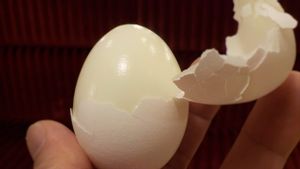
Maybe you often hear salt water makes boiled eggs easier to peel. Unfortunately it's just a myth. According to research, the ease of peeling eggs depends on the age of eggs, the method of cooling, and the temperature when the erosion begins.
SEE ALSO:
-
 | LIFESTYLE
Cara Merebus Telur agar Mudah Dikupas, Rahasianya Ada di Minyak Goreng
16 Juli 2024, 04:24 -
 | LIFESTYLE
Merebus Telur dengan Sempurna ala Peneliti, Butuh Waktu 32 Menit
14 Februari 2025, 14:25 -
 | LIFESTYLE
8 Cara Memasak Telur ala Restoran untuk Menu di Rumah, Biar Variatif
03 Desember 2024, 17:47

Eggs that are still very fresh tend to be difficult to peel because their inner membranes are still strongly attached to egg whites. On the other hand, eggs that have been stored for 710 days are easier to peel.
After cooked, soaking the eggs in ice water also helps the egg's whites stick slightly from the skin, making it easy to peel. Salt is important but not to make it easier to peel.
Reporting from the Times of India page, a study published on ScienceDirect explained that salt can change the environment around egg white protein, making it clump faster. When the egg crackes, this fast clot forms a natural kind of cover in the crack gap.
Only a little salt is enough to make egg whites immediately harden when they touch hot water. This shows that adding salt to boiled water is not only the habits of the ancestors, but indeed there is a chemical basis.
The effect of salt on eggs is actually closely related to food chemistry. Protein is very sensitive to changes in ions in its environment. So when salt is added, the process of coagulation or clotting can take place faster and more stable.
The same principle is used in various other food processing processes such as making cheese or meat preservation.
In addition, salt also slightly increases the boiling point of water, so that the egg maturation process becomes more even and the texture is smoother.
To get a perfect boiled egg, pay attention to the following steps.
1. Use eggs that are not too new, for about 7'10 days to be more easily peeled.
2. Boil with boiling water, not cold water, so that the skin does not crack easily.
3. Add a little salt. Not for taste, but to prevent leakage of egg white when cracked.
4. Immediately soak the cooked eggs into the ice water, so that it is easy to peel and the texture remains soft.
The combination of this technique will help you produce boiled eggs that are solid, not messy and easy to peel.
The English, Chinese, Japanese, Arabic, and French versions are automatically generated by the AI. So there may still be inaccuracies in translating, please always see Indonesian as our main language. (system supported by DigitalSiber.id)


