
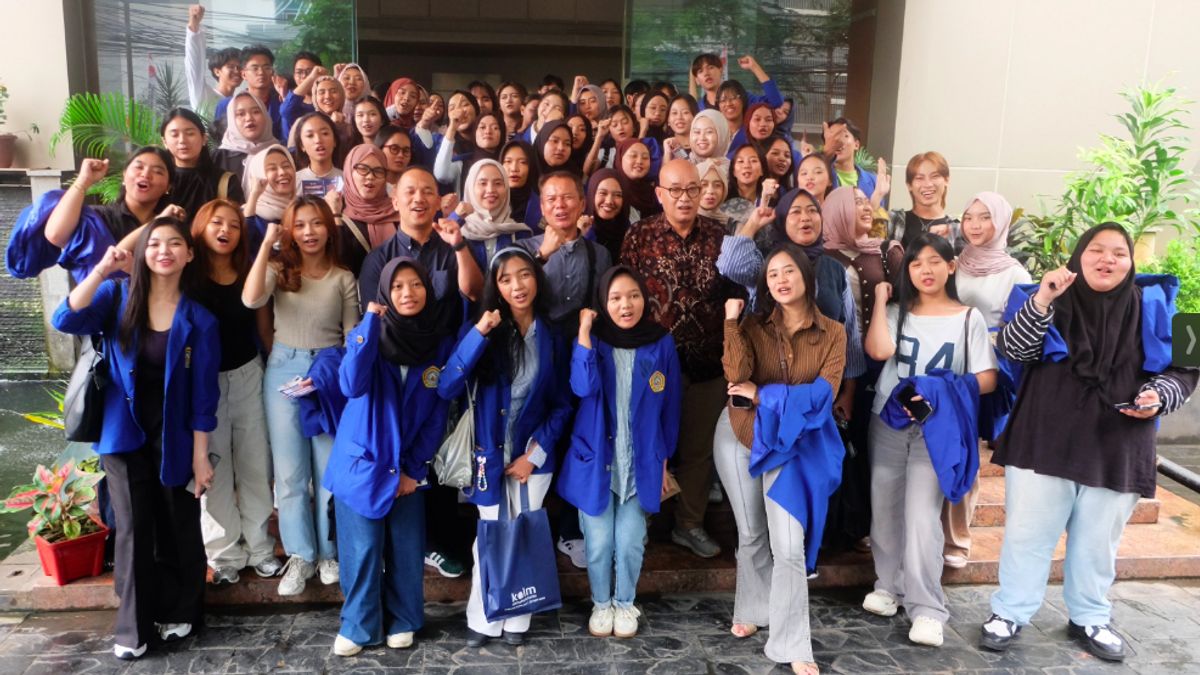


JAKARTA - A lively and enthusiastic atmosphere was seen at the Voice of Indonesia (VOI) Media Group office, Tanah Abang, Jakarta, when 120 students of the Communication Sciences of the Indonesian Computer University (UNIKOM) Bandung visited, Tuesday, August 12.
This visit is a special moment for students to get to know more closely the professional online media work process as well as gain new insight into career opportunities in the field of communication.
The visit agenda led directly by the Head of the UNIKOM Communications Sciences Study Program, Manaf Solihat and was welcomed by the VOI team.
Various interesting agendas were also followed by students ranging from the introduction of the news creation process, the creative media creative content workshop, to interesting sessions around KALM, a mental health consulting platform and AI Care services hosted by dr. Benita and dr. Karol.
Students also had the opportunity for an office tour to see the VOI team's workspace firsthand. According to Manaf, the selection of VOI Media Group as the destination of the visit was not without reason.
"There is relevance to what we learn on campus. First, we want students to understand how to work in online media and professional media. Second, they also get an idea of what careers in the field of communication will be like, so they can prepare the soft skills and hard skills needed," he explained to VOI.
He added that this visit was also a means of building a relationship between the world of education and industry (link and match).
"The enthusiasm of students is extraordinary, this is the second time we have come here. Even the interest is up to 100 percent from one generation," said Manaf.
During the visit, students got a lot of practical lessons, ranging from news writing techniques, strategies to create viral content, to understanding the media business model described by Iqbal Irsyad as the editor-in-chief of VOI.
"VOI can be a role model for other media businesses. After seeing firsthand, students will know what the media is doing, such as VOI, including opportunities in the content creator world," added Manaf.
SEE ALSO:
-
 | TEKNOLOGI
Takut Lokasi Anda Bocor? Begini Cara Menonaktifkan Fitur Maps di Instagram
09 Agustus 2025, 17:50
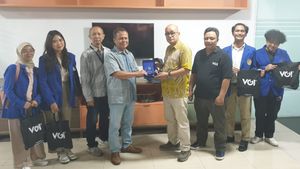
For him, an agenda like this is also an evaluation material for the curriculum so that it is more adaptive to the development of the media industry.
Not only lecturers, students also benefit greatly from this activity. Like Aura Zahra Supriyadi (19) or who is familiarly called Zara.
On this occasion, he admitted that he was happy to be able to visit VOI.
"It's really fun! At first I didn't know there was a program like this. It turns out that visits to the media are really interesting, especially here so I know there is an application for mental health consultation from KALM. The session I like the most is the cut-off discussion of friends, because it's really related," he said.
In addition, Zara also enjoyed a brief session of news making and content production for social media.
"Hopefully, in the future campuses will often make visits to other media, such as TV stations or similar companies. This is very related to majoring in communications and future careers," he added.
Apart from Zara, Muhammad Fawzy Rifkiansyah, (20) also said the same thing. He said, the agenda for visits to online media from campus is very beneficial for students who really want to continue their career in the field of communication after graduation.
"From the first, I wanted to enter the communication department and become a journalist because there are relatives who work in this field,"
"In my opinion, visits to media like this can add new insights into future career prospects, and in VOI we can also know several developments in other business lines such as AI Care and KALM as well," said Fawzy.
Furthermore, for UNIKOM itself, industrial visits to the media have become a tradition for more than a decade. However, each visit always brings a new color and expands student insight.
"The hope is of course that this activity will continue every year, so that students always get knowledge updates and are ready to compete in the world of work which continues to change," concluded Manaf.
The English, Chinese, Japanese, Arabic, and French versions are automatically generated by the AI. So there may still be inaccuracies in translating, please always see Indonesian as our main language. (system supported by DigitalSiber.id)
Popular


