


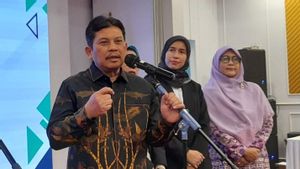
JAKARTA - President Director of BPJS Kesehatan Ghufron Mukti explained several reasons why payments to health facilities (faskes) were delayed and dismissed the issue that his party rejected hospital claims due to a deficit.
"One of the reasons causing the payment to be delayed is the behavior of filing claims for health facilities that are upcoding," he said as quoted by ANTARA.
Upcoding is the behavior of converting or manipulating a diagnosis code or medical procedure into a code that has a higher rate than it should have with the aim of obtaining a larger claim from the Health Social Security Administration (BPJS).
"Another cause is the low quality of claim documents, and is not in accordance with BPJS Kesehatan provisions," he said.
Ghufron also stated that some of the errors commonly encountered in submitting claims by BPJS Kesehatan which caused payments to health facilities to be delayed, namely an incorrect diagnosis or procedure, inappropriate treatment indications, and indications of fraud (fraud).
"Including benefits that are not guaranteed, do not comply with procedures or service standards, and are not accompanied by supporting evidence or claim documents," he said.
Ghufron also responded to the minister's decision on 7.3 million participants in the National Health Insurance Contribution (PBI) Recipients (JKN) who were disabled due to the transfer to the National Sole Social Economic Data (DTSEN).
The decision was based on the Decree (SK) of the Minister of Social Affairs Number 80 of 2025 and Presidential Instruction (Inpres) Number 4 of 2025 concerning National Sole Social and Economic Data (DTSEN).
"Referring to the regulation, starting in May 2025 the determination of PBI participants will use the DTSEN database. However, those who are deactivated can be active again if they contact or report to the local social service," he explained.
He explained that there are three conditions for PBI JKN participants to be able to return to being active and regain facilities at BPJS Kesehatan, first, namely being disabled in May 2025.
"Second, after being verified (the local government/Ministry of Social Affairs) it is true that it is poor or almost poor, thirdly, if the person concerned has a chronic disease or the term emergency (emergency) which requires immediate treatment, it can be immediately activated," he said.
SEE ALSO:


However, according to him, if the participants do not meet the three requirements, they are not considered to be included in PBI JKN, so that the BPJS Health contribution scheme can be financed by the local government or paid independently.
Ghufron also stated that the number of non-active participants would not affect the PBI JKN allocation from the state, which was around Rp. 96.8 million.
The English, Chinese, Japanese, Arabic, and French versions are automatically generated by the AI. So there may still be inaccuracies in translating, please always see Indonesian as our main language. (system supported by DigitalSiber.id)
Most Popular Tags
#Prabowo Subianto #donald trump #firearm #8791 #giias 2026Popular


