
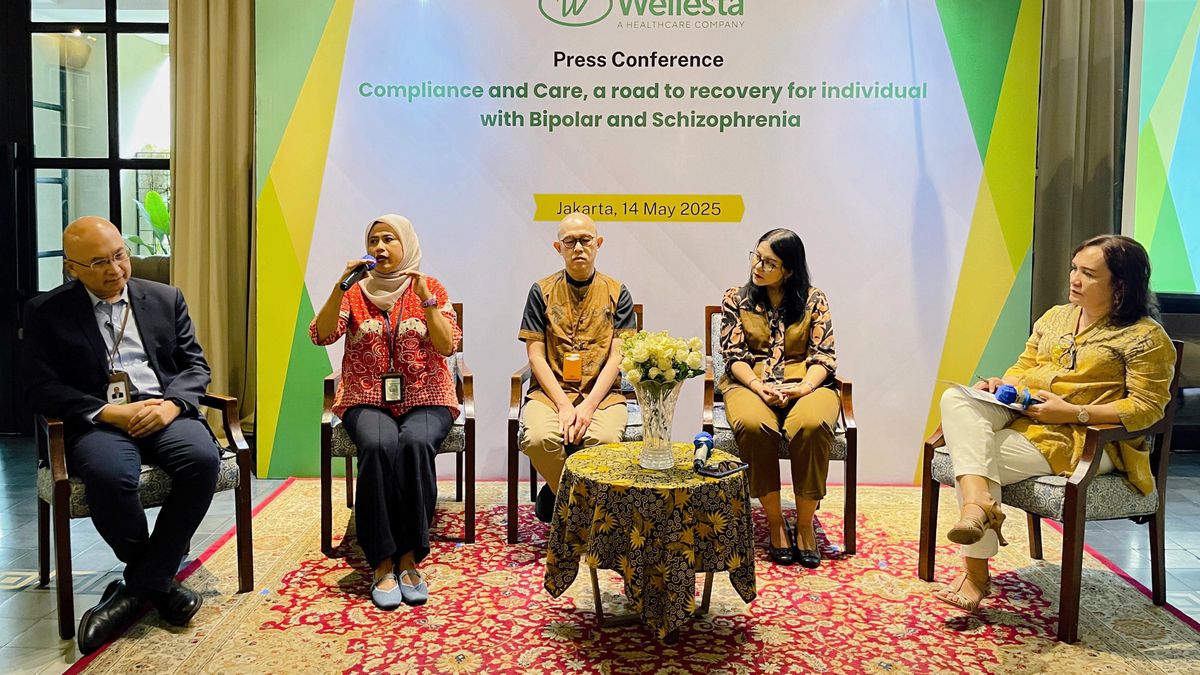


JAKARTA Compliance and Concern (Care) play a very important role in the recovery of Bipolar Disorder (GB) and Skizophrenia patients. Compliance with this treatment is crucial, and has a direct impact on improving the patient's condition. But unfortunately, until now in Indonesia, compliance is still a major challenge due to negative stigma in disease and the emergence of side effects on treatment. On the other hand, compliance requires support systems from both family and environment.
GB and Skizophrenia are two different types of mental health. GB is characterized by intense mood swings between deep depressive states and also human episodes. Meanwhile, Schizophrenia is usually characterized by impaired thought processes, thought content and psychosis perceptions that can include hallucinations, misery, or chaotic thoughts or thoughts.
Hanadi Setiarto, Country Group Head of Wellesta CPI stated, as a company focused on health and medical technology, Wellesta is committed to the health and quality of patient life, including for depressed patients with GB I and Schizophrenia.
"It is very important to increase public knowledge and concern regarding mental illness conditions that are sometimes not realized. We realize that if it is not resolved properly, depression events with GB I and Skizophrenia will continue to increase so that in the future it will reduce the quality of life, increase early mortality, and contribute to physical diseases such as cardiovascular, metabolic, and infection," he said.
SEE ALSO:
-
 | INFO SEHAT
10 Tips Ilmiah Menyimpan Bahan Makanan agar Tetap Segar Lebih Lama
17 Februari 2025, 16:46 -
 | INFO SEHAT
Diduga Penyebab Kematian Kim Sae Ron, Kenali Gejala Henti Jantung
17 Februari 2025, 15:25 -
 | INFO SEHAT
Dokter Tirta Beri Penjelasan soal Air Mineral Ada Manisnya, Bisa Bikin Diabetes?
17 Februari 2025, 13:25


To realize our commitment, his party is working with the Association of Indonesian Mental Medicine Specialists (PDSKJI) in helping individuals with GB I and Skizophrenia.
"This collaboration is expected to be able to increase public awareness so that they understand the initial symptoms, provide support to these individuals, and in the future they know who is looking for the right help and preventing long-term disabilities," explained Hanadi.
Prof. Dr. dr. Tjhin Wiguna, SpKJ, SubSp. AR (K), MIMH, Professor of Psychiatry for Subspecies of Children and Youth FKUI-RSCM in their presentation stated that mental health challenges such as GB and Skizophrenia.
"In the past, it was considered to only attack adults, now it also affects children and adolescents with a worrying level. Some studies and experience at the practice table show that cases that appear earlier or early-onset occur at a younger age, and are often not diagnosed due to lack of awareness or misinterpretation of symptoms as common adolescent behavior. Mental health conditions like this can disrupt the development, education, and relationships of adolescents if not treated appropriately," he explained.
GB occurs due to several risk factors such as genetic, environmental, neurobiological, and psychosocial. Some recognizable symptoms such as human episodes or emotional moods are easily angry, depression episodes or deep sad atmospheres and suicide desires, and a mixture between the two. Meanwhile, Schizophrenia has risk factors such as genetic, perinate or complications from birth, environment, and neurodevelopmental or brain structure disorder. Some of the symptoms include positive symptoms (halusination,tender), negative symptoms (lack of motivation and tends to flatness), and disorganization (speaking incoherent and inappropriate behavior), "explained Prof. Tjhin.
Diagnosis and early intervention are essential to improve the outcome of treatment, but the complexity of cases that arise at the early stages often causes delays in detection and handling.
The English, Chinese, Japanese, Arabic, and French versions are automatically generated by the AI. So there may still be inaccuracies in translating, please always see Indonesian as our main language. (system supported by DigitalSiber.id)


