
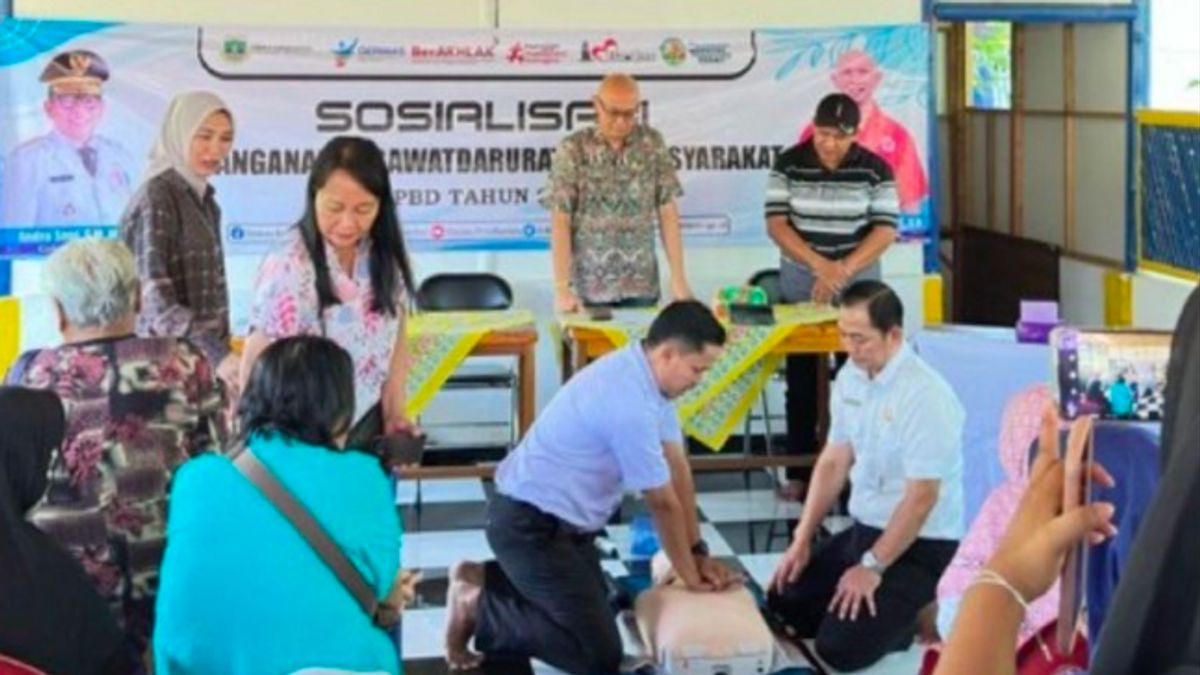


JAKARTA - As part of efforts to increase people's capacity in dealing with critical situations or health emergencies, emergency handling training is held in densely populated environments, such as Tangerang City.
This activity targets residents at the RT/RW level to be able to provide first aid when a medical emergency occurs around them.
The Tangerang City Health Office became the initiator of this activity by conducting training and education in the RW 10, Pabuaran Tumpeng Village, Karawaci District. The head of the Health Service, Dini Anggraeni, explained that emergency conditions could occur at any time without warning, and needed a quick response to save lives or prevent defects.
"The medical emergency does not choose a place. It could happen at home, on the road, or in public spaces. Therefore, the public needs to know what to do in the first seconds before medical personnel arrive," he said on the sidelines of training, Wednesday (the activity date).
This training was attended by dozens of residents together with representatives of local environmental administrators. The main focus of the activity is to provide a basic understanding of quick and precise actions in dealing with medical emergency situations, including how to provide Basic Life Assistance (BHD).
SEE ALSO:
-
 | INFO SEHAT
10 Tips Ilmiah Menyimpan Bahan Makanan agar Tetap Segar Lebih Lama
17 Februari 2025, 16:46 -
 | INFO SEHAT
Diduga Penyebab Kematian Kim Sae Ron, Kenali Gejala Henti Jantung
17 Februari 2025, 15:25 -
 | INFO SEHAT
Dokter Tirta Beri Penjelasan soal Air Mineral Ada Manisnya, Bisa Bikin Diabetes?
17 Februari 2025, 13:25
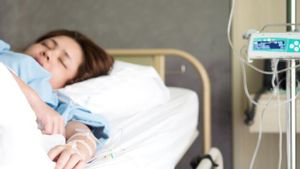
Participants are taught first aid techniques in conditions such as household accidents, cardiac arrest, loss of consciousness, and handling serious injuries. In addition to theoretical materials, practical simulations are also provided to strengthen residents' understanding.
"The densely populated environment has a high risk of various emergency events. So this kind of training is very important so that residents can act as the first aid before emergency services arrive," said Dini.
The Tangerang City Health Office hopes that this training can create a community that is better prepared in dealing with emergency conditions. These basic knowledge and skills are expected to reduce the death rate or disability caused by delays in early handling.
"We hope that what the residents learn today can be applied in their daily lives. The quick response of the community can be a difference between life and death in critical situations," he concluded.
The English, Chinese, Japanese, Arabic, and French versions are automatically generated by the AI. So there may still be inaccuracies in translating, please always see Indonesian as our main language. (system supported by DigitalSiber.id)
Most Popular Tags
#Prabowo Subianto #donald trump #Febrie Adriansyah #8791 #giias 2026Popular


