

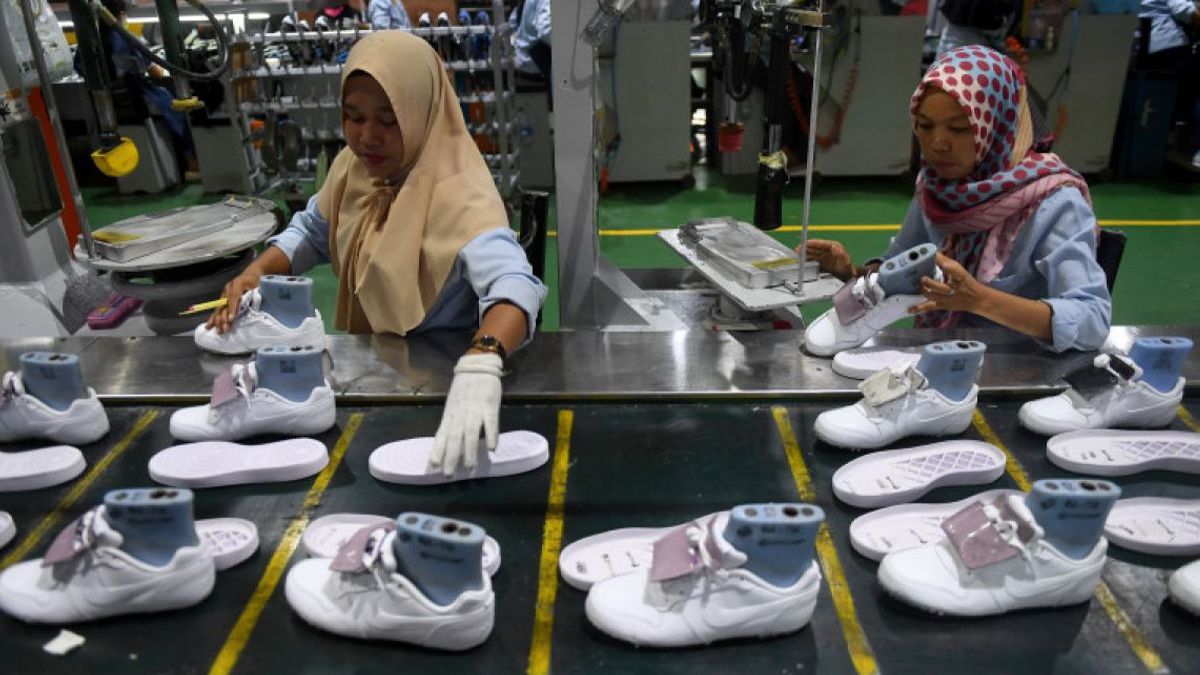


JAKARTA - The Ministry of Industry (Kemenperin) admits that the domestic footwear industry is still dependent on imported raw materials from China. As a result, the domestic footwear industry is less able to compete.
Director General of Small, Medium and Multi-Industry (IKMA) of the Ministry of Industry, Reni Yanita, said that industrial actors are required to increase their competitiveness in the future.
"So, for the footwear industry, the main source of materials or raw materials is still controlled by China with a very strong industrial supply chain. Well, when the components are still heavily imported, of course, from other factors, our business actors are required to increase their competitiveness so that the price is competitive," said Reni in the January 2026 IKI Release in Jakarta, Thursday, January 29.
Reni said that domestic footwear industry players must be able to circumvent the invasion of Chinese products, both in terms of quality, quantity and price.
"So, we are trying to compete with imported products which are indeed more from China. You can imagine when the product is from China, we import raw materials from China. This, we want to make the shoes, the soles, the raw materials from China, face the finished goods from China," he said.
He is worried that if business actors do not immediately solve it, the domestic footwear industry will lose competitiveness to products from China in the future.
"If we can't derive it from R&D, from its productivity, we will definitely lose out. This is our pr (homework) for all of us," he said.
Even so, Reni said, his party had made a number of efforts to boost the growth of the footwear industry. Among others, do attractive marketing, both online by partnering with several existing marketplaces and also offline.
Not only that, he continued, the existence of the Indonesian Cooperative Industry Empowerment Center which was inaugurated in November 2025 is also expected to be a breath of fresh air for the subsector.
"It is hoped that the designers, motifs or raw materials used by small and medium industries will also be better, quality. So, there is no impression that the IKM product, right, is just a product," said Reni.
Moreover, said Reni, the main market share of Indonesian footwear products is the United States (US) and the European Union.
"With the existence of innovation, continued R&D, the hope is that more and more footwear will be produced by IKM, which will be more competitive," he explained.
"How do we have many IKM, now we have to empower them so that they still love their work," he added.
Previously, the performance of the footwear industry was confirmed to be at a declining level, alias contraction, in January 2026. This was revealed by the Ministry of Industry (Kemenperin) in the January 2026 IKI Release today.
Ministry of Industry spokesman Febri Hendri Antoni Arif revealed that the performance of the footwear industry was below the 50 level, alias not expansive, at the beginning of this year.
"The three subsectors that experienced contraction below 50 are the leather industry, leather goods and footwear (KBLI 15), the wood industry subsector, wood and cork goods (excluding furniture) and woven goods from bamboo, rattan and the like (KBLI 16) and the third is the computer industry, electronic and optical goods (KBLI 26)," said Febri on the same occasion.
According to Febri, the performance of the export-oriented industrial sub-sector is still depressed due to global uncertainties to the tariff war between countries.
"The export-oriented industrial subsector is still in preparation to see how global uncertainties affect their demand, global uncertainties include geopolitical turmoil and tariff wars between countries," he explained.
The English, Chinese, Japanese, Arabic, and French versions are automatically generated by the AI. So there may still be inaccuracies in translating, please always see Indonesian as our main language. (system supported by DigitalSiber.id)
Most Popular Tags
#Prabowo Subianto #donald trump #Febrie Adriansyah #8791 #giias 2026Popular


