
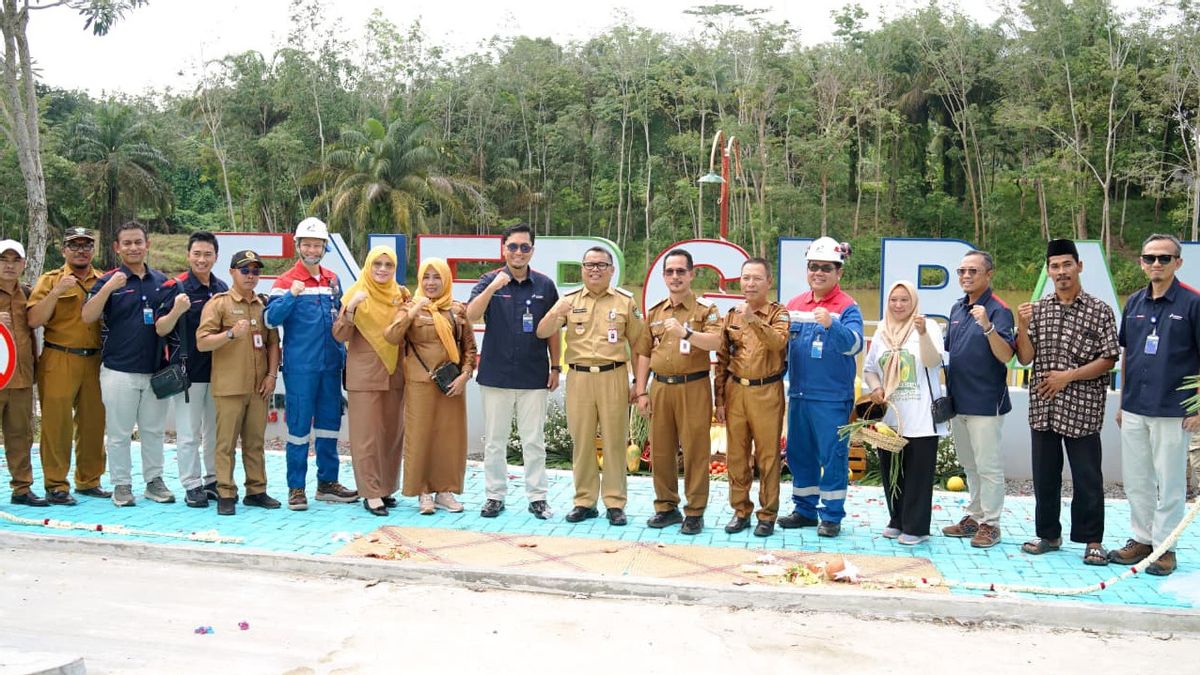


JAKARTA - PT Perusahaan Gas Negara Tbk (PGN) as a Subholding of Pertamina Gas has handed over an educational and creative tourist facility in the form of a playground and a tourist landmark of Danau Kemiri to the Pagardewa Village Government, Muara Enim Regency, South Sumatra, on Monday, January 12. The facility is part of PGN's Corporate Social Responsibility (CSR) program through the Social Innovation Program Strengthening Creative Economy, Safe, and Equal Villages (Pendekar Dewa).
This program aims to strengthen environmental resilience, encourage equitable access and inclusiveness for vulnerable groups, and develop added value for creative economy based on local potential. Through Pendekar Dewa, PGN strives to realize a Pagardewa community that is empowered, works, and is innovative.
Pagardewa Village has a high dependence on the rubber plantation sector, with about 70 percent of the community relying on the commodity for their livelihood. However, fluctuations in rubber prices, limited access to clean water, and the high risk of forest and land fires in the dry season often put pressure on productivity and stability of community income, especially for vulnerable groups.
PGN Risk Management Director, Eri Surya Kelana, explained that the Pendekar Dewa Program was designed and implemented gradually to ensure sustainable impact. The first phase in 2021-2022 focused on building the foundation and mapping community needs. The second phase in 2023-2024 is directed at developing systems and strengthening independence, while the third phase in 2025 focuses on strengthening sustainability through the management baton to local stakeholders.
"This program is not only oriented towards short-term assistance, but building a system that is capable of improving the environmental and economic resilience of the community sustainably," said Eri, Tuesday, January 13.
Pendekar Dewa is run through three main pillars, namely Safe, Equal, and Creative Economy. The Safe pillar focuses on increasing business certainty and rubber farmer income through the Latex Station Program which cuts the sales chain and stabilizes prices, Sebakul Dewa as a center for superior rubber seeds, and SITEGAS through the development of beekeeping and family-based SMEs of farmers.
Through this pillar, rubber farmers' income in 2025 was recorded at Rp57.6 million per year or increased by 33.3 percent compared to the previous year. In addition, the optimization of replanting land reached a value of Rp120 million, and as many as 28 members of the farmer's family - especially women - now have a source of independent income, with a total value of UMKM sales reaching Rp11.38 million.
Meanwhile, the Setara Pillar answered the limitations on access to clean water and sanitation, which previously required some residents to walk up to one kilometer to get water. PGN built five PLTS-powered latrine facilities and formed the Pendekar Talang group as water managers. This program provides access to clean water for 28 families and supports efforts to mitigate forest and land fires.
Center for Tourism and Environmental SustainabilityThe Creative Economy Pillar is realized through the development of the Danau Kemiri area as an educational tourism center and a village creative economy. This area is equipped with five public facilities, including a hall, UMKM booths, playgrounds, traffic parks, and amphitheaters. In addition to serving as a public space, Danau Kemiri is also a water source with a capacity of 22,500 cubic meters to support environmental sustainability.
Lake Kemiri is now managed by the Sadar Wisata Group (Pokdarwis) Kemiri Cluster. Throughout 2025, the area recorded a total of 6,554 visitors and generated tourism revenue of Rp. 92.48 million, or an increase of 191 percent compared to the previous period.
Eri added that the existence of Lake Kemiri and its supporting facilities has a strategic function that goes beyond the aesthetic and recreational aspects. This area is designed as an integrated public space that supports educational tourism, social interaction, and serves as an alternative water source in mitigating forest and land fires during the dry season.
"Lake Kemiri is not only developed as a tourist area, but also as a solution based on community needs that supports strengthening the environmental resilience of villages," he said.
He hopes that all the facilities and programs that have been handed over can be maintained, cared for, and utilized optimally by the community in order to provide long-term and sustainable benefits.
The Expert Staff for Government, Law, and Politics of Muara Enim Regency, Juli Jumatan Nuri, appreciated the implementation of the Pendekar Dewa Program which was considered comprehensive and oriented towards the real needs of the community.
"PGN programs are designed and implemented from upstream to downstream, starting from mapping problems, meeting basic needs, to strengthening independence and sustainability of management by residents. This approach reflects PGN's commitment to presenting empowerment programs that are not momentary, but rather have a real and sustainable impact," he concluded.
The English, Chinese, Japanese, Arabic, and French versions are automatically generated by the AI. So there may still be inaccuracies in translating, please always see Indonesian as our main language. (system supported by DigitalSiber.id)
Most Popular Tags
#Prabowo Subianto #donald trump #Febrie Adriansyah #8791 #giias 2026Popular


