

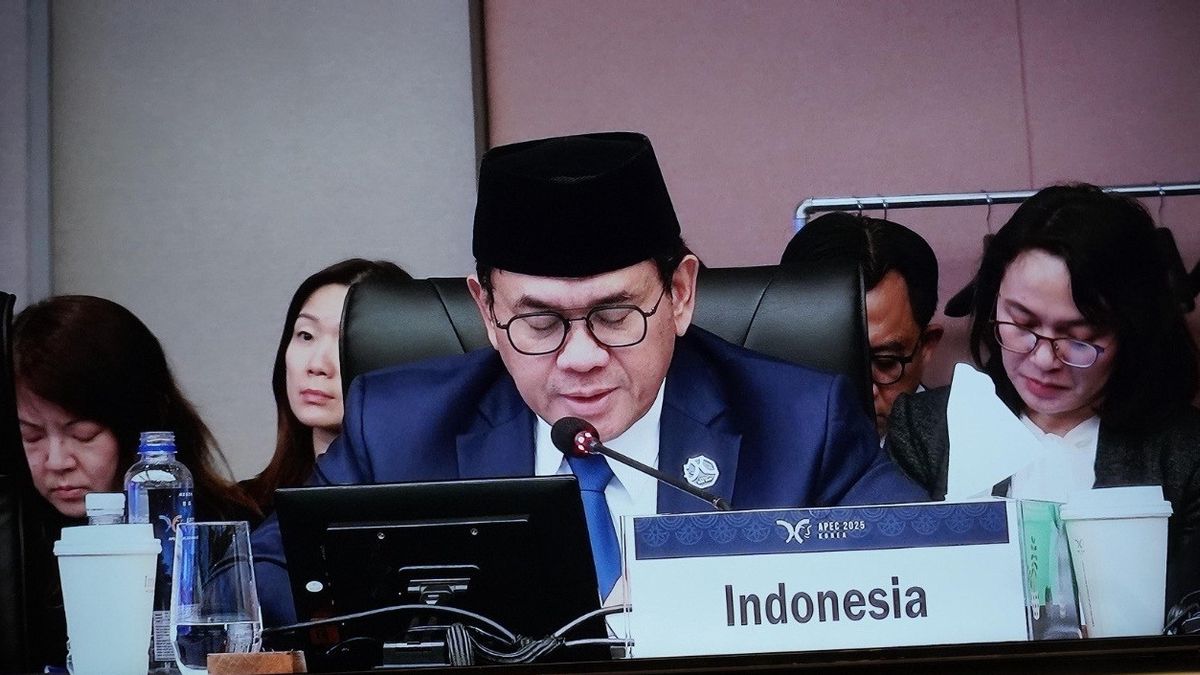


JAKARTA - Indonesian Trade Minister Budi Santoso emphasized the importance of the principle of inclusiveness in economic cooperation in the Asia-Pacific region (APEC) amidst global uncertainty and challenges.
He said APEC must ensure that all its members grow together without anyone being left behind.
This was conveyed by Budi during an intervention in the Second Session of the APEC Ministerial Meeting today, Thursday, October 30 in Gyeongju, South Korea.
The agenda is part of the Asia-Pacific Economic Leaders Week Summit Series from October 29 to November 1, 2025.
Budi emphasized that various strategies to ensure APEC remains relevant in the global economy must continue to be accompanied by efforts to overcome the inter-Economic gap.
"We need to overcome challenges such as inequality of access, infrastructure gap, and good data governance needs. We also need to strengthen cooperation and connectivity and ensure that no economy is left behind," Budi said in an official statement, Thursday, October 30.
According to Budi, although the global economy is gradually recovering, various challenges such as geopolitical tensions, climate change, and supply chain fragmentation are still looming. However, behind these challenges there is a great opportunity to carry out economic transformation.
"We can take advantage of this momentum to invest in downstream industries, strengthen the green economy, and take advantage of new technologies such as artificial intelligence (AI). APEC's approach to AI must be inclusive and careful by considering the difference in conditions and the level of APEC's economic readiness," said Budi.
Budi conveyed Indonesia's attitude regarding the increasing risk of supply chain fragmentation which changed the global trade order.
He said Indonesia consistently supports the role of the World Trade Organization (WTO) as the main pillar of multilateral trade based on regulations (rules-based).
He said, Indonesia also supports various collective efforts to restore the dispute resolution system by moving back the WTO appeal agency.
WTO's credibility rests on maintaining open dialogue, certainty of rules, and trust between members. Consensus remains an important element for WTO legitimacy and inclusiveness. Meanwhile, open and inclusive plurilateral initiatives must be complementary to multilateralism, not replacing them," he said.
SEE ALSO:
-
 | EKONOMI
Kementerian UMKM Fasilitasi Legalitas-Pembiayaan ke 1.000 Usaha Mikro di NTT
30 Oktober 2025, 20:51 -
 | EKONOMI
Kemenperin Klaim Kinerja Industri RI Setahun Terakhir Sering Ekspansif
30 Oktober 2025, 19:47

Untuk itu, Budi menyampaikan, Indonesia mendukung peran kepemimpinan APEC dalam memperkuat multilateralisme.
Indonesia juga siap bekerja sama dengan APEC untuk mewujudkan kerja sama multilateral yang seimbang dan substantif melalui Konferensi Tingkat Menteri (KTM) ke-14 WTO di Kamerun pada 2026 mendatang.
“Indonesia juga mendorong agar pembahasan yang telah dimulai sejak KTM ke-13 terus dilanjutkan, termasuk di bidang pertanian, subsidi perikanan, niaga elektronik (e-commerce), dan reformasi WTO,” ujar Budi.
Sekadar informasi, total perdagangan Indonesia dengan APEC pada 2024 mencapai 380,04 miliar dolar AS.
Ekspor Indonesia ke APEC tercatat sebesar 195,01 miliar dolar AS, sedangkan impor Indonesia dari APEC sebesar 185,04 miliar dolar AS.
Indonesia mencatatkan surplus terhadap APEC sebesar 9,97 miliar dolar AS.
Produk-produk unggulan ekspor Indonesia ke kawasan APEC, antara lain, besi dan baja, mesin kelistrikan, minyak nabati dan hewani, nikel dan turunannya, dan kendaraan.
Di sisi lain, mayoritas impor Indonesia dari kawasan APEC mencakup mesin dan peralatan mekanis, mesin kelistrikan, plastik, besi dan baja, serta kendaraan.
SEE ALSO:
-
| EKONOMI
Kementerian UMKM Fasilitasi Legalitas-Pembiayaan ke 1.000 Usaha Mikro di NTT
30 Oktober 2025, 20:51 -
| EKONOMI
Kemenperin Klaim Kinerja Industri RI Setahun Terakhir Sering Ekspansif
30 Oktober 2025, 19:47
For this reason, Budi said, Indonesia supports APEC's leadership role in strengthening multilateralism.
Indonesia is also ready to cooperate with APEC to realize balanced and substantive multilateral cooperation through the 14th WTO Ministerial Conference (KTM) in Cameroon in 2026.
"Indonesia also encourages discussions that have started since the 13th KTM to continue, including in agriculture, fishery subsidies, electronic commerce (e-commerce), and WTO reforms," said Budi.
For your information, Indonesia's total trade with APEC in 2024 will reach US$ 380.04 billion.
Indonesia's exports to APEC were recorded at 195.01 billion US dollars, while Indonesia's imports from APEC amounted to 185.04 billion US dollars.
Indonesia recorded a surplus against APEC of 9.97 billion US dollars.
Indonesia's leading export products to the APEC region include iron and steel, electrical machinery, vegetable and animal oils, nickel and its derivatives, and vehicles.
On the other hand, the majority of Indonesia's imports from the APEC area include mechanical machinery and equipment, electrical machinery, plastic, iron and steel, and vehicles.
The English, Chinese, Japanese, Arabic, and French versions are automatically generated by the AI. So there may still be inaccuracies in translating, please always see Indonesian as our main language. (system supported by DigitalSiber.id)


