
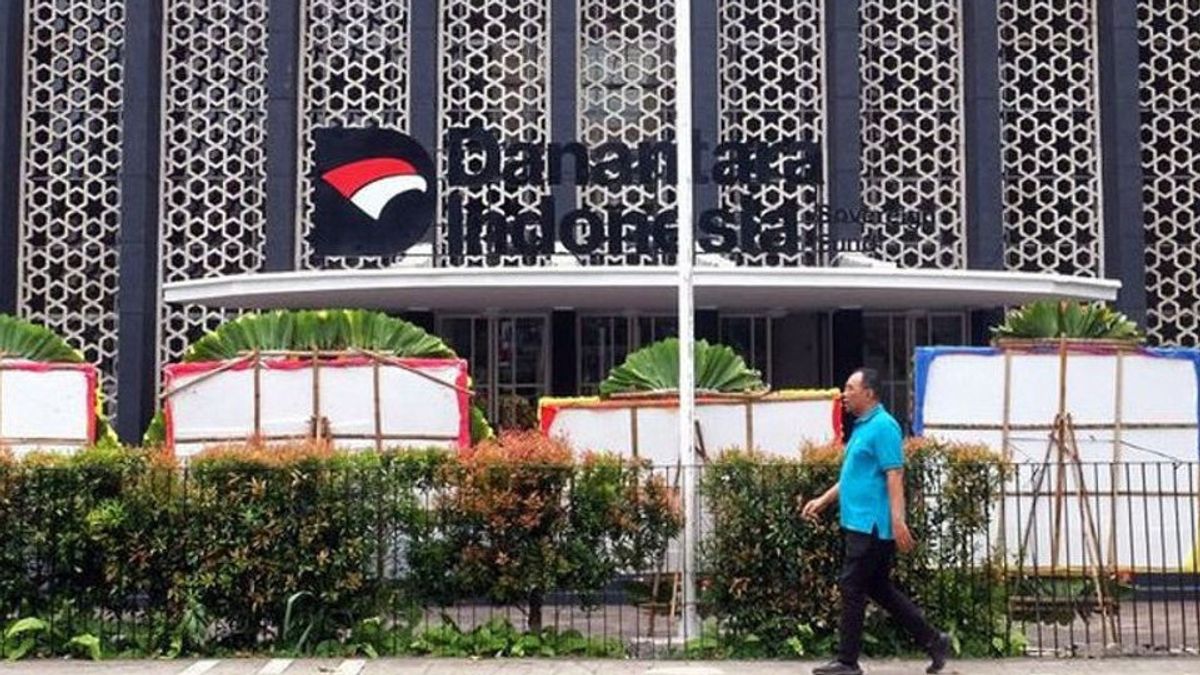


JAKARTA - Economic Policy Analyst of the Indonesian Employers' Association (APINDO) Ajib Hamdani believes that the Danatangan Investment Management Agency (BPI) has placed some funds in Government Securities (SBN) is a step commonly taken by sovereign wealth funds (SWF) in various countries.
"Temasek di Singapura, Kuwait Investment Authority, hingga Abu Dhabi Investment Authority juga memulai dengan investasi publik seperti bonds dan saham sebelum masuk ke proyek sektor real," kata Ajib dalam keterangan tertulis di Jakarta, dikutip Antara, Senin, 20 Oktober.
According to Ajib, this method was generally taken by SWF in the early days of fund formation or ramp-up period while waiting for a feasibility study and coordination of strategic projects to be financed.
Ajib sees that the public often mistaken that big funds can be directly invested into the project. In fact, building a hydroelectric power plant (PLTA), for example, could take six years for construction and 10 years to break even.
"If all the funds are immediately disbursed, it's actually a high risk," he added.
Therefore, the purchase of SBN is said to be not a deviation, but part of the normal SWF stage of building portfolios and long-term investment governance.
During the transition period, the placement of funds in SBN can maintain liquidity while at the same time making state money rotate in the national financial system. The process will then make the composition of public and private investments more balanced.
In the context of the Danantara, instruments such as liquid and rupiah-denominated SBN were chosen to maintain the value of state capital without taking any measurable risks.
"This is a short-term step to ensure long-term capabilities," he said.
However, the allocation to the public market does not stop at the beginning. The portion of investment in public instruments will still exist permanently, said Ajib, although the proportion will decrease or balance along with the increasing allocation of direct investment in strategic projects.
This is very common in the world of SWF. Norges, GIC, Temasek, all of them maintain some portfolios in public markets as anchors of liquidity and risk diversification," he said, explaining.
BACA JUGA:
-
 | EKONOMI
IFG Tunjuk Leonardo Henry Gavaza jadi Direktur Keuangan PT Askrindo
22 November 2024, 20:47

However, he admits that not all SWFs have the same focus. There are SWFs that are more oriented towards capital conservation, some emphasize national growth financing.
The criticism conveyed to Danantara this time, continued Ajib, needs to be used to increase literacy in the role and work mechanism of SWF.
The issue of securitization and use of assets as collateral for further financing is a more technical topic, with different approaches and communication channels. Issues like this require a separate discussion. However, Ajjib said the steps taken by Danantara, in principle, were carried out within the framework of careful governance.
The SWF is not an institution that seeks instant profits. They maintain the value of state assets across generations. Danantara's mandate remains: financing industrialization and strengthening economic independence. But to get there, it takes a clear time and process. And all of that is being built now," he said.
The English, Chinese, Japanese, Arabic, and French versions are automatically generated by the AI. So there may still be inaccuracies in translating, please always see Indonesian as our main language. (system supported by DigitalSiber.id)


