

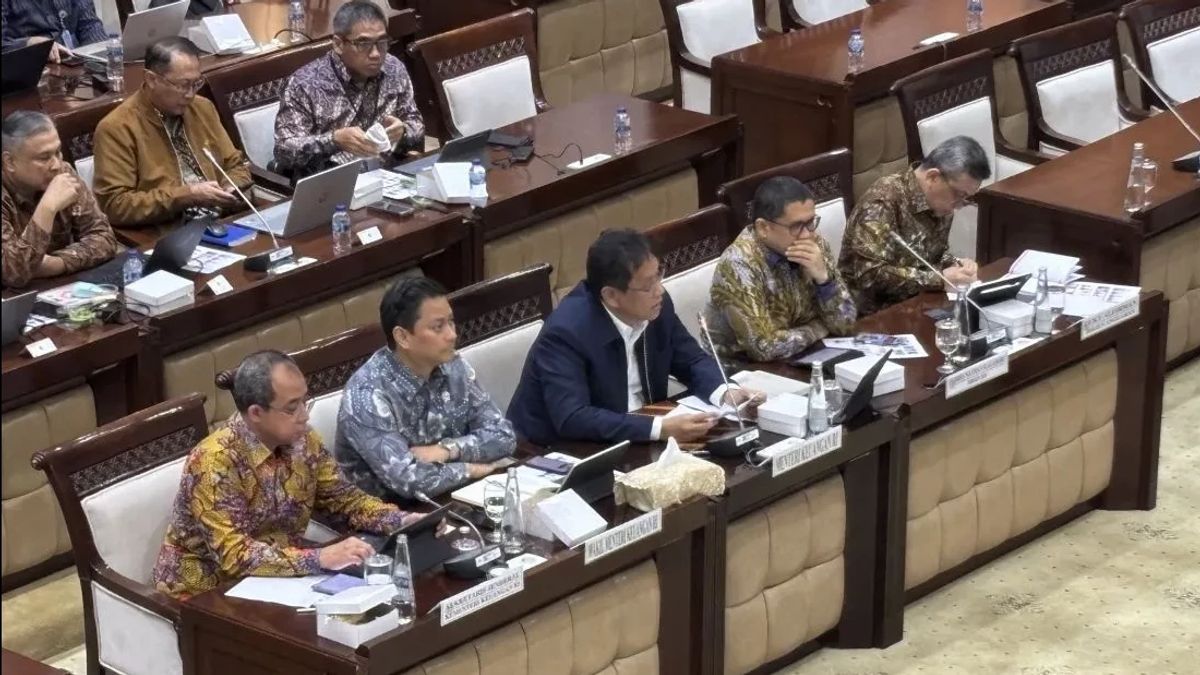


JAKARTA - Minister of Finance Purbaya Yudhi Sadive said, the price of a number of energy and non-energy commodities consumed by the community is different from the original.
He explained that so far people have enjoyed cheaper prices due to subsidies and compensation from the government.
"The government has so far borne the difference between economic prices and prices paid by the community through the provision of subsidies and compensation for both energy and non-energy," he said in a working meeting with Commission XI of the Indonesian House of Representatives, Tuesday, September 30.
He gave an example, for diesel fuel, the economic price reached IDR 11,950 per liter.
However, people only pay Rp. 6,800 per liter.
Thus, the government bears a difference of Rp5,150 per liter through the state budget.
Meanwhile, for Pertalite, the original price is Rp. 11,700 per liter, but it is sold to the public at a price of Rp. 10,000 per liter and which is borne by the state budget of Rp. 1,700 per liter.
Meanwhile, kerosene still gets a large subsidy, which is Rp. 8,650 per liter, from the economic price of Rp. 11,150 per liter, so that the selling price to the public is only Rp. 2,500 per liter.
Next for LPG gas measuring 3 kg, the actual price is IDR 42,750 per cylinder, however, with a subsidy of IDR 30,000 per cylinder, people only pay IDR 12,750.
Furthermore, subsidies are also given to 900 VA-powered household electricity, where the economic price is IDR 1,800 per kWh, but the public simply pays IDR 600 per kWh because the Government provides subsidies of IDR 1,200 per kWh.
Then for non-subsidized 900 VA household electricity, the government still provides assistance of Rp. 400 per kWh or an estimated 22 percent of the economic price, so that the tariff paid by the community becomes Rp. 1,400 per kWh.
SEE ALSO:
-
 | EKONOMI
Kementerian PU Targetkan 15 Bendungan dan Irigasi Dapat Beroperasi Sebelum 2029
30 September 2025, 13:25 -
 | EKONOMI
Pemerintah Masih Berutang Rp55 Triliun ke BUMN, Purbaya Janji Percepat Pembayaran ke Depan
30 September 2025, 17:33

Komoditas non-energi seperti pupuk juga mendapat dukungan fiskal, yaitu untuk pupuk urea, pemerintah menanggung Rp3.308 per kg dari harga keekonomian Rp5.558 per kg, sehingga masyarakat hanya membayar Rp2.250 per kg.
Berikutnya pupuk NPK, dari harga asli Rp10.791 per kg, pemerintah menanggung Rp8.491 per kg, sehingga harga yang dibayar masyarakat menjadi Rp2.300 per kg.
"Ini adalah bentuk keberpihakan fiskal yang akan terus dievaluasi agar lebih tepat sasaran dan berkeadilan," tuturnya.
SEE ALSO:
-
| EKONOMI
Kementerian PU Targetkan 15 Bendungan dan Irigasi Dapat Beroperasi Sebelum 2029
30 September 2025, 13:25 -
| EKONOMI
Pemerintah Masih Berutang Rp55 Triliun ke BUMN, Purbaya Janji Percepat Pembayaran ke Depan
30 September 2025, 17:33
Non-energy commodities such as fertilizers also receive fiscal support, namely for urea fertilizers, the government bears Rp3,308 per kg from the economic price of Rp5,558 per kg, so that people only pay Rp2,250 per kg.
Next is NPK fertilizer, from the original price of Rp. 10,791 per kg, the government bears Rp. 8,491 per kg, so that the price paid by the community becomes Rp. 2,300 per kg.
"This is a form of fiscal partiality that will continue to be evaluated so that it is more targeted and fair," he said.
The English, Chinese, Japanese, Arabic, and French versions are automatically generated by the AI. So there may still be inaccuracies in translating, please always see Indonesian as our main language. (system supported by DigitalSiber.id)
Most Popular Tags
#Prabowo Subianto #donald trump #Febrie Adriansyah #8791 #giias 2026Popular


