
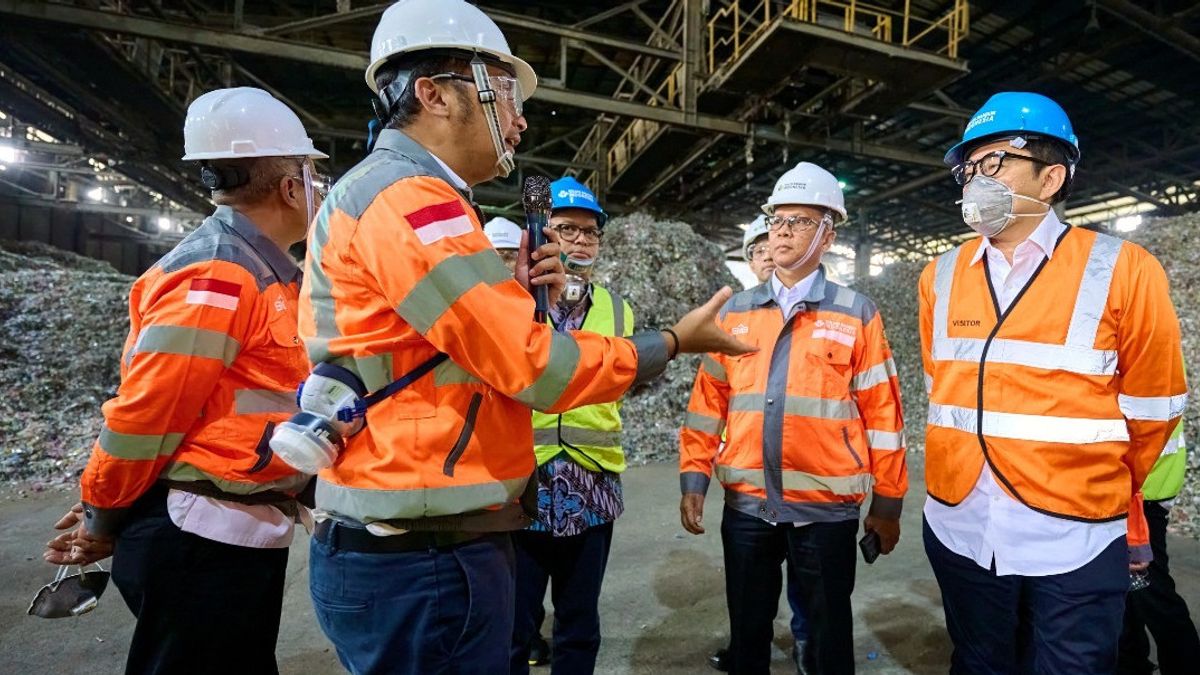


JAKARTA - Deputy Minister of Industry, Faisol Riza gave high appreciation to PT Semen Indonesia (Persero) Tbk (SIG) for the Company's commitment and consistency in running business in a sustainable manner that reconciles economic, environmental and social aspects. Faisol Riza even believes that GIS can be the best practice in implementing green industry principles, not only for the cement industry specifically, but for the national industrial sector in general.
During a working visit to the GIS Factory in Narogong, Bogor, West Java in order to see firsthand the implementation of the green industry standards run by a subsidiary of GIS, PT Solusi Bangun Indonesia Tbk, on Monday, June 23, Deputy Minister of Industry, Faisol Riza said the cement industry has a very important role in infrastructure development.
"SIG Group has been an example of how industrial performance must be comply (compliance) with green industry standards. We understand that all companies in the cement industry sub-sector have a high commitment and have become the best example of business practices for other industries. We hope that what the cement industry has done can be followed by industry and industry associations in other sub-sectors," said Faisol Riza.
Faisol Riza added, based on Law Number 3 concerning Industry, the application of the green industry is based on three main pillars, namely efficiency and effectiveness of resources, environmental protection, and social benefits.
"With this basis, the green industry not only supports achieving environmental targets but is also in line with the concept of a green economy, namely a carbon-low economy, resource-efficient, and socially inclusive. As has been stated, how GIS seeks to innovate for resource efficiency and energy use, even consistency is proven to have received awards from the Ministry of Industry," said Faisol Riza.
Similarly, the Chairperson of the Indonesian Semen Association, Lilik Unggul Raharjo, said that the acceleration of the green industry is very important for the cement industry. In addition to contributing to domestic decarbonization efforts, it is also to anticipate policies to limit carbon emissions, both those that the Government will implement in the Carbon Economic Value policy, and also those set by export destination countries.
President Director of GIS, Indrieffouny Indra expressed his gratitude for the support from the Ministry of Industry to GIS so far, especially in the journey of transforming into a company that applies the principles of the green industry and industry 4.0.
As a market leader in the national cement industry, GIS has a vision to become the largest provider of building materials solutions in Indonesia that are customer-oriented, best business practices based on sustainability principles, creation of added value for stakeholders, and development of human resources.
The spirit of SIG sustainability is based on the awareness that development must go hand in hand with the needs of today's human beings. Therefore, SIG seeks to map out challenges and opportunities to be fit for the future through decarbonization initiatives, creating innovative building materials solutions, implementing circular economy, water conservation and nature, as well as creating value for the community.
"SIG's sustainability commitment is strengthened by a sustainability strategy which includes the creation of innovative and modern solutions, protection of the environment, and the creation of value for employees and the community. The three pillars of sustainability are realized through the application of good governance and upholding law compliance, ethics, and integrity," said Indrieffouny Indra.
SEE ALSO:
-
 | EKONOMI
Ini Penyebab Dolar Perkasa di Negara Berkembang tapi Lemah di Negara Maju
23 Juni 2023, 19:02 -
 | EKONOMI
Paris Summit 2023 Ungkap Belum Ada Investasi Ideal dalam Transisi Energi
23 Juni 2023, 17:19

Currently, GIS is present in the representation of leading pocket cement brands, namely Semen Gresik, Semen Padang, Semen Tonasa, Dynamix, Semen Andalas, Thang Long, Semen Baturaja and Semen Merdeka. Thanks to the sustainability initiative carried out, SIG cement products have reached 38% lower carbon emissions than conventionally produced products.
Not only cement bags, but also cement bulk and ready-to-use concrete products. GIS's sustainability commitment is increasingly stable with an environmentally friendly waste management business line called Nathabumi which has the largest waste management facility in Southeast Asia. Through Natabumi as well, SIG pioneered the implementation of the first refuse-derived fuel (RDF) technology in Indonesia, located in Cilacap, Central Java.
To achieve the green industry, GIS is also focused on efforts to create value for the community by involving them in the Company supply chain, such as providing biomass supply, as well as managing and utilizing RDF.
For various efforts that have been carried out, GIS has won three awarders for the Gold PROPER, five Green PROPERs, and 2024 Green Leadership from the Ministry of Environment (KLH). GIS also won various awards from the Ministry of Industry, including the 2024 Green Industry award, the National Lighthouse Industry 4.0 award, and INDI 4.0," concluded Indrieffouny Indra.
The English, Chinese, Japanese, Arabic, and French versions are automatically generated by the AI. So there may still be inaccuracies in translating, please always see Indonesian as our main language. (system supported by DigitalSiber.id)
Most Popular Tags
#Prabowo Subianto #donald trump #2026 World Cup #Febrie Adriansyah #8791Popular


