
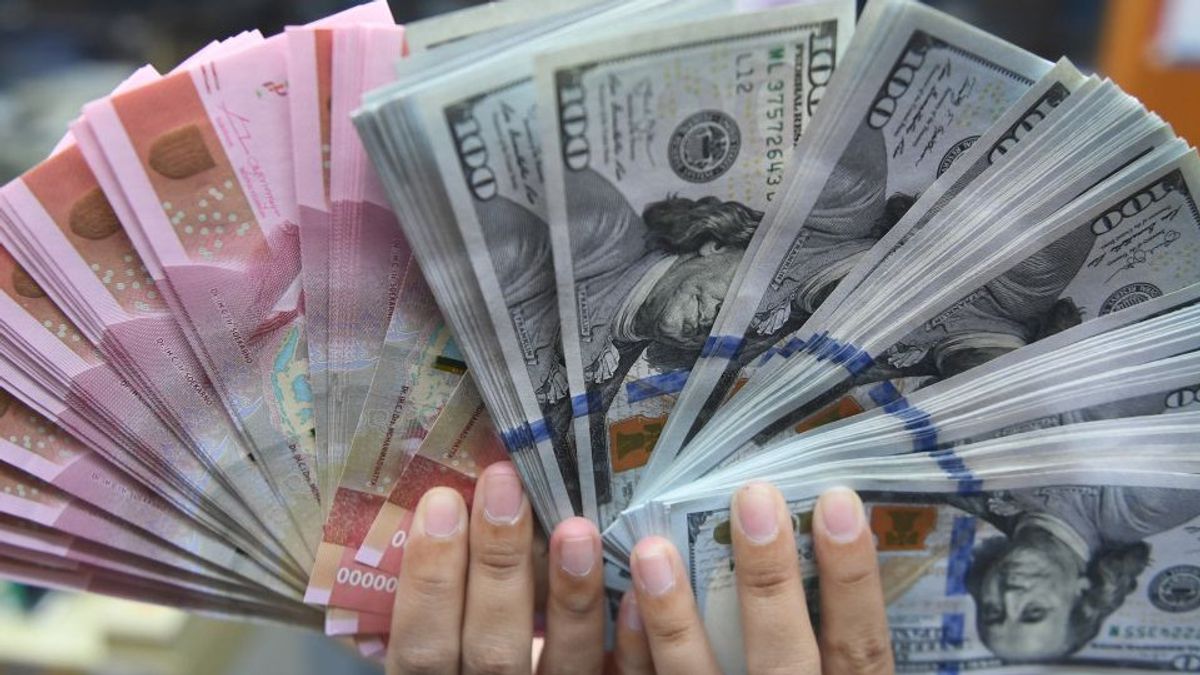


To note, citing Bloomberg, on Wednesday, March 5, the rupiah spot exchange closed up 0.81 percent to the level of Rp. 16,312 per US dollar. Meanwhile, the Jakarta Interbank Spot Dollar Rate (Jisdor) exchange rate of Bank Indonesia (BI) closed up 0.43 percent to a price level of Rp. 16,371 per US dollar.
Currency Observer Ibrahim Assuaibi said US President Donald Trump's trade rates against China, Canada, and Mexico took effect this week, highlighting plans for stricter tariff measures during his speech at Congress.
According to Ibrahim, this trade tariff will have an impact on the region's largest economy.
"Trump's plans for reciprocal rates will also have an impact on the main export-oriented economy in Asia, especially South Korea, Australia, Taiwan and Singapore," he said in his statement, quoted Thursday, March 6.
However, Ibrahim said the market was a bit relieved after US Commerce Secretary Howard Lutnick stated that US President Trump may be open to reaching trade deals with Canada and Mexico.
On the other hand, Ibrahim said the Chinese government announced a series of countermeasures targeting US agricultural imports and other sectors after a 20 percent tariff against China came into effect.
Ibrahim said that the focus was also on more stimulus steps from China when the National People's Congress began.
"The government is expected to outline more stimulus to support China's economy, especially in dealing with trade-related barriers," he said.
Meanwhile, from within the country, President Prabowo Subianto has set a fiscal target for five years, such as economic growth, tax ratios, state spending, to the percentage ratio of government debt to GDP.
This stipulation is stated in Presidential Regulation (Perpres) Number 12/2025 concerning the National Medium-Term Development Plan (RPJMN) 2025-2029, documents will take effect on February 10, 2025.
There are six government fiscal targets during 2025-2029, namely first, state revenues of 13.75 percent-18.00 percent of gross domestic product (GDP) in 2029.
Revenue comes from tax revenues which are targeted to reach 11.52 percent-15.00 percent of GDP in 2029 and non-tax state revenues (PNBP) which are targeted to reach 2.21 percent-2.99 percent of GDP by 2029.
Second, state spending of 16.20 percent - 20.50 percent of GDP in 2029 which will come from central government spending which is targeted to reach 11.79 percent - 15.01 percent of GDP and transfers to regions targeted to reach 4.41 percent - 5.49 percent of GDP.
SEE ALSO:
-
 | EKONOMI
Ini Penyebab Dolar Perkasa di Negara Berkembang tapi Lemah di Negara Maju
23 Juni 2023, 19:02 -
 | EKONOMI
Paris Summit 2023 Ungkap Belum Ada Investasi Ideal dalam Transisi Energi
23 Juni 2023, 17:19

Next third, namely the primary balance of -0.15 percent to -0.20 percent of GDP in 2029 and fourth, the APBN surplus/deficit of -2.45 percent to -2.5 percent of GDP in 2029.
Furthermore, fifth, government debt stocks of 39.01 percent to 39.10 percent of GDP in 2029 and sixth, investment financing of 0.50 percent to 1.00 percent of GDP in 2029.
In the RPJMN document, it is explained that the government will direct the medium-term fiscal policy 2025-2029 to efforts to accelerate structural reforms as the key to accelerating economic transformation towards Indonesia Gold 2045.
Ibrahim estimates that the rupiah will fluctuate but close higher in trading Thursday, March 6, 2025, in the price range of IDR 16,230 - IDR 16,320 per US dollar.
The English, Chinese, Japanese, Arabic, and French versions are automatically generated by the AI. So there may still be inaccuracies in translating, please always see Indonesian as our main language. (system supported by DigitalSiber.id)
Most Popular Tags
#Prabowo Subianto #donald trump #2026 World Cup #venezuela #konflik timur tengahPopular


