

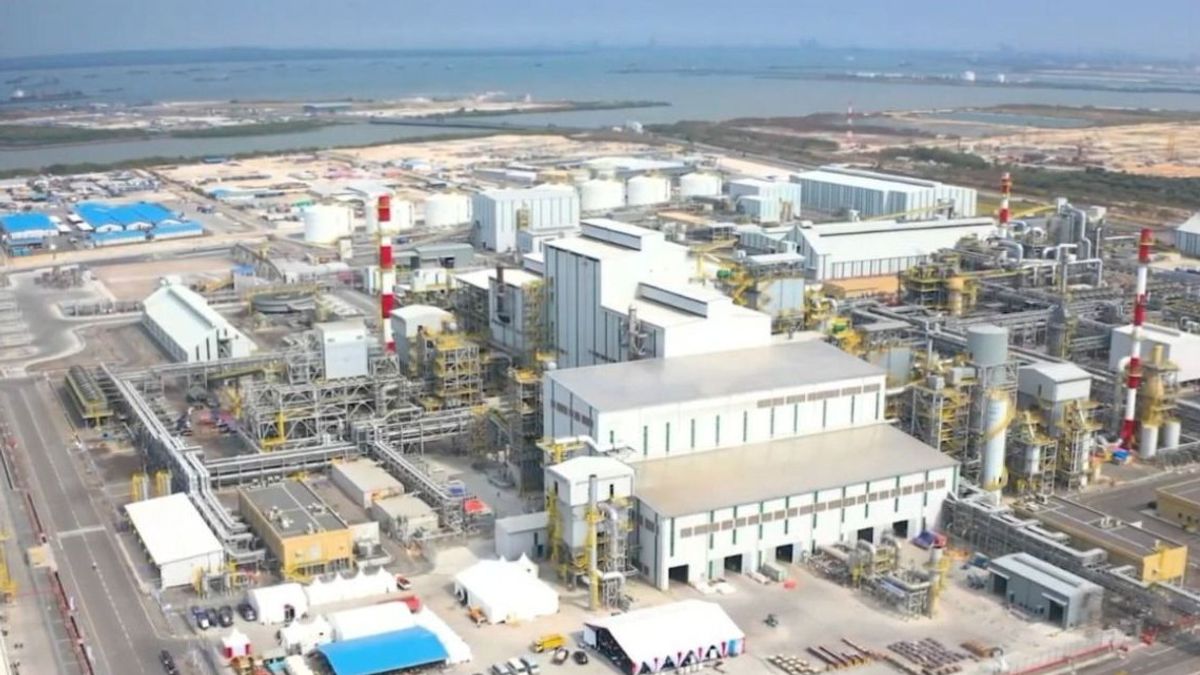


JAKARTA - The government through the Task Force for the Acceleration of Downstreaming and National Energy Resilience of the Minister of Energy and Mineral Resources (ESDM) emphasized the importance of downstreaming as a trigger for economic growth, by prioritizing domestic financing to reduce dependence on foreign financial institutions.
"The President's directive is very clear. We will formulate a financing pattern that involves domestic financial institutions. That way, the perception that this policy only benefits foreign parties will slowly erode," said Bahlil, Friday, January 17.
Bahlil added that the involvement of domestic financial institutions can be a great opportunity to strengthen the national financial sector as well as encourage economic independence. This effort is in line with Presidential Decree Number 1 of 2025 concerning the Task Force for the Acceleration of National Downstreaming and Energy Resilience which emphasizes downstreaming as a strategic step to increase investment and create added value in the country.
"We have formulated strategic steps to carry out President Prabowo's orders in order to increase investment and downstream. The Ministry of Energy and Mineral Resources will become a post for us to work for approximately five years until we wait for further directions from the President," continued Bahlil.
In addition to reducing dependence on foreign parties, the government through the Downstream and Energy Security Task Force also maps strategic opportunities in the energy sector to involve more domestic industry players. One of the main focuses is accelerating the use of crude palm oil (CPO)-based biodiesel.
"Currently it has reached B40, and by 2025 it is targeted to increase to B50 according to the President's direction," he said.
To support this target, Bahlil emphasized that the process of mixing and procuring raw materials such as CPO, methanol, and ethanol must be carried out domestically.
The Downstream Task Force is also committed to ensuring the implementation of downstream policies that provide direct benefits for the community, including job creation and improving welfare.
SEE ALSO:
-
 | EKONOMI
Ini Penyebab Dolar Perkasa di Negara Berkembang tapi Lemah di Negara Maju
23 Juni 2023, 19:02 -
 | EKONOMI
Paris Summit 2023 Ungkap Belum Ada Investasi Ideal dalam Transisi Energi
23 Juni 2023, 17:19
"The value of the addition must really be felt in Indonesia," said Bahlil.
In the next five years, the Task Force will oversee the implementation of a downstream roadmap that includes the mineral and coal sector, oil and natural gas, agriculture, forestry, and marine and fisheries. All of these steps are aimed at strengthening national energy security and supporting sustainable economic growth.
As part of its responsibility, the Task Force will report the progress of carrying out its duties to the President every six months or at any time if necessary. This step is expected by the government to accelerate the realization of downstreaming and realize energy justice throughout Indonesia.
The English, Chinese, Japanese, Arabic, and French versions are automatically generated by the AI. So there may still be inaccuracies in translating, please always see Indonesian as our main language. (system supported by DigitalSiber.id)
Most Popular Tags
#Prabowo Subianto #donald trump #firearm #8791 #giias 2026Popular


