

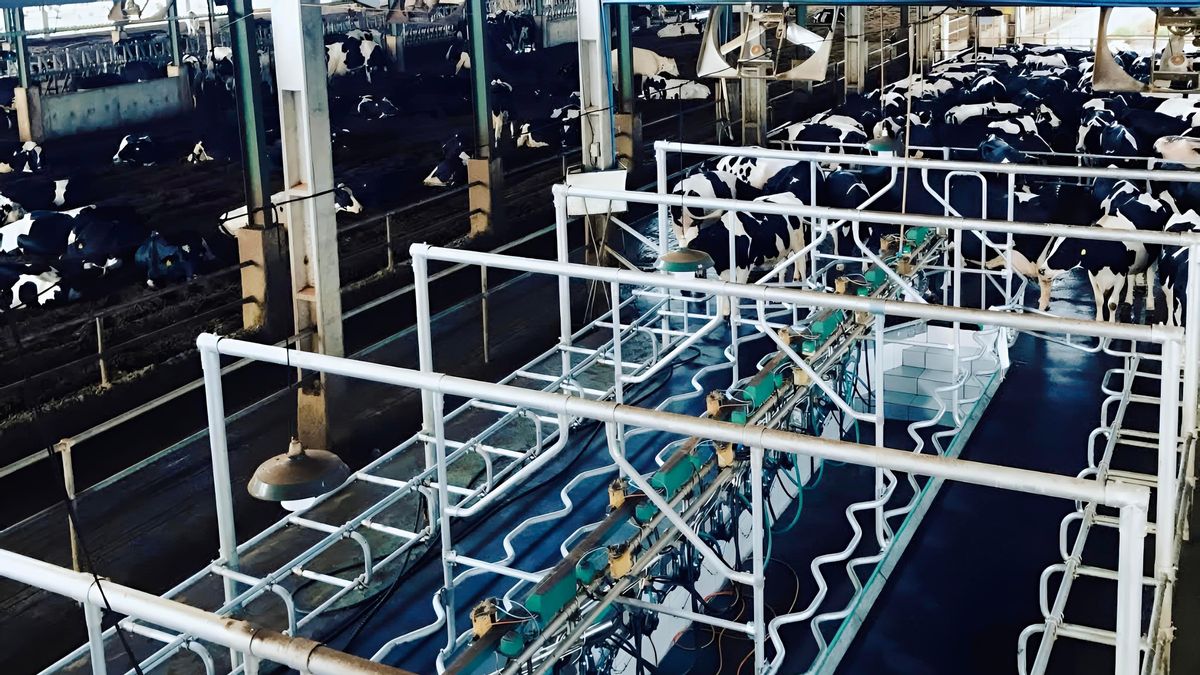


PT Perkebunan Kandangan Madiun as a National Strategic Project (PSN) continues to accelerate the preparation of national milk downstream to reduce import dependence and strengthen the domestic milk processing industry.
The commitment was discussed in an online meeting with the Ministry of National Development Planning (PPN)/Bappenas, which provided support for the development of the dairy sector as part of the national agenda to increase nutritious food production.
Director of PT Perkebunan Kandangan Madiun PSN, Roberto Hendrikson, stated that this project will develop the Madiun area as an integrated milk production center from upstream to downstream, based on superior F1 imported dairy cows from the United States.
"At the online meeting, I conveyed several things about the readiness of PT Perkebunan Kandangan Madiun PSN's support for the milk production improvement program. Among them is the ability to provide milk produced from F1-type superior dairy cows that we import from the United States," he said in his statement, Wednesday, December 24.
Furthermore, he explained that the Madiun area was designed as an integrated modern dairy cattle center, ranging from cultivation to milk processing and this area is targeted to become the largest and most modern dairy cattle breeding model in Indonesia.
Roberto said that development was carried out comprehensively in one area, including the maintenance of dairy cows, the milking process, to the processing of milk into ready-to-consume products.
In the initial phase, the company will bring in F1 dairy cows from the United States. This type of cow is known to have a high productivity rate with milk production reaching 45-55 liters per milking, far exceeding local dairy cows which on average only produce around 18 liters.
According to him, with a lactation period of around 280-300 days, F1 cows are considered capable of supporting large-scale and sustainable milk needs, including to support the Free Nutrition Program (MBG) which requires a consistent supply of milk.
Roberto revealed that the main challenge in the upstream sector is the availability of quality feed, especially corn and fodder, so to overcome this, the company is preparing a partnership model with local farmers to ensure the sustainability of feed supplies.
"We want local farmers to be directly involved. They supply corn for cattle feed. The livestock is running, the agriculture is also growing," he said.
He explained that most of the national milk needs today still depend on imports, which makes the domestic milk processing industry not yet optimally developed.
Through this PSN project, Roberto hopes that the entire downstream process, from production, processing, to distribution of milk in one integrated area, can be realized.
"Until now, milk has been imported first and then processed in Indonesia. With this model, all processes are carried out in the country and are directly distributed to MBG and the free market," said Roberto.
He said the company targeted a 20,000-head F1 dairy cow ownership by 2026 and the delivery process would be carried out gradually, each with 5,000 heads.
"All the livestock facilities are designed to follow international standards, including air circulation arrangements, ideal temperatures, and the availability of clean water," he explained.
Based on data from the Central Statistics Agency (BPS) RI in 2025, East Java recorded fresh milk production of 468,712 tons per year, or about 58 percent of the total national production which reached 808,352 tons per year.
The English, Chinese, Japanese, Arabic, and French versions are automatically generated by the AI. So there may still be inaccuracies in translating, please always see Indonesian as our main language. (system supported by DigitalSiber.id)
Most Popular Tags
#Prabowo Subianto #donald trump #2026 World Cup #Febrie Adriansyah #8791Popular


