

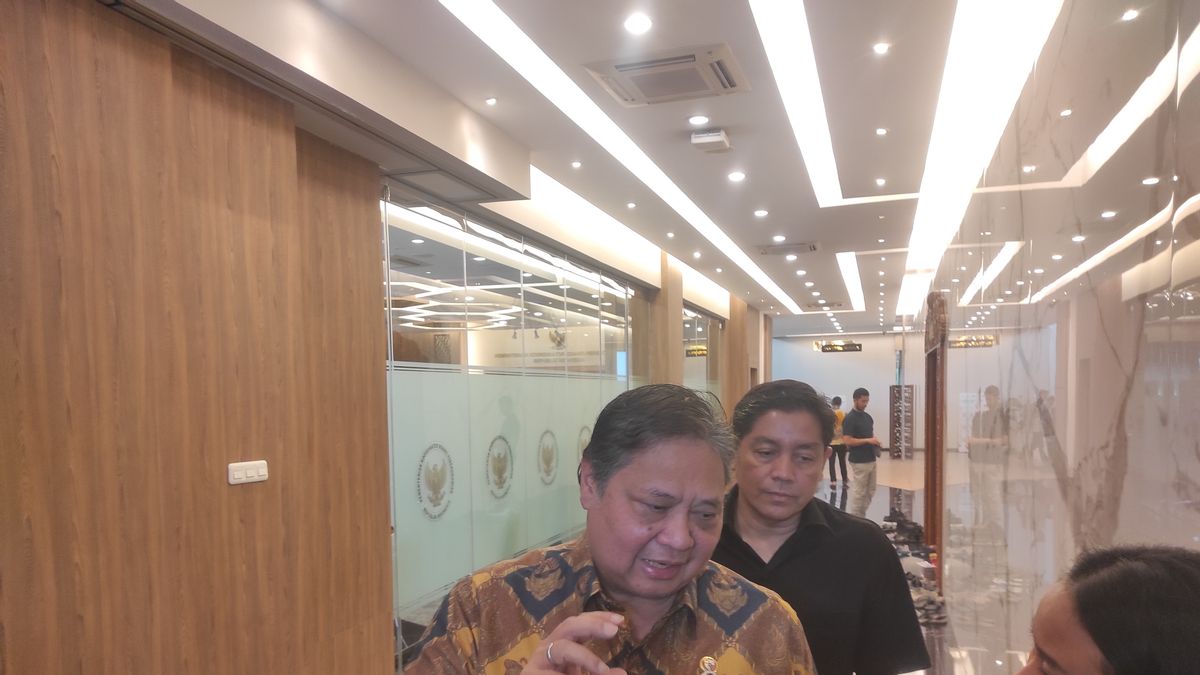


Coordinating Minister for Economic Affairs Airlangga Hartarto said that the government would take advantage of the Housing People's Business Credit (KUR) program as an effort to increase the contribution of Gross Fixed Capital Formation (PMTB) to national economic growth.
Airlangga said the government had prepared a budget of IDR 130 trillion to support the implementation of the program.
"One of the PMTBs is that we also encourage Housing KUR. Now the Housing KUR is IDR 130 trillion and the supply side is given IDR 117 trillion," he told the media crew in Jakarta, Wednesday, November 5.
Airlangga explained, most of the Housing KUR funds will be directed at financing housing projects on the supply side, with loan ceilings of up to IDR 20 billion.
Through this scheme, Airlangga hopes to increase the contribution of Gross Fixed Capital Formation to national economic growth.
"So the push from the housing sector will encourage PMTB," he said.
However, Airlangga emphasized that Indonesia's economic fundamentals remain solid, despite the decline in PMTB and household consumption.
"Indonesia's economy is still solid among our G20 number 3," he said.
Previously, the Central Statistics Agency (BPS) revealed that economic growth in the third quarter of 2025 reached 5.04 percent year on year (yoy) when compared to the same quarter in the previous year of 4.95 percent.
BPS Deputy for Balance and Statistics Analysis Moh Edy Mahmud explained that the national economy will continue to grow stable in the third quarter of 2025, mainly driven by high public consumption activities.
According to Edy, household consumption is still the main driver of economic growth with a contribution of 53.14 percent to Gross Domestic Product (GDP) and recorded a 4.89 percent growth compared to the same quarter last year.
"The expenditure component that contributes the largest to GDP is household consumption with a contribution of 53.14 percent in the third quarter of 2025, this component grew by 4.89 percent which shows that the level of public consumption is still maintained," said Edy at the BPS press conference, Wednesday, November 5.
Edy added that the increase in public spending was seen in various sectors, especially in transportation, communications, restaurants, and hotels, which grew 6.41 percent.
He said the increase was driven by increased population mobility, increased sales of vehicle fuel, and an increase in the number of rail and sea transport passengers.
In addition, the restaurant and hotel sectors also recorded a positive performance with a growth of 6.32 percent, as domestic tourist activities increased compared to the same period the previous year.
In terms of investment, the components of Gross Fixed Capital Formation (PMTB) play an important role in encouraging economic growth, with a contribution of 29.09 percent to GDP.
SEE ALSO:
-
 | EKONOMI
Laba Bersih BTN Tembus Rp2,3 Triliun, Kinerja Keuangan Tumbuh Gemilang
26 Oktober 2025, 20:16
"Thus 82.23 percent of GDP in the third quarter comes from household consumption and PMTB," he said.
He explained that PMTB grew positively mainly due to an increase in engine and equipment sub-components, which rose 17 percent, and vehicles grew 6.24 percent.
Furthermore, Edy mentioned that the realization of BKPM investment in the third quarter of 2025 increased by 13.89 percent, reflecting the optimism of business actors in the national economic prospects.
In addition to investment, the export component also provides support for economic growth with an increase of 9.91 percent, especially from exports of non-oil and gas and services.
Meanwhile, some of the leading commodities experiencing export increases include vegetable fats and oils, iron and steel, machinery, and vehicles and their components, along with improving global demand.
The English, Chinese, Japanese, Arabic, and French versions are automatically generated by the AI. So there may still be inaccuracies in translating, please always see Indonesian as our main language. (system supported by DigitalSiber.id)


