

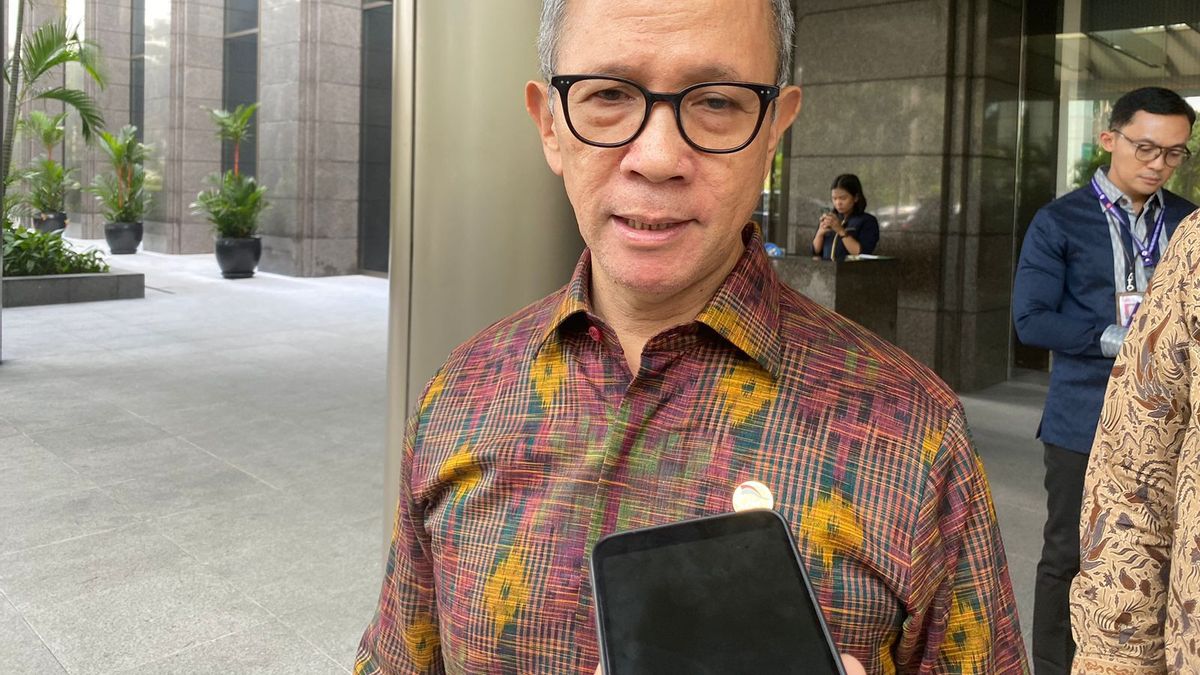


JAKARTA - Chairman of the Board of Commissioners of the Financial Services Authority (OJK) Mahendra Siregar revealed that lending by State-Owned Banks (Himbara) for government funds amounting to Rp200 trillion shows varying figures.
According to him, there are banks that have distributed up to close to 70 percent, but some are still in the range of 50 percent or even lower, namely 20 percent to 30 percent.
"Well, we convey this to the Minister of Finance (Purbaya Yudhi Sadive) for his purpose, he can also enter the speed of absorption in each bank," he told the media crew, Wednesday, October 22.
However, Mahendra has not been able to explain specifically the main constraints from the low distribution, but the OJK will continue to provide information updates to the Minister of Finance regarding these developments.
Regarding the distribution sector, Mahendra said that no special sector is the focus, because the funds distributed have been mixed or blended with other funds that have been owned by each bank.
"So it can't be seen, oh, what's from Rp200 trillion, what's the percentage, while from the non-Rp200 trillion, what's the percent. But in terms of implementation, it's usually mixed, blended. So what we convey is this blended amount, the credit growth rate at Himbara Banks from before the fund was created, there was an increase in growth like that," he explained.
Furthermore, Mahendra highlighted the impact of setting a 4 percent interest rate on bank bargaining power on depositors.
He explained earlier, many depositors asked for higher deposit interest rates through a special rate. However, with the low-interest government funds, banks now have a stronger bargaining position to reject the request.
"He said no, because we had a lower one, we just wanted that, so that's what happened, so when it matured from these deposits, there was a change in the rate of interest that occurred. Or it was offered and then accepted by each deposit. Now what we see is that the value is already lower than before. But that's all, maybe I went second. The next one, I think should be further improved," he said.
Mahendra also revealed that a number of government-owned accounts also asked for a special rate, which he said needed to be the attention of the Minister of Finance as the state treasurer.
"Because we also report that there are a number of accounts owned by the government, they also ask for a special rate. This also needs to be known by the Minister as a form of state treasurer and also as the one who takes care of all of us, so that he knows how this is and who it is. We have said it, but especially if what will be done by the Minister, please ask him later," he explained.
SEE ALSO:
-
 | EKONOMI
Purbaya Ungkap Ternyata Bukan 110 Ribu, Hanya 100 Orang yang Terkendala SLIK untuk KPR
21 Oktober 2025, 22:50 -
 | EKONOMI
Dirjen Pajak Ungkap Berbagai Kebijakan Pajak dalam Satu Tahun Pemerintah Prabowo
20 Oktober 2025, 18:55
He emphasized that accelerating the reduction of deposit interest rates will help adjust to benchmark interest rates such as yields for Government Securities (SBN) and BI rates.
According to him, although the market mechanism still applies, the encouragement from the fund owner, including the government, will accelerate the reduction process.
"But if it is left solely on the market mechanism, it will take a bit of time. But if there are fund owners who have the desire to also see the interest rate drop even faster, yes of course they have flexibility there. And instead, the Minister of Finance has its authority," he said.
However, Mahendra was reluctant to elaborate on the amount of the special rate requested for government fund savings and suggested asking directly to the Minister of Finance.
"If the special rate asks for a higher, not lower. (How much is the range?) Ask the Minister later," he explained.
The English, Chinese, Japanese, Arabic, and French versions are automatically generated by the AI. So there may still be inaccuracies in translating, please always see Indonesian as our main language. (system supported by DigitalSiber.id)


