
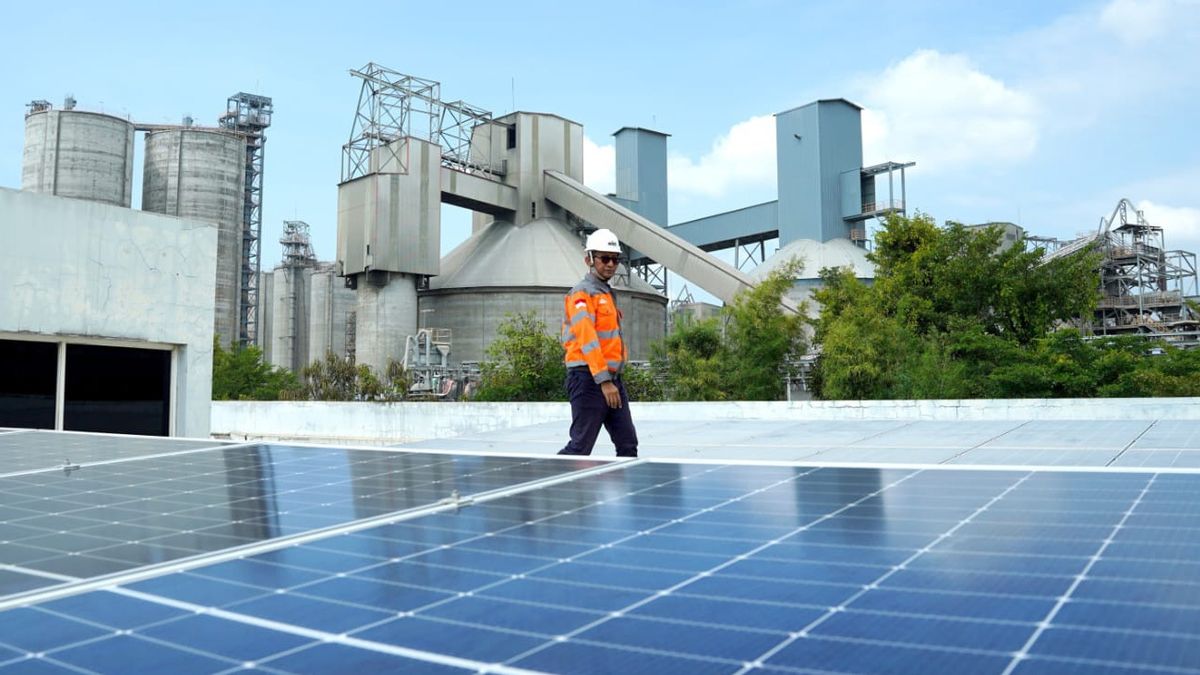


JAKARTA - PT Semen Indonesia (Persero) Tbk (SIG) continues to increase the use of new and renewable energy (EBT) through the development of Solar Power Plants (PLTS) as an alternative energy source that is environmentally friendly and sustainable throughout the Company's operations area, one of which is at the Tuban factory, East Java.
In November 2024, the installation of 6.4 Megawatt peak (MWp) solar panels on ten roofs of the Tuban factory building has reached the commercial operation stage. The achievements at the factory, managed by PT Solusi Bangun Indonesia Tbk as a subsidiary of GIS, boosted the total solar panel capacity in the SIG Group by 6 times to 6.5 MWp, from 0.12 MWp (2023). Megawatt peak is the maximum potential for renewable power generation, when all technical support power is met.
GIS President Director, Indrieffouny Indra said, GIS places the aspect of sustainability as a foundation in running a business. As a building material company that utilizes natural resources, GIS has a strong commitment to carrying out the best business practices in the corridor of sustainability and has the Sustainability Roadmap 2030 as a reference for responsible and environmentally friendly operations.
The construction of solar panels at the Tuban Factory which has been completed further proves GIS' commitment to running environmentally friendly business operations. The use of this alternative energy source not only helps the Company in achieving the greenhouse gas (GHG) emission reduction target, but also has a positive impact on the efficiency of electricity consumption costs," said Indrieffouny Indra, in a written statement, Tuesday, June 24.
Indrieffouny Indra added, solar energy generated from PLTS in all GIS operating areas in 2024 will reach approximately 1,726 MWh. This solar energy production has a positive impact on the environment by reducing CO2 emissions by 1,450,260 kg CO2.
"The use of solar energy is a concrete proof of GIS' commitment in the transition to an environmentally friendly EBT to realize sustainable development in Indonesia. As a company for the solutions of leading building materials in Indonesia, GIS is ready to lead the transformation of industry towards a green economy that focuses on economic growth without neglecting environmental and social aspects," said Indrieffouny Indra.
The geographical location of Indonesia which is along the equator with an average solar energy irradiation of around 4.80 kWh/m2/day, is a huge potential for the use of alternative energy solar power. The Tuban Factory SBI itself is in a geographical position with solar energy irradiation above the national average, which is around 5.4 kWh/m2/day.
SEE ALSO:



This opportunity is behind SBI developing a Rooftop PLTS connected to the existing power grid (On-Grid Connected Rooftop PV System) on 10 roofs of buildings with an installed capacity of 6.4 MWp. This Roof PLTS is operated in parallel to electricity from PLN to support part of the operational needs of factories, offices, and other supporting facilities at SBI Tuban Factory.
President Director of PT Solusi Bangun Indonesia Tbk, Asri Mukhtar said, the world is facing the challenge of climate change due to GRK emissions that require collaborative action, including from the business world, to minimize the impact it has. The fossil energy transition to solar energy is a concrete step for Solusi Bangun Indonesia to participate in realizing low-emission development.
"Sar energy is a long-term investment to create a better life for future generations. SBI consistently implements responsible operating practices in line with the company's decarbonization target, and as a contribution to achieving Sustainable Development Goals or SDGs," said Asri Mukhtar.
The English, Chinese, Japanese, Arabic, and French versions are automatically generated by the AI. So there may still be inaccuracies in translating, please always see Indonesian as our main language. (system supported by DigitalSiber.id)


