
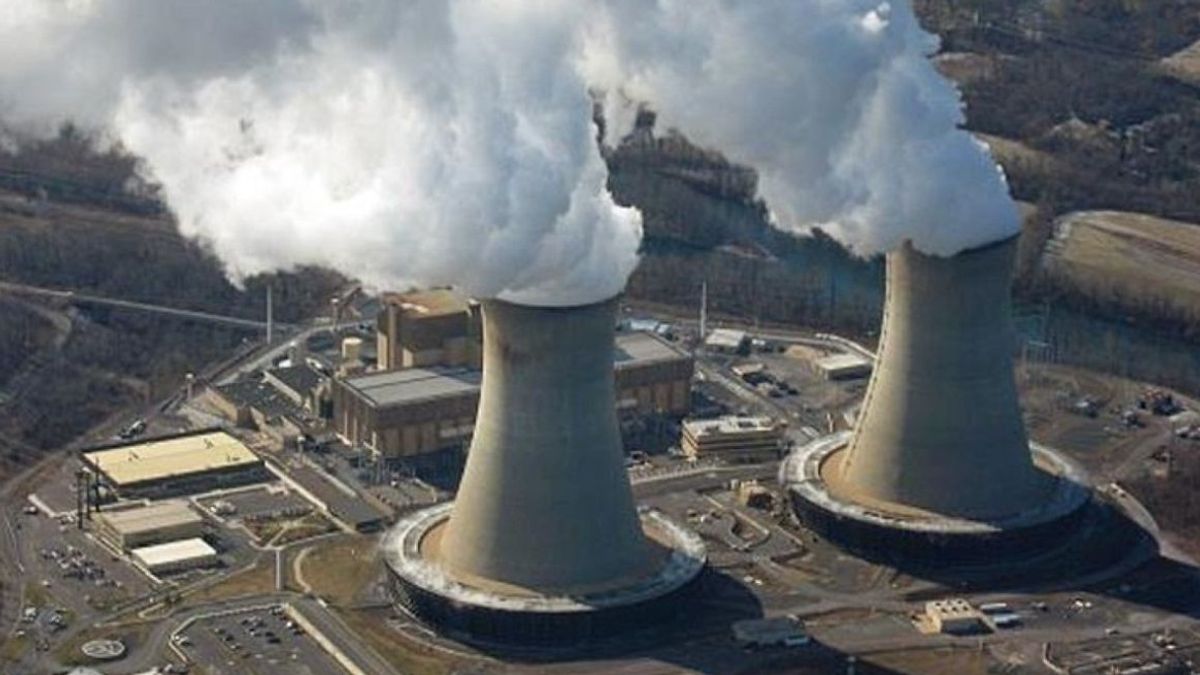


JAKARTA - The Indonesian Chamber of Commerce and Industry (Kadin) fully supports the government in developing Nuclear Power Plants (PLTN) in Indonesia as part of efforts to diversify energy sources and support the sustainability of the national energy sector.
"Kadin Indonesia supports the government to develop Nuclear Power Plants or PLTN in the country," said Deputy Chairperson of the Indonesian Chamber of Commerce and Mineral Energy and Resources (ESDM) Aryo Djojohadikusumo in his statement in Jakarta, quoted by Antara, Wednesday, March 5.
He appreciated the government's move to prioritize the new and renewable energy sector (EBT) as one of the investment goals.
"The president mentioned renewable energy, green energy many times. He specifically mentioned additional fresh funds," he said.
According to him, the trend of investment in PLTN in the world continues to increase from year to year. Kadin and the government are now aggressive in taking advantage of this momentum and potential by continuing to encourage industrial decarbonization through strengthening infrastructure and withdrawing EBT investments.
In the closing of the Democratic Party's VI Congress in Jakarta, Tuesday, February 25, President Prabowo Subianto assessed that nuclear is one of the cleanest renewable energy. The generated energy can be utilized for the health sector, the development of agricultural seeds to other energy sources.
Furthermore, Aryo explained, most of the funds might be injected into the green and renewable energy sector as well as industries that are important for green energy such as minerals.
This step is in line with one of the work plans for the Indonesian Chamber of Commerce and Industry's ESDM 2024-2029, namely new, renewable energy, and energy conservation.
He said, according to information from the Indonesian Chamber of Commerce and Industry Data Center for Energy and Mineral Resources quoted from the International Energy Agency (IEA) report in January 2025, the value of nuclear investment will continue to increase from year to year according to three scenarios of world energy outlook.
First, the Stated Policies Scenario (STEPS) which is conservative, the world's nuclear investment will rise from USD 65 billion per year to USD 70 billion per year by 2030. In that scenario, the nuclear reactor capacity will increase by more than 50 percent approaching 650 gigawatts (GW) in 2050.
Second, the Announced Pledges Scenario (APS), where there is strong government support and energy and climate policies run on time, nuclear investment could reach 120 billion US dollars per year by 2030 with a capacity of more than double in 2050.
Third, in Net Zero Emissions Scenario, the investment of 150 billion US dollars per year in 2030 and the nuclear installed capacity reaches 1,000 GW in 2050.
By 2023, more than 410 reactors will have operated in 30 countries and supply nine percent of global electricity supplies. This number is expected to rise to 420 reactors by 2025.
Countries in the world (in particular developing countries) are currently competing to build nuclear plants as alternative energy. Most of the power plants developed use Chinese and Russian technology.
It is known, nuclear is the second low-energy source of emissions after hydropower, capable of producing 20 percent higher electricity than wind and 70 percent above solar panels.
PLTN is also able to provide heat for the industry, even desalination (pure) of seawater into clean water. Since 1971, nuclear energy has reduced 72 gigatons of carbon dioxide emissions from coal, natural gas and oil plants and strengthened energy security in several countries.
Aryo emphasized that Kadin already has a priority program in 2025 for the "Green Indonesia" initiative by promoting investment in EBT projects. The effort was carried out by attracting investors and encouraging the government to provide investment incentives for investors interested in EBT.
So far, there are three major countries that have offered PLTN development development proposals in Indonesia, namely the United States (US), Russia, and China.
BACA JUGA:
-
 | EKONOMI
Ini Penyebab Dolar Perkasa di Negara Berkembang tapi Lemah di Negara Maju
23 Juni 2023, 19:02 -
 | EKONOMI
Paris Summit 2023 Ungkap Belum Ada Investasi Ideal dalam Transisi Energi
23 Juni 2023, 17:19

"From three countries and coincidentally these three involve Kadin members. These are partners from abroad who are involved with our members," he said.
The US interested party is the Westinghouse Electric Corporation, a leading electric equipment manufacturer. Meanwhile, China is represented by China National Nuclear Corporation (CNNC), a business entity owned by the Chinese government in the field of nuclear power. Meanwhile, Russia is represented by Rosatom State Atomic Energy Corporation (Rosatom).
According to Aryo, proposals from the three countries are still in the negotiation stage with the Indonesian government in order to reach the best agreement for the country.
"These three countries have communicated with us, in the members of the Indonesian Chamber of Commerce and Industry, so there have been serious discussions," he said.
The English, Chinese, Japanese, Arabic, and French versions are automatically generated by the AI. So there may still be inaccuracies in translating, please always see Indonesian as our main language. (system supported by DigitalSiber.id)


