
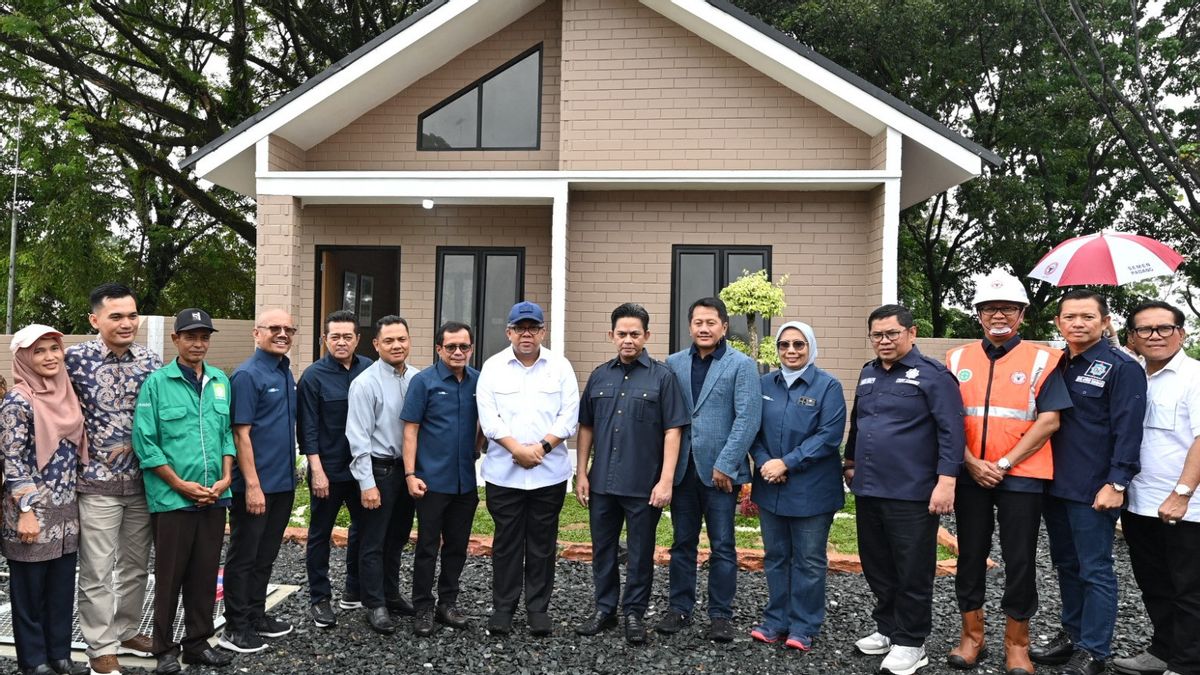


JAKARTA - The strong commitment of PT Semen Indonesia (Persero) Tbk (SIG) in supporting the realization of Asta Cita Presiden Prabowo Subianto, is shown through the presence of precision interlock brick products as a solution to pursue the target of building 3 million houses.
Following up on the coordination of the Ministry of SOEs and the Ministry of Housing and Settlement Areas (PKP), Deputy Minister of PKP, Fahri Hamzah, visited the SIG precision interlock brick production facility operated by a GIS subsidiary, namely PT Semen Padang in Indarung, Padang, Friday, January 24.
The visit of the Deputy Minister of PKP was received directly by the President Director of SIG, Donny Arsal, Director of Operations SIG, Reni Wulandari, Director of Supply Chain SIG, Yosviandri along with the management of SIG, and President Director of PT Semen Padang, Indrieffouny Indra and the management of PT Semen Padang.
The Minister of SOEs, Erick Thohir, said that the capacity of the Ministry of SOEs as a support system of technical ministries, is ready to commit and fully support all programs that have become the focus of President Prabowo's administration.
"Within 100 working days of government, related state-owned companies will support the acceleration of the development of major infrastructure projects, including subsidized houses for low-income people (MBR)," explained Erick Thohir.
As a state-owned company engaged in the building materials industry, GIS encourages the use of precision interlock bricks which are derivative products of GIS green cement, as a solution to answer the challenges of MBR's house construction, namely construction time, construction costs, and quality building materials.
Having the opportunity to see firsthand the precision interlock brick production facility and the example unit of the MBR house in Indarung, Padang, Deputy Minister of PKP, Fahri Hamzah believes that the solution presented by SIG is a breakthrough step in meeting affordable housing needs for the community as a step to overcome poverty. Fahri Hamzah said that the Ministry of PKP focuses on helping overcome poverty and economic gaps, one of which is through the massive housing development throughout Indonesia, namely the 3 million house a year program.
Fahri Hamzah said that together with several government agencies, the Ministry of PKP is currently identifying and agreeing on poverty data, including in the parameters of home ownership. He said that currently there are around 30-40 million family homes with various problems. In rural areas, many people have houses but are not suitable for irregular/rapidity, lack sanitation, and are inhabited by too many people in one house. Meanwhile, in cities, houses are piled up irregularly and become a source of massive pollution.
The government through the Ministry of PKP will encourage our economic side system so that housing development does not think too much about the market. The government will guarantee and consolidate the needed support including land financing and availability and various simplified schemes and licensing. The government will also help with the availability of building materials, including precision interlocks, not only for landed houses but also for vertical housing. SIG must continue to focus on blue ocean opportunities to support the Government's project, strengthen its ecosystem, because this solution is the future of the construction of our home in Indonesia, "said Fahri Hamzah.
The President Director of GIS, Donny Arsal, expressed his gratitude for the support of the Deputy Minister of PKP, the Housing Task Force of the Republic of Indonesia, stakeholders, and business actors in housing development who participated in the visit. GIS believes that the gathering of stakeholders in the housing sector is based on the common vision to provide environmentally friendly, quality and affordable housing for people throughout Indonesia.
After introducing the Bata Interlock Precision Type 36 Example House in the capital city of Nusantara (IKN) last August, GIS also presented the Bata Interlock Presisi Example House type 36 and type 57 in Bambu Apus, East Jakarta. Precision interlocks are the result of applied research with work mechanisms that lock each other between beams such as the lego system.
The use of precision interlock bricks provides many advantages in housing development rather than conventional materials, because it is more efficient in the use of materials, easier in application which makes the duration of development faster, and has been declared earthquake friendly.
SEE ALSO:
-
 | EKONOMI
Ini Penyebab Dolar Perkasa di Negara Berkembang tapi Lemah di Negara Maju
23 Juni 2023, 19:02 -
 | EKONOMI
Paris Summit 2023 Ungkap Belum Ada Investasi Ideal dalam Transisi Energi
23 Juni 2023, 17:19

In addition to precision interlock bricks, SIG also encourages innovative cement-based green concrete applications, such as decorative concrete, and paving blocks as solutions for inundated areas. The presence of environmentally friendly building materials that can accelerate the construction of the house is expected to be a concrete solution to support the Government in providing infrastructure and housing facilities that are feasible for the community. This spirit is in line with the direction of the Ministry of SOEs to provide affordable and sustainable housing solutions.
"To support the Government in meeting the target of building 3 million houses per year, collaboration of all parties is needed and of course technological innovation. Precision interlocks are technology that changes the housing development method to be easier, faster and more efficient, with strong construction quality and a modern appearance, thus providing added value for developers and homeowners," said Donny Arsal.
The English, Chinese, Japanese, Arabic, and French versions are automatically generated by the AI. So there may still be inaccuracies in translating, please always see Indonesian as our main language. (system supported by DigitalSiber.id)
Most Popular Tags
#Prabowo Subianto #donald trump #2026 World Cup #Febrie Adriansyah #8791Popular


